
Innovation the family way at Montague
When Bill Montague planted Jonathan, Statesmen and Stewart Seedling apples in 1950 little could he have foreseen that almost 70 years later his one-man-band would have become a thriving operation marketing in excess of 58,000 tonnes of fruit a year and a byword for industry innovation and excellence.
Like those first apple trees planted in 1950, Montague has put down roots, matured and spread its reach wide to include packing, procurement, logistics, wholesale markets, marketing and exports to Asia, Europe and the Middle East as well as 140,000 pallets of chiller and freezer spaces for many Australian businesses.
Success breeds success and the growth of Montague has brought with it new market opportunities, brands, varieties and a renewed optimism for the future for their grower suppliers who, like the staff and suppliers, are all regarded as ‘part of the family’.
Montague now has over 280 hectares of apple orchards in Batlow (NSW), Harcourt (Vic), Narre Warren (Vic) and Legana (Tas); a stone fruit orchard called Bilmont, near Swan Hill; and five cold storage sites in Victoria. As well as its own fruit, Montague sources fruit from a national network of over 300 apple, pear and stone fruit growers to deliver to major and independent retailers nationally and greengrocers through the central market systems.
Throughout its history Montague has always been a big innovator. The business was instrumental – with fellow orchardist Jack Petty – in the introduction of controlled atmosphere (CA) storage in 1967. Montague also introduced apple labelling stickers in 1988 and the supply relationship struck up by Bill with Safeways (now owned by Woolworths) in 1966 still stands.

Members of the Montague family: (lt to rt) Bill Montague, Scott Montague, Ray Montague, Tim Montague and Crystal Montague.
Montague is now at the forefront of the shift towards managed varieties and last year celebrated 10 years of managing the very successful Jazz™, the release in February of new early-season variety Smitten™ and the forthcoming release of Eve™, Envy™ and Ambrosia®.
Montague estimates that the four new apples will produce a combined total of 12,600 tonnes by 2020.
All this, and still a family-run affair.
Arguably beyond the wildest dreams of Bill, who is on record as saying that when he started out with the purchase of a small carting operation and two market stalls, he never thought he’d own a car.
Bill eventually got his car and a few others besides. The cars have not survived, but according to General Manager IP and Business Development Rowan Little, the attitude to hard work, willingness to embrace change and meet it with innovation and the philosophy of treating customers and suppliers as part of the Montague family is still very much a part of the Montague approach now delivered under the leadership of his youngest son Ray and Bill’s grandchildren Hamish, Scott, Tim, Crystal and Andrew.
Managing the future

A block of Pink Lady® apples at Montague’s orchard in Narre Warren – it remains their biggest selling apple.
The move towards managed varieties is just such a response to change and making the most of it.
“Getting into managed varieties wasn’t really a conscious decision,” Rowan said. “It was more about being innovative and always adopting new varieties. We are very keen on innovation. The question is not what things look like now, it is what they will look like in 20 years.
“Additionally we saw that statistically apple consumption was falling (Australian apple consumption averages just under 8kg/yr/person, down about 13 per cent 10 years ago). If we don’t innovate we become less relevant.
“We had to find a way to reignite consumer interest in the category.”
Rowan said looking around the world, it had been clear that most breeding programs were looking for commercialisation models that generated ongoing cash flow and not just a once off tree royalty.
“The resulting model saw promising new varieties trademarked by breeders and their growth was through licensing for a fee as a way of funding the high cost of breeding and development,” said Rowan. “This commercialisation model has delivered such high-profile brands as Jazz™, Kanzi®, Rocket™, Kalei™, Modi™ and Bravo™ and, internationally, Pink Lady®.
“Cynics might say these systems are an effort to control growers and reduce flexibility.
“When it comes to market control it is 100 per cent different. Our biggest seller Pink Lady has no (domestic) market control, nor does Gala, Red Delicious or Granny Smith – price is purely determined by luck, not management.
“It is true that if you want to do your own thing, managed varieties probably won’t work, but the merits of the new models are if you are a grower you can concentrate on growing and leave packing, marketing and logistics to someone else. In the end it provides the small grower with the opportunity to focus on one activity thereby achieving a better work life balance.
“Our most successful growers are those that say, ‘I just want to be a grower’. It allows them to concentrate on what they do best, they save on packing and they have a better work life balance.
“I think these new systems have encouraged the next generation of farming families to stay in the business. There was a period where many growers through regional Australia were contemplating the sale of the family farm as their children were seeking alternative career paths but now we have a strong presence of young enthusiastic next generation growers in our grower network.”
Rowan added that licensed varieties gave Montague and its growers greater control over quality, volume of fruit on the market, clear brand identity and strong promotional activities combined with the support and collaboration of both local and international partners.
Despite this, what managed varieties do not guarantee, Rowan said, is a price premium.
“There is a lot of misinformation about price premiums,” he said. “There is no guarantee of a price premium. What we are interested in is in generating a profit. If you grow 50t/ha and need $100/box, what do you need if growing 70t/ha?
“We don’t need to generate massive margins, we just need to make sure we get a price that justifies reinvesting.
“We say to growers, you need to look at revenue versus costs. A new variety might have more costs, but you need to also compare what you get back per hectare.”
Montague has 38 growers nationally growing Jazz, Smitten, Eve and Envy.
Growing a managed variety when quality is critical to marketing and brand maintenance does have its risks.
“Every year someone has a disaster and we have to tell them their fruit is not up to it,” he said. “It really is about the brand.”
Comparing apples with apples
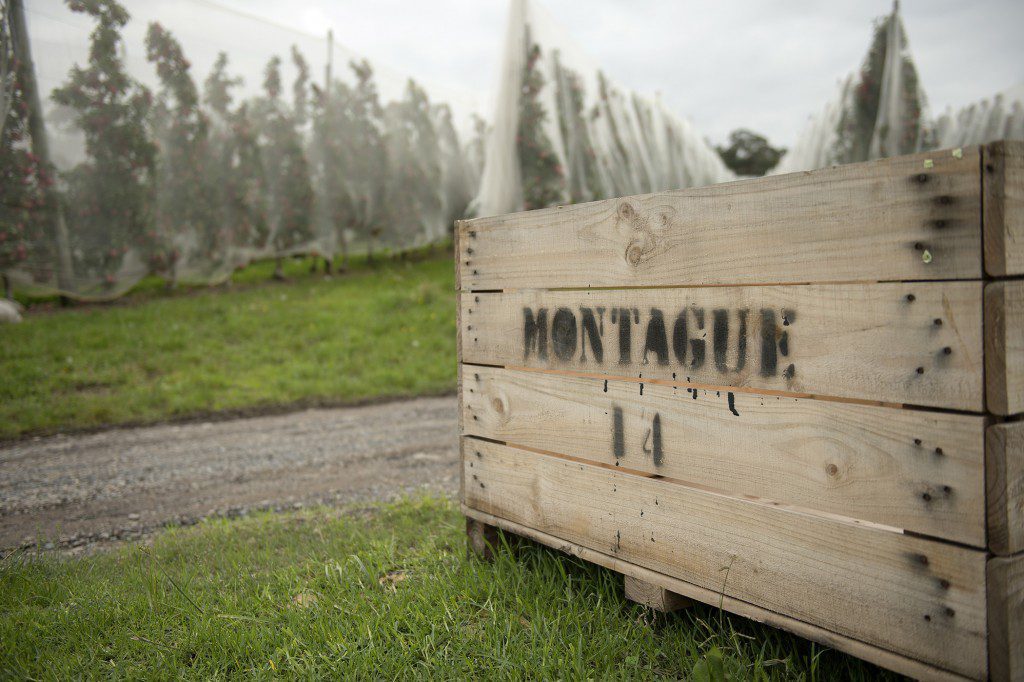
Montague – a byword for industry innovation and excellence.
When it is all about the brand, choosing the right one is key.
“We are very conservative,” Rowan said. “We look at a lot of breeding programs and we have ideas of where the gaps in the market are in terms of timing, flavour and characteristics.”
Newly released Smitten was chosen for its eating qualities and the fact that it was an early season variety coming in around the same time as Gala.
Selected varieties are grown on Montague test blocks and only if they perform ‘super well’ would they be taken further.
“We wouldn’t talk about it until we had tested it and were ready to commercialise,” Rowan said. “Growers tend to look at the yield, but at the end of the day it is about how it eats, if it tastes horrible, no one is going to buy it.
“We want to give consumers a series of good eating options.”
Despite the testing, not all varieties work out as well as Jazz.
“We pulled Cameo™ out in 2005,” Rowan said. “The biggest issue was the variable quality and post-harvest issues.”
Bill’s big break came when he won a tender to supply fruit and vegetables to Melbourne’s hospitals. Service was key and his philosophy was to treat customers, suppliers and industry peers as part of the family circle.
Rowan said the collaborative approach between breeders, brand managers and growers was one of the model’s strengths.
Montague has responsibilities to the brand owner, providing a business plan that is updated annually, and supporting growers.
“With managed varieties, everyone has a good opportunity to see the properties of others and learn from others,” he said.
“We have study tours, pre-season field days, sales plans, end of season recaps on which promotions worked and which didn’t. Our growers are part of the discussion, they are part of the family.”
It’s a sentiment Bill, you suspect, will recognise.
Refreshed Jazz still tastes great at 10

The re-invigorated Jazz brand.
Jazz™ had plenty of natural advantages when it was launched onto the apple scene in Australia in 2007 and 10 years later is a golden pin up for the managed varieties concept.
Crisp to bite, tangy, sweet and juicy, and consistently so thanks to strict quality controls on the 29 growers in Manjimup (WA), Stanthorpe (Qld), Gippsland (Vic), Yarra Valley (Vic), Adelaide Hills (SA), and the Tamar and Huon Valleys (Tas) who had to be licensed to grow it. It was such a hit with consumers that growers had trouble meeting demand at a premium price of $5.99. Crisp of skin and firm of flesh, it also stores well.
The trademarked name for the Braeburn/Gala cross Scifresh variety bred by T&G Global’s apple marketer ENZA, orchardists, and the New Zealand Plant and Food Research institute (PFR), Jazz is marketed exclusively in Australia by Montague.
Initial sales of 1,000 cartons in 2007 have grown to an estimated 420,000 in 2017 and a brand refresh by New Zealand-based brand owner T&G Global coinciding with the tenth birthday of Jazz in Australia aims to ensure demand continues to grow.
Montague General Manager IP & Business Development Rowan Little said the success of Jazz could be put down to a number of factors, the quality of the apple itself, a consumer-focussed marketing campaign and the co-operation between brand owners, managers and the growers themselves.
“The biggest aspect was the way it ate,” he said. “It’s a fantastic eating apple and a lot of consumers said ‘this is an apple I want to eat’. Eating is the most important thing.
“In the first year we had 10,000 trees in Batlow. This year there are 580,000 trees in the ground. The product has grown very strongly.
“It hasn’t been particularly easy. There were nowhere near the yields of Pink Lady® and we had post handling issues with pit and soft scale, but we have worked closely with growers.”
Marketing and brand are a big part of the managed variety approach and growers invest $3/carton towards marketing and promotion.

Montague’s Michael Russo accepting the 2016 APAL Innovative Marketing Award.
The success of the Australian campaign, under the tagline ‘Taste the Crunch’, won Montague last year’s 2016 APAL Innovative Marketing Award.
“We were proud and grateful to win the award,” Rowan said. “But it is not just about Montague, it is about the 29 growers in the program.”
Jazz is now sold in Europe, the United States and Asia and Rowan said the apple needed a common global brand. T&G Global had launched the brand refresh at Fruit Logistica in Berlin in March and it would be rolled out progressively in Australia as the season progressed, with any existing packaging used up first.
Marketing is around the phrase ‘always refreshing’ and focuses on the apples’ crunch and taste.
Instead of the previous blue apple sticker with the flowing white ‘Jazz’ written above a red half apple, the new label features just the white ‘Jazz’ in white capitals, arranged offset over the word apple, in red.



