Future Orchards November Orchard Walks recap
APAL’s Future Orchards® Orchard Walks took place across apple and pear growing regions throughout November, showcasing a range of strategies, innovations and technology options that may assist with decision-making in the orchard.
Some regions also had the opportunity to hear and see updates from national and regional research, including that funded by the apple and pear levy and managed by Hort Innovation.
Tasmania – Getting into the soil
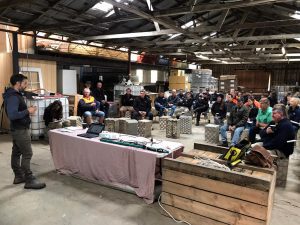

Orchard Walks kicked off in Tasmania, hosted by R&R Smiths Orchard.
Marek Matuszek from AgLogic discussed mapping, monitoring and interpretation of soil moisture and irrigation data in orchards. Stephen Quarrell from the University of Tasmania gave an update on IPDM research being conducted in Smith’s Orchard as part of the PIPS3 projects, which generated discussion in the orchard about different management inputs, biology of pests, diseases and beneficials, and interrow plantings.
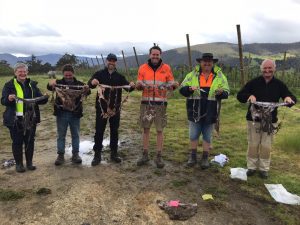
Growers also had the opportunity to bring along the undies they had planted at the previous orchard walk in September as part of the Soil Your Undies challenge – with some only having the elastic remaining to show. Growers were surprised at the level of degradation of their undies, even in cooler soils, and very surprised to find more activity in the tree-line rather than the inter-row. Reflecting on these results as a group, they concluded that perhaps soil compaction in the inter-row combined with the very wet soil due to the constant rain over the last few weeks has reduced activity in the inter-row.
See more about the PIPS3 IPDM research site in the video below.
Western Australia – new technologies including mapping, unmanned vehicles, and drones
Ladycroft Orchard in Manjimup hosted the Western Australia Orchard Walk. Participants heard from Andreas Neubauer who discussed the potential for soil mapping to assess orchard inputs and what to do with data once it has been collected.
In the orchard, participants were able to see how drones and unmanned vehicles can be used for spraying. Marcel Veens was also onsite to discuss orchard practices. Growers were also asked to bring along their undies that had been buried at the previous orchard walk as part of the Soil Your Undies challenge.
See some results – and drones and unmanned vehicles in action – in this video from WA FLA, Susie Murphy-White.
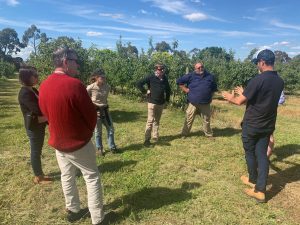
Orange, NSW – Miticide resistance: rotate chemical groups with different modes of action
-
- Credit: Marguerite White
-
- Credit: Marguerite White
Dr Grant Herron and Dr Duong Nguyen, entomologists and insecticide resistance specialists from the New South Wales Department of Primary Industry’s Elizabeth Macarthur Agricultural Institute, discussed the reasons why mites may develop resistance, the consequences of resistance developing, and what to consider when choosing to spray – or not. The take home messages were to rotate different chemical groups, avoid over spraying and be proactive in the use of IPDM.
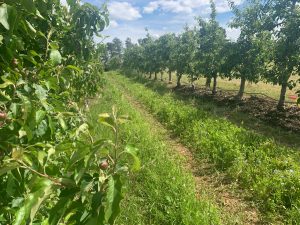
The Orchard Walk also provided an opportunity to discuss the PIPS3 trial demonstration where interrow crops are being trialled to encourage beneficial insects.
If you are interested in more information about resistance in two-spotted mites, or in sending in samples to be part of the insecticide resistance study being conducted by NSW DPI, please contact Dr Duong Nguyen or Grant Herron at NSW DPI on 02 4640 6389.
You can view Grant’s presentation slides here.
Batlow – experiences with potted plants and bushfire recovery


The sun came out, and participants were treated to some of the best views in the district at Greg and Kris Mouat’s orchard. Participants saw new plantings of Pink Eve that were grown using Ellepots (paper pots) rather than bare rooted. This made them easier to handle when planting because the plants are planted into the ground with the pot, which then degrades. Greg and others at the walk found the benefits of Ellepots include the reduced risk of transplant shock, no pot bound plants, and greater ease of handling. Greg’s plants transplanted successfully and have begun to feather well.
The second stop allowed participants to see trees that were severely scorched during the 2019/2020 bushfires and discuss with Kevin Dodds how, in the second year, trees are recovering and slowly returning to normal cropping. This research is part of the Hort Innovation funded bushfire recovery project (AS19002).
At the Batlow Fruit Company orchard Gavin Williams discussed their thinning practices for this year using Ethrel and Maxell.
Read more about Ellepots here.
Adelaide Hills – irrigation, rootstocks and bibaum
The orchard walk in the Adelaide Hills was hosted by John Vickers at Aberdeen Orchards. Roger Flavell gave a presentation about the future options for irrigation systems, discussion around which continued in the orchard. Tom Frankcomb and Paul James (FLA for Adelaide Hills) led a discussion about rootstocks and bi-baum systems.
You can find more information about rootstocks and orchard systems in the Future Orchards library.
Queensland – Timely tips for Alternaria management and a technology demonstration
Trent Vedelago hosted the Queensland Orchard Walk at Fonlea Orchard at Thulimbah.
Stephen Tancred (FLA for Queensland) presented recommendations for management of Alternaria – the key message was to start early.
You can find Stephen’s presentation slides and factsheet on Alternaria management here.
Matt Johnson from Crop Scan Tech came prepared with orchard scans that had been made using the Green Atlas Cartographer, and gave a presentation on its functionality and capabilities. Participants then headed to the orchard to see the technology in action.
Learn more about Green Atlas in the video below.
Northern Victoria – data insights from the Tatura SmartFarm to improve fruit production
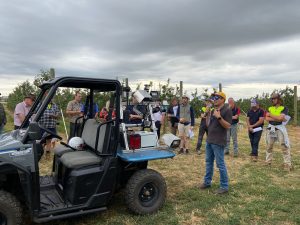
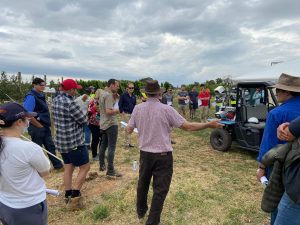
The Orchard Walk in northern Victoria was held at the Agriculture Victoria Tatura SmartFarm, home to a number of the PIPS3 projects. Participants were introduced to the Sundial Orchard by Dr Ian Goodwin. Dr Alessio Scalisi provided a demonstration of the Green Atlas Cartographer, a discussion of the potential opportunities for using data for management purposes, and how it was being used in research both on the SmartFarm and in commercial orchards. Ian also showed participants the dendrometers being used in the orchard to monitor irrigation requirements, including deficit irrigation for pears and smartphone-based technology to see soil moisture data. Dr Greg Lefoe provided an update on interrow plantings and how they can be used to encourage beneficial insects, and progress being made in biological control studies on the establishment and performance of Mastrus ridens, a parasitic wasp being investigated as a potential biological control option for codling moth.
More information about the PIPS3 projects can be found here.
Southern Victoria – Growing premium fruit (and keeping the birds off)
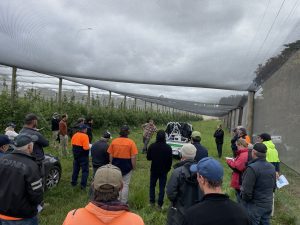
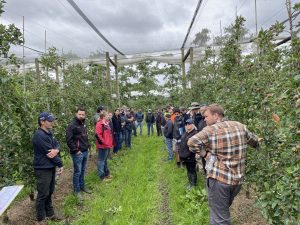

Southern Victoria’s Orchard Walk was hosted by Paul Priest at Priest’s Orchard. The fully netted orchard grows a range of apple varieties including Yello®, Golden Delicious, Sweetango® and (young) Fuji.
Nic Finger (Fruit Help consultant and FLA for southern Victoria) led the walk and encouraged growers to think about the value of data and smart technologies to help with decision making. The morning included a demonstration of Green Atlas technology, and how variable mapping can be used to inform thinning decisions as well as other orchard management inputs and tasks by identifying and targeting specific parts of the orchard that are underperforming.
Walking through the orchard, discussions turned to the benefits of different trellis systems, including ECO V ® compared with timber poles, thinning inputs and producing premium fruit. Paul focuses on producing high quality fruit of both managed and open varieties, rather than prioritising yield.
Participants also had the opportunity to see a laser bird scarer demonstration by EE Muir & Sons, which Paul reported to have been very effective in the orchard.
More information about bird management options here.
National Orchard Talk
A centrepiece to the Orchard Walks was the national Orchard Talk, presented by AgFirst’s Craig Hornblow and Fruit Help’s Nic Finger who discussed why collecting and using data can be useful to make more informed decisions for orchard management, the type of data that can be collected and options available (tools, technology) for collecting data.
You can view the Orchard Talk here.
Thank you to all our Orchard Walk hosts, and the participating growers that shared their experience, knowledge and innovations. Without you, these walks would not take place.
Thank you to the FLAs who facilitate these events in each of the regions.
The Future Orchards program and Orchard Walks are funded by Pink Lady.