Fruit Growers Tasmania Conference – Telling the good story
Tasmanian growers have a great story to tell and should continue to work together to market and build the profile and profitability of the sector, they were told at the annual Fruit Growers Tasmania conference last Thursday and Friday.
A broad program over two days in Launceston covered topics ranging from managing labour more efficiently, orchard crop management and pest and disease research updates, trends in fresh produce, systems approaches to support market access opportunities and practical actions for business profitability.
Against a backdrop of rising costs and falling returns, a range of speakers talked to the opportunities of improving productivity, quality, opening up export markets and leveraging customer demands for greater sustainability and provenance.
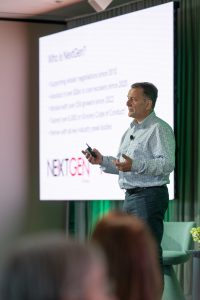
Andrew Smith, R&R Smith managing director, and self-confessed ‘self-promoter’, challenged the audience to seize the opportunity of a wealthy Australian local target market motivated by brand values and sell the many ‘intangible’ benefits of apples and apple growing.
Quoting figures presented by demographer Bernard Salt at the recent APAL Forum, Andrew highlighted the opportunity from millennials at their peak earning capacity seeking sustainable values and wanting to eat healthier and live longer.
“We’ve got a fantastic product to sell and we don’t focus on that enough,” Andrew said.
“I feel like the industry is trying to grow 100 tonnes per hectare of fruit without knowing where it’s going to be sold, who its consumer is. I want to be working from the consumer, asking what do they want?
“It’s about the farm, and it’s not about 100 tonnes per hectare and it’s not about NIR, and it’s not about the picking platforms and it’s not about self-drive tractors. They don’t want to see mass produced, they don’t want to see perfection, they want to see real.
“Look at what we can do with fruit that most industries can’t do. They can’t open the door and let people in and show them this hand on heart and say this is what we do.
“Producers spend too much time trying to be more efficient than the next guy, to wipe him, and think I’ll survive and he won’t, instead of saying how can we get together and sell the intangibles and take market share off chocolate, off potato chips and own the health snacks in the supermarket.”
The use of data to inform decisions was a key theme with the emphasis on using available data to drive efficiency and improved profitability and to inform marketing campaigns.
AgFirst’s Ross Wilson pointed to the ‘disturbing trend’ in recent years of returns that did not cover costs and encouraged growers to use the free-to-industry resource of the annual Orchard Business Analysis (OBA) to benchmark their own businesses against industry averages and upper quartile performance, to identify areas for improvement.
He also urged growers to look deeper than their overall profitability to delve into results block by block and understand where their profit was generated and where it was not.
“There are always massive variations in block performance,” he said. “Attempt to calculate the profit ($/ha) for each block. Some pull the business down. To be a sustainable apple grower going forward it is not good enough to be average, you have to be targeted to be at the upper quartile level.”
Ross said profitable orchards of the future would be high margin varieties, on productive rootstocks, with canopies that were platform-suitable in orchards set up for autonomous vehicle operation.
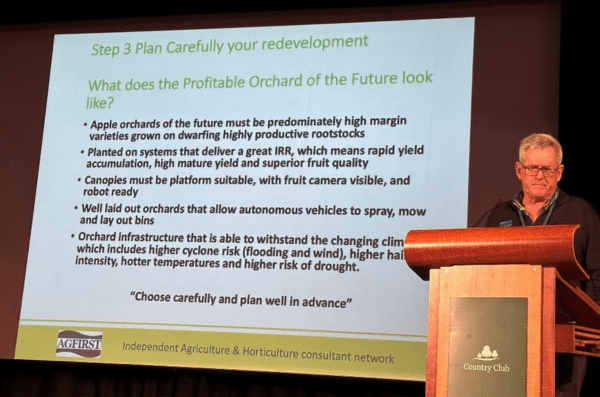
AgFirst’s Ross Wilson
Tasmanian Institute of Agriculture’s Ramandeep Sidhu presented the findings of research into the causes and management of internal browning and fruit softening.
The research found fruit from lighter crop load (off-year) trees are larger, firmer and denser, and more prone to fruit softening and flesh browning. Mineral imbalances, particularly high potassium and low calcium were also factors.
Key takeaways for growers included:
- Crop load management should be the major focus to mitigate the risk of fruit softening and flesh browning.
- Managing crop load to ~6 fruit/cm2 limb cross-sectional area (LCSA) can prevent biennial bearing and reduce flesh browning.
- Target fruit weight should be <200 grams.
- Balancing mineral nutrition, particularly fruit Ca, is critical.
- Higher fruit K and Mg and lower Ca, Mn, Zn can increase risk of fruit softening and flesh browning.