Understanding apple sunburn damage in response to sunlight
Important research conducted at the Tatura SmartFarm by Agriculture Victoria Research scientists highlights the importance of light quality and intermittent shading on colour development and sunburn in ANABP 01 apples.
Australia has the highest amount of solar radiation per square metre of any continent on the planet. This high-light environment can be advantageous in the business of horticultural crop growth, but it also raises concerns for the sunburn risk that growers need to manage, particularly in the context of a changing climate with increasingly frequent heat events.
Apple fruit that develop sunburn damage have lowered external fruit appeal and internal quality, and negatively impacted storage potential. The PIPS3 project Advancing sustainable and technology driven apple orchard production systems is now in its third and final year of research activity, aiming to determine improvements and adaptations in orchard design and management to mitigate the impact of climate change on the industry.

Figure 1: Extensive sunburn necrosis of an ANABP 01 apple in the Sundial Orchard at Tatura SmartFarm
Sunburn damage largely occurs in response to excessive exposure to light and temperature. Because the exposure of a surface to light causes radiant heating, there is considerable interaction between the two environmental factors in the field. Many advances have been made in recent international research on the topic of apple sunburn, but global differences in climatic conditions and levels of solar radiation warrant the exploration of crop responses to local light environments and temperature intensities.
Sunburn damage is commonly categorised into three types of injury: sunburn necrosis, sunburn browning and photo-oxidative sunburn. Sunburn necrosis presents as a dark brown or black spot on the exposed fruit surface. An apple’s fruit surface temperature (FST) needs to reach 52 ± 1°C for only 10 minutes to develop this type of burn. Sunburn browning, which is more common, occurs when FST reaches a minimum 46–49°C, depending on the cultivar, for 60 minutes. This type of sunburn damage causes either yellow, brown or bronze discolouration on the exposed fruit surface and is said to be induced under exposure to ultraviolet B (UVB) radiation. Photo-oxidative sunburn presents as a white patch on fruit that were once shaded but then suddenly exposed to high levels of solar radiation. This can happen after manual thinning, branch movements with increasing fruit weight, summer pruning, selective picking or fruit sitting in uncovered bins.
What we have found
Scientists at Agriculture Victoria’s Tatura SmartFarm have been exploring orchard light relationships and how they affect aspects of productive performance, including fruit quality, in ANABP 01 apple trees (fruit marketed domestically as Bravo® and internationally as Soluna™). This premium cultivar originates from Western Australia and is known for its deep burgundy peel colour. ANABP 01 trees grown in the multidirectional Sundial Orchard at Tatura SmartFarm have been studied over the last three seasons. The scions were grafted onto three different dwarfing rootstocks (Bud.9, M26 and M9) and trained to slender spindles at 1m tree spacing and 3.5m row spacing.
Direct sunlight, shade and UV radiation experiment
In summer 2021–22, sample fruit were chosen from the western side of the north–south row orientation in the Sundial Orchard, being the most likely to develop sunburn with afternoon sun exposure in combination with high afternoon temperatures. Five light exposure/shade treatments were distributed between the sample fruit over two consecutive time periods: 17 January to 17 February (95–123 days after full bloom [DAFB]) and 17 February until harvest on 4 April (123–172 DAFB; Table 1). The treatments involved covering sample fruit with either aluminium umbrellas (SS1, SS2 and SS3, classified according to the time period) or a longpass ultraviolet filter (UVF), in addition to a fully exposed control (C). The aluminium umbrellas prevented direct sun exposure of the fruit and the longpass UV filter absorbed UV radiation and only transmitted photosynthetically active radiation (PAR). Any coverings applied to fruit were open at the bottom to ensure adequate air flow and to prevent increases in ambient air temperature.
A subsample of fruit was monitored for FST from 1 February 2022 until harvest, with fine-wire thermocouples inserted under the fruit peel on the face of the fruit expected to receive the most sun exposure. Fruit were assessed at harvest for sunburn damage on a scale of zero (no sunburn damage) to five (necrosis; Figure 2).

Table 1: The five light exposure treatments applied to sample fruit. Green cells indicate when the fruit were covered with aluminium umbrellas and orange cells indicate when fruit were covered with the longpass UV filter. Yellow cells indicate when sample fruit were fully exposed to sunlight.

Figure 2: Post-harvest visual classification of sunburn damage in ANABP 01 fruit.
The SS2 treatment, which was initially shaded from direct sunlight and then exposed, had the highest degree of sunburn damage severity (1.2) and was significantly higher than the fully shaded SS1 treatment (p < 0.05; Table 2). The UVF treated fruit also had high average severity of sunburn damage (1.0) but was not significantly different from any other treatment. This could be due to a tendency for higher FST under the longpass filter around midday and slightly higher FST, although not apparently different during the afternoon (Figure 3).

Table 2: ANABP 01 harvest fruit quality data collected on 4 April 2022 (harvest) for the different light exposure treatments. Standard error of the means (SE) are reported. Letter separation by Tukey’s honestly significant difference test.
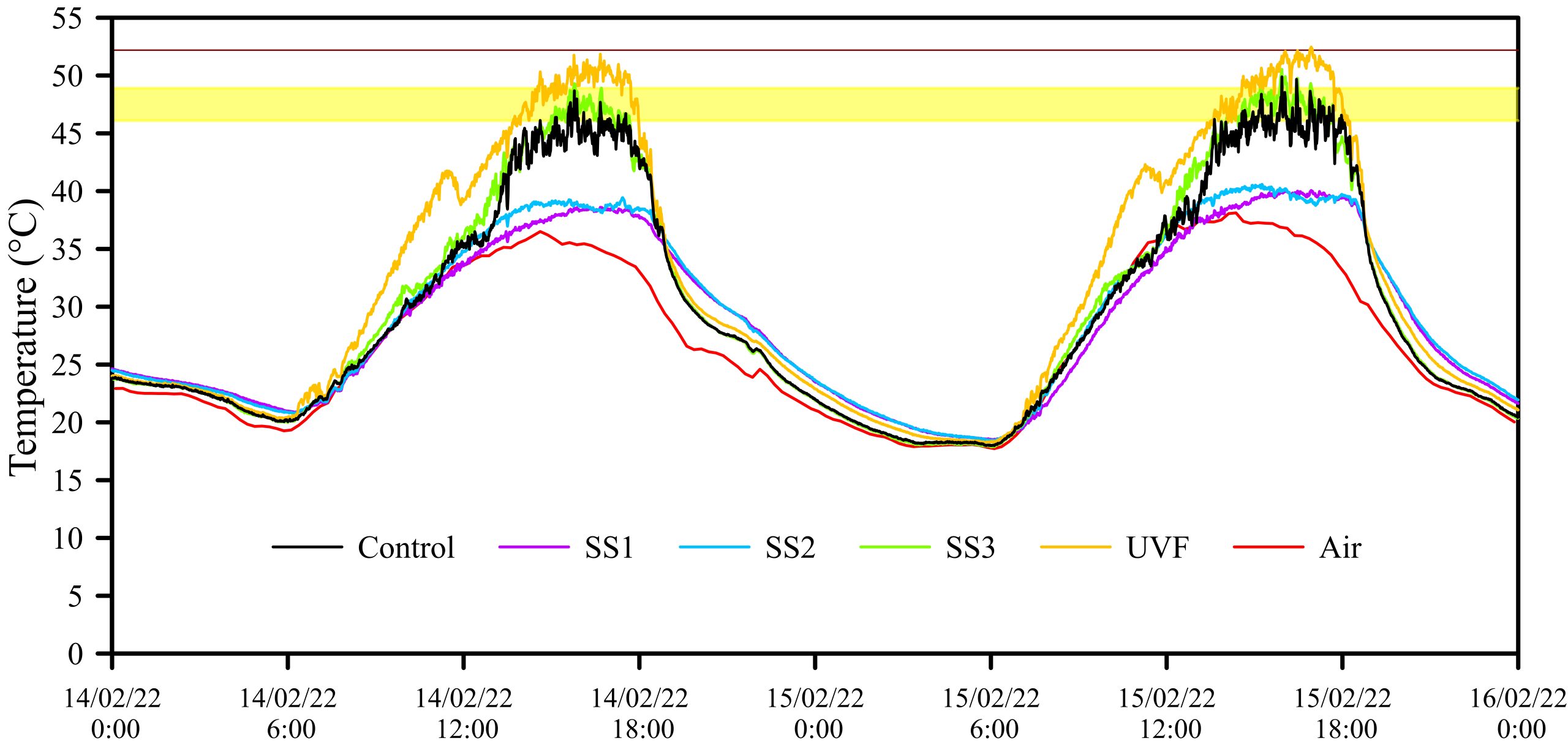
Figure 3: Recorded air temperature (Air T) and maximum sample fruit surface temperature (FST) of sample fruit under different light exposure treatments from 14–15 February 2022. The yellow area represents the minimum one-hour threshold region for sunburn browning development (46.1–48.9°C) and the brown line represents the 10-minute threshold for sunburn necrosis (52.2 ± 1 °C).
Shaded fruit throughout the experiment had much lower FST, which were much closer to the ambient air temperature, although they retained some heat during the afternoon once the air temperature started to drop. Sun-exposed fruit consistently displayed significantly higher FST (p < 0.001) with UVF-treated fruit reaching the highest values, although not significantly different from the C treatment (Figure 3). Night-time average FST was similar for all treatments.
Interestingly, despite similar FST results to the control, the UVF fruit did not behave normally when it came to colour development. Figure 4 shows an example of the colour profile that developed under the UVF treatment, being an undesirable yellow-orange colour. This indicates that UV light, in addition to PAR, is a key to the appealing dark-red colour development in this cultivar. Future developments in netting technology for apples should take into account light quality transmission and ensure that sufficient PAR and UV light reach the fruit, particularly for red and bi-coloured cultivars.

Figure 4: Yellow/orange colour development of ANABP 01 fruit situated under a UV longpass filter (i.e. UV light filtered out).

Figure 5: Photo-oxidative sunburn damage on ANABP 01 fruit that were initially shaded with aluminium umbrellas and subsequently exposed to sunlight.
Acknowledgements
 The PIPS3 Advancing sustainable and technology driven apple orchard production systems (AP19003) project has been funded by Hort Innovation using the apple and pear research and development levy, contributions from the Australian Government and co-investment from Agriculture Victoria. Hort Innovation is the grower-owned, not-for-profit research and development corporation for Australian horticulture.
This article was first published in the Winter 2023 edition of AFG.