Prioritising profit – practical steps to a better bottom line
Rising costs and entrenched pricing are squeezing margins – the winter Future Orchards® walks reviewed practical steps towards improving profitability.
Key points
- Collect data and use it
- Know which blocks make money and which don’t
- Benchmark blocks to identify areas for improvement
- Check your packout data; can you target a more profitable size or grade?
- Spread costs over a higher yield to improve margins
- Remove underperforming blocks that can’t be improved
Improving quality, targeting premium size profiles and markets, reducing costs through more efficient and consistent canopies and removing underperforming blocks are all levers which growers can use to boost orchard returns.
Practical steps that can be taken to improve profitability have been a key theme of APAL’s events and orchard walks over the winter, with industry specialists sharing a range of opportunities to boost income or reduce costs.
Absolutely key to the success of all steps is collecting and reviewing crop and cost data per block to identify opportunities and to forecast the additional cost and expected return of any management change.
Control what you can
APAL’s State of the Industry webinar, delivered in June, outlined a challenging outlook. Orchard Business Analysis (OBA)¹ data for the past five years confirmed that rising labour and postharvest costs had contributed to a 23 per cent rise in the cost to produce a Class 1 kg of apples since 2019 to $2.54/kg.
Higher density plantings are delivering efficiency gains, but as APAL’s Orchard Census and National Crop Forecast showed, they are also increasing supply, putting further pressure on prices that remain stubbornly out of step with the cost of production.
Although there are individual and niche export success stories, and considerable work going into developing promising market opportunities to take volume off the domestic market, apple exports are at all-time lows of <2,000t (1 per cent of production)². (Pear exports were four times those of apples in 2022–23, 7 per cent of pear production.)
On the domestic market, faced with a smorgasbord of choice of exotic fruit, annual consumer purchases of apples and pears, according to the Australian Horticulture Statistics Handbook² data, continue to fluctuate around 8kg and 2.3kg per head respectively.
The newly-released marketing campaign ‘No Snackgrets’ (Encouraging healthier snacking with Aussie Apples, AFG Spring 2024) promoting apples as a more rewarding snack, and APAL’s own Quality Program aimed at ensuring that consumers get the best fruit possible and return for future purchases, are both investments in driving greater consumption.³ But in the medium term, even taking into account anticipated population growth, the gap between Class 1 production and consumption is expected to grow.
So, what can growers do to tackle declining returns?
As APAL CEO Phil Turnbull summed it up in the State of the Industry webinar: “Our industry has some systemic issues, many of which are out of our control, but actually many are in our control.”
Variation is opportunity
AgFirst consultants Jonathan Brookes and Jack Wilson, presenting at the Future Orchards® winter orchard walks, pointed to the often ‘huge’ variation in block performance as an area within growers’ control that offered an incentive for lifting returns.
Jonathan said using industry benchmarks was a good way of homing in on where effort could add value. He shared OBA data showing a $25,392/ha difference in cash operating surplus for 2022 between the average and upper quartile participating businesses, despite similar costs.
“How do you compare to others?” he asked. “What are they doing differently? What do you need to change?”
Understanding which blocks are contributing to profits and which are dragging them down by measuring and analysing block data is essential to knowing where to focus efforts.
“You can’t manage what you don’t measure,” Jonathan said.
“We used to measure at orchard level, then on a variety level; now we need to be doing it at a block level. Once you get down to block level, you realise that the range between the different blocks is huge. If you are not making money, you need to know where you should be focusing to get your best bang for buck. Then decide: improve or remove.”
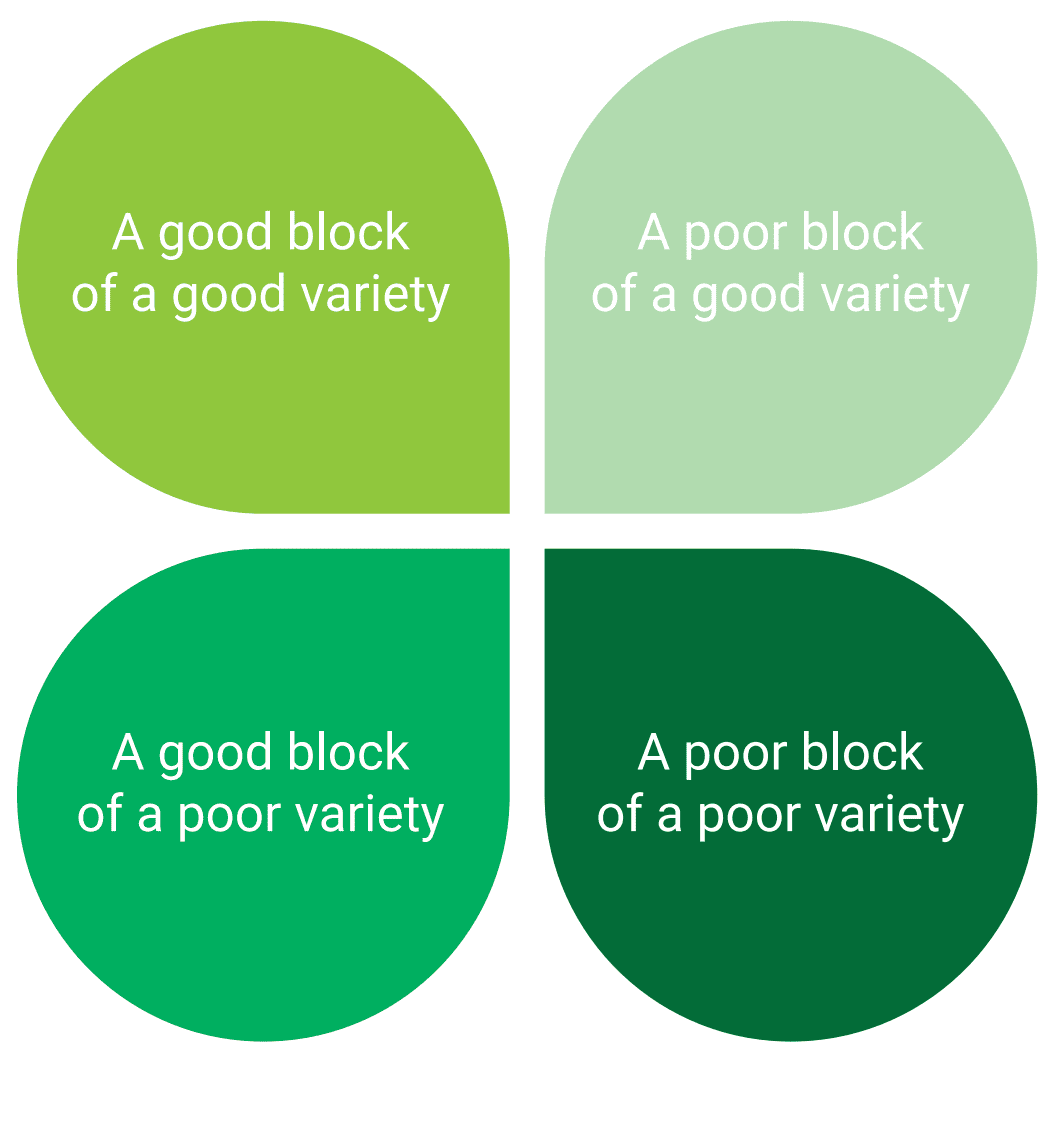
Establishing the status of each block is the first step to identifying what can be improved, what can’t and where to focus effort to get the best reward.
Focus right effort in right area
Sharing examples of four blocks with similar costs but a wide variation in yields and returns, Jonathan said by using data on yield, packout and price to identify the status and limiting factor of each block, ‘the right effort can be put into the right area’.
“You need to be able to understand, is it good block of a good variety, a poor block of a good variety, a good block of a poor variety or a poor block of a poor variety which just needs to go,” he said. “Being able to walk into each block and know where you sit is really important. If I don’t know where I am, a decision to save $2,000/ha on thinning a block might be just shifting the deck chairs on the Titanic.”
Once a clear picture of performance and potential had been established, Jonathan said putting effort into poor blocks of good varieties was likely to deliver the greatest reward for effort.
“We know it’s a good variety, we know the returns are good; what is limiting your management that is not making this a good block and what do you need to change?” he said.
Common areas that could reward effort included setting optimised crop targets, controlling vigour, filling out uneven canopies, and reducing variability in crop load, canopy and fruit size.
“We need to make sure that whatever we’re doing, the block has to be making a sustainable profit – we’re not just keeping it because it is an easy block or a nice block – if it’s not making a profit, it doesn’t cut it.”
Target price premiums
Jonathan said a target benchmark for average block performance, based on OBA and Orchard Net data, would be at least a yield of 60t/ha, with 80 per cent packout and 80 per cent fruit in target fruit size.
Drilling down into data on individual fruit attributes within a Class 1 packout could identify opportunities for further gains.
He singled out target fruit size in particular as both a lever to lift $/kg – a view echoed by other orchard walk guests Brent Reeve from Redland Apples (Redland turns to export for new Dazzle, AFG Spring 2024) and APAL Industry Services Manager (Grower Development and Trials) Nic Finger – and also key to establishing target crop loads.

Jonathan advises checking packout data to see what grades, fruit sizes and market timing offer the best prices to identify opportunities to shift fruit into more premium pricing.
“If you don’t know what your fruit size is, you can’t work out what your crop load needs to be per tree and you can’t know if your tonnage is too soft or too hard, whether you have a risk of biennial bearing or of under cropping trees. You need to really try and get that data.”
Citing the New Zealand experience of exporting the variety PremA129 (marketed as Dazzle™) to high-paying markets, he said knowing and targeting the price sweet spot could deliver significant premiums.
“What we find with the higher paying markets is it’s not just about the variety, it’s about knowing where the best price point is for that variety,” he said. “The price difference between the optimum-sized – which for Asia is generally big – and reddest fruit, and a standard colour, standard grade piece of fruit can be NZ$40 a carton difference.
“If you grew a 100 count of Dazzle for export, there’s no profitable market; you are better off growing fewer tonnes of bigger apples rather than higher tonnes of small apples. So, it’s not just about tonnage, it’s about targeting the best yield for the best return.
“Even with the local market, there is a price curve and, once you get into the small fruit, you do get clipped a bit more on the packing, so there is a price point of difference. You need to know what weight is too small and what is too big.”
Fruit size and the impact of shifting fruit into higher value counts on returns was also covered by Nic in his excellent unit on Orchard Economics as part of the inaugural APAL Short Course in Fruit Production in July.
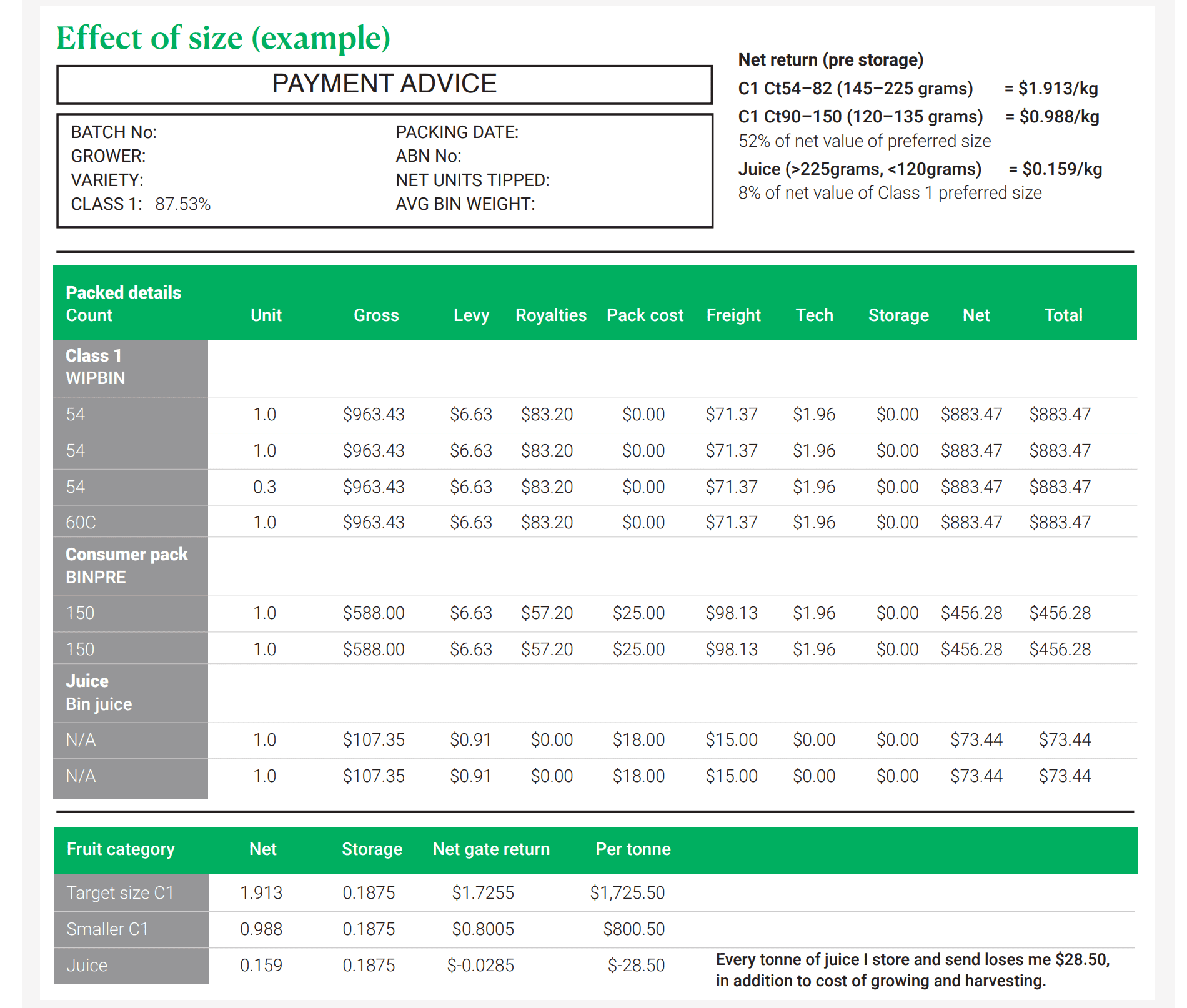
This sample payment advice shows the marked difference in returns between the two Class 1 counts and the juice fruit, highlighting the incentive to shift fruit into the higher value size and class. Source: APAL Short Course in Fruit Production, Orchard Economics, Nic Finger.
Other opportunities to influence price and return include:
- lifting pickout and packout – less left behind, better fruit and more of it
- supplying in-demand varieties
- changing market window.
But Jonathan warned that while fruit kept in storage might bring a higher price, it would also incur additional costs.
“You need to understand where that storage price/cost point sits.”
Spread and reduce costs
According to the 2023 OBA, labour costs accounted for 68 per cent of on-farm costs, working expenses for 23 per cent and overheads for 9 per cent. Cost awareness is essential to identify areas for attention, but Jonathan and Jack said the OBA project showed managing production, packout and price provided greater opportunity for gain than reducing costs.
“We need to prune our blocks to create good production, good packout and good price,” Jack said. “We need to thin them to do the same thing. We’re not getting rid of any of these. So, we need to optimise, know whether we’re in the realm and make sure we don’t have any anomalies.”
Opportunities to reduce or spread costs include:
- improving labour efficiency – incentives, training
- modern canopies, less labour intensive to manage
- increasing yields, costs spread over greater volume.
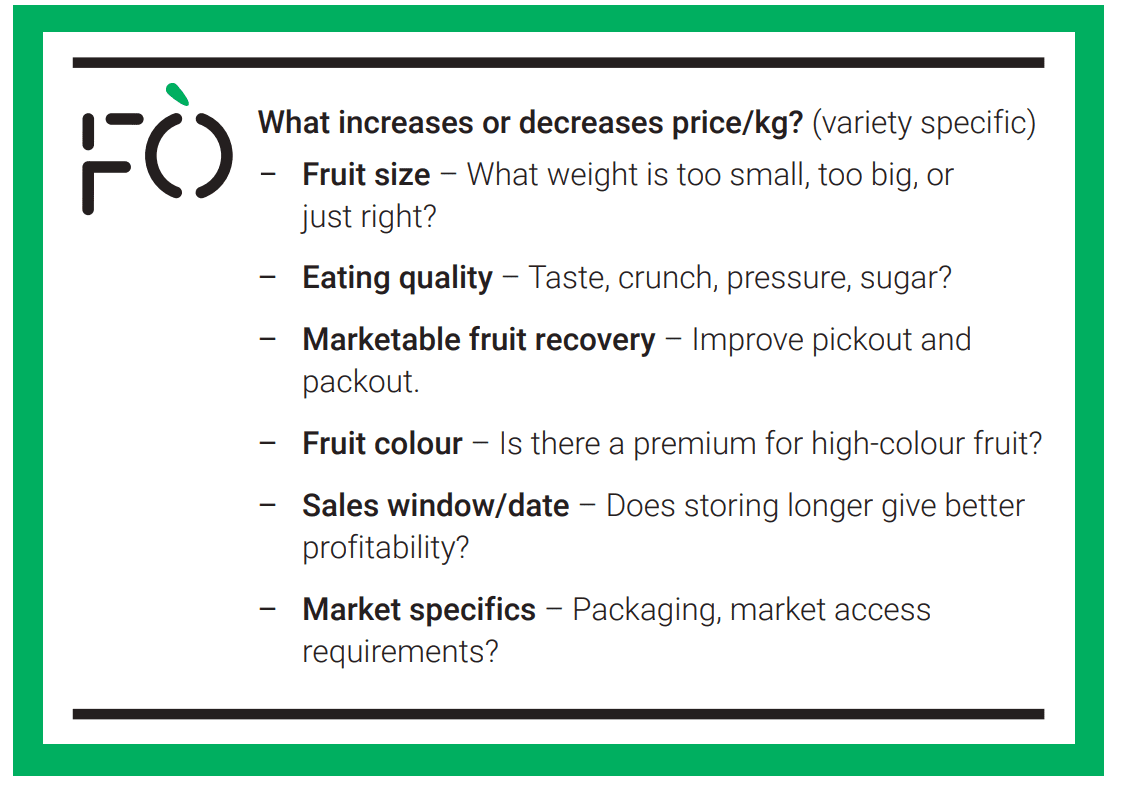
In his orchard walk presentation, Jonathan advised checking packout data to see what grades, fruit sizes and market timing offer the best prices to identify opportunities to shift fruit into more premium pricing.

There can be a big price difference between the optimum-sized and reddest fruit, and a standard colour, standard grade piece of fruit.
Remove what can’t be improved
Blocks that land in the ‘poor block, poor variety’ block status do not justify the investment to improve and, where costs may outstrip returns, need to be removed to protect returns.
Jonathan said a decision to remove or rework a block should not be based on one year alone but take into account past performance and also where the market outlook for that variety might be heading.
“Don’t just look at the one year, look back over two or three and also try and understand where you think markets want to go, because some of these new varieties that are coming through will kick some other varieties out.”
He said removing under-performing blocks and deciding what to replant them with were two separate decisions.
“The decision is: ‘do I take it out? Yes’ – then it needs to happen. Replanting, that is a different decision and doesn’t have to be done in the same step.”
When deciding on what to replant with, first identify a market that will give you a sustainable return.
“When you are planting new blocks, think about the home,” Nic told attendees at the Shepparton winter orchard walk. “Don’t just plant it because your neighbour next door did. Work backwards from the end point. There’s no point planting a heap of something that doesn’t have a home. You need a market.”
In the June State of the Industry webinar Phil urged all growers to review their own block data ahead of the 2025 crop and assess whether each block was likely to be profitable, could be improved if not, or should be removed.
Key signs a block might struggle to be profitable were identified as:
- a yield of 30 tonnes a hectare or below
- low density and over 25 years old
- packout consistently 50 per cent or below
- the variety no longer being mainstream.
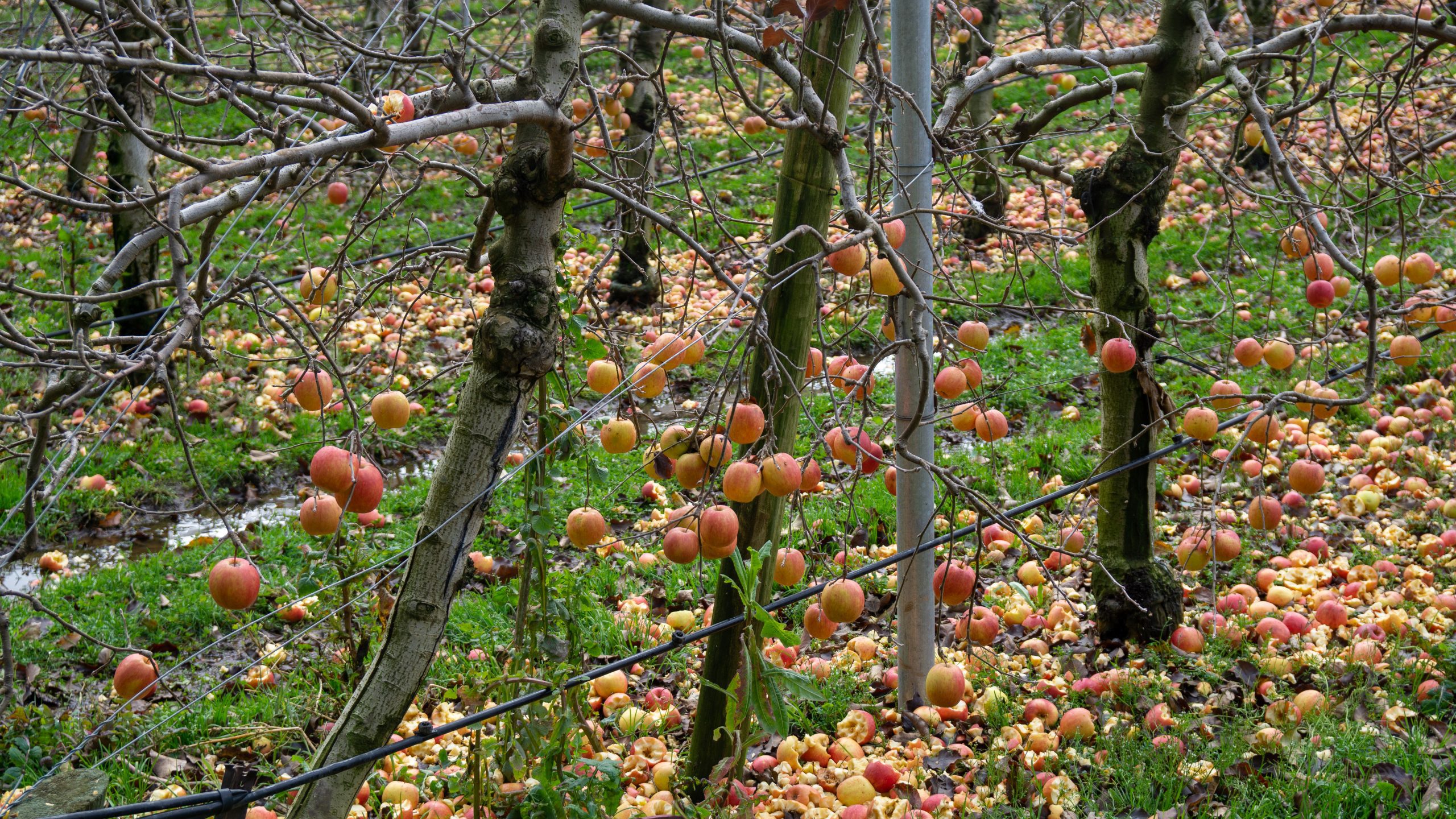
This Rosy Glow block has room for improvement, with poor colour development resulting in a low pickout for this block.
Presenting the data during the winter orchard walks, APAL Industry Services Manager Justin Smith stressed targeting older blocks was intended only as a starting point.
“We’re not saying all older blocks are not worth keeping, we’re saying if you don’t know your numbers on older blocks, that is a logical place to start, to say: ‘is this block holding its own?’ If you don’t know your numbers, what we’re really encouraging you to do is to make that a priority.”
*The spring Future Orchards walks, to be held from 18–22 November, will focus on “Strategies to impact block profit”. Register now at eventbrite.com/cc/november-2024-future-orchards-spring-series-3666229.

When deciding what to replant with, first identify a market that will give you a sustainable return. New Dazzle™ (PremA129) plantings at Redland Apples’ Merrigum Orchard were chosen for their appeal to the Asian consumer.
Resources
- Jonathan Brooks and Jack Wilson’s orchard walk presentation: youtube.com/watch?v=VAxvcgTrxCc&t=3s
- Brent Reeve’s orchard walk presentation: youtube.com/watch?v=BFEjWoysm6k&t=3s
- OBA: to request a copy or participate, email [email protected]
- Future Orchards Library: apal.org.au/programs/future-orchards/future-orchards-library/
References
¹ The Orchard Business Analysis industry benchmarking project is funded by APAL and has been delivered by AgFirst since 2008. It provides 15 years of data on costs and returns to aid orchard decision-making. Australian growers can request copies/participate by contacting APAL.
² The Australian Horticulture Statistics Handbook 2022–23 is available online at horticulture.com.au/contentassets/a36fdfa2427d4ad284c426663b06f15c/hort-stats-fruit-22-23.pdf
³ Know your consumer – check out the latest data on consumer purchases, preferences and insights on the Hort IQ site.
This article was first published in the Spring 2024 edition of AFG.