
Leaders of the pack: what successful US growers are doing to stay well above average
Facing another ‘disastrous’ year of low pricing, Washington State growers are re-examining every task in the orchard as they strive to produce better fruit, more efficiently and at a lower cost.
Key points
- Low US pricing driving need for lower costs/higher efficiency
- Precision crop management improving quality and reducing costs
- Keep up with market trends
- Automate, but not too early
- Cash is king, don’t over-extend
What separates a successful Washington State apple grower from one that is losing money?
Precision crop load management, diversification, keeping up with market trends and having access to cash to ride out the downturn for a start, according to Jeff Cleveringa, Head of Orchard Operations, at Wenatchee-based Columbia Fruit Packers.
Having a high-performing orchard, renewed a decade ago and now in full production helps also.
US growers are facing similar issues to Australian growers as rising costs, combined with prices suppressed by domestic markets over-supplied by bigger and bigger crops, squeeze margins.
A massive shift to corporate ownership – 70 per cent of Washington orchards are now owned by investors – demanding productive orchards and return on investment has ‘kicked the production ball further down the road’.
A guest at the recent Future Orchards® spring walk series, Jeff told attendees that Washington’s 2023 season crop had been 15 per cent above the five-year average, resulting in ‘very low pricing’ and an average loss of US$130/bin (A$200/bin) for every Columbia Fruit grower in the state.
With a similar crop forecast for the 2024 season and some 10 million 18-kilogram boxes (approx. 180,000 tonnes) in store nationally carried over from last year, the industry is understandably ‘nervous’.
Nervous, but not out of ideas.
“Tough times are a great way of making us rethink what we do,” Jeff said. “That US$130/bin loss is an average. There are winners above that and losers below that. We are rethinking every orchard task. We’ve got to cut the things that don’t really make us money. If it’s not making money, there’s no return on that investment. We have to get rid of it.”
Precision crop load management
Precision crop load management is a hallmark of successful growers, Jeff said. Starting at pruning, he said, pruning to bud count was ‘the best spend per acre possible’, making chemical thinning easier and reducing the hand thinning bill.
“If you’re saying a tree needs 100 apples, to produce a really nice high-quality, high-production crop, we are pruning to get close to that number of buds,” he said. “We are keeping just an additional 15 per cent of buds to what is required.”
The percentage of expected return bloom is factored in using dormant bud analysis to assess vegetative buds versus fruit buds and adjusting the target bud number accordingly.
To simplify and speed up counting, Columbia Fruit counts in ‘quadrants’ within the trellis, bounded by the trees and wires.
“We break it down where we never count above 10,” he said.
Jeff said with the tree set up, chemical thinning was far easier.
“We want every site left behind to hang at least one apple, maybe two, so we no longer have to swing for the home run of knocking whole clusters off the tree,” he said. “We’re spending a little more money per acre on pruning, but we’re reducing our hand thinning bill per acre.”
Washington State growers have been using a pollen tube growth model for the last decade to improve the timing and effectiveness of chemical thinning, and return bloom.
Once the target number of king blooms are open and pollinated, the model is started and, taking into account temperature, estimates the point at which 100 per cent of the desired number of flowers would be fertilised and thinners – Columbia Fruit uses lime sulphur – should be applied to prevent fertilisation of secondary or subsequent flowers.
“The model says spray, we spray,” Jeff said. “The model starts back over and it accumulates; it speeds up or slows down depending on the temperature. We get up (to the predicted point of fertilisation for subsequent flowers) again, and we spray. It’s been fantastic for us, especially for organics.”
Cull (reject) analysis from packout reports is also ‘the knowledge piece you need to have’ in identifying issues and improving the quality and packout of subsequent crops.
“Every packout comes with a 100-apple sample that just breaks down what all the culls are, why those apples are not making the box,” he said. “If I don’t know what the issue is, or what I need to change, then next year I’m less effective in my management style or skill, or whatever insect or pest or disease that I am facing.”
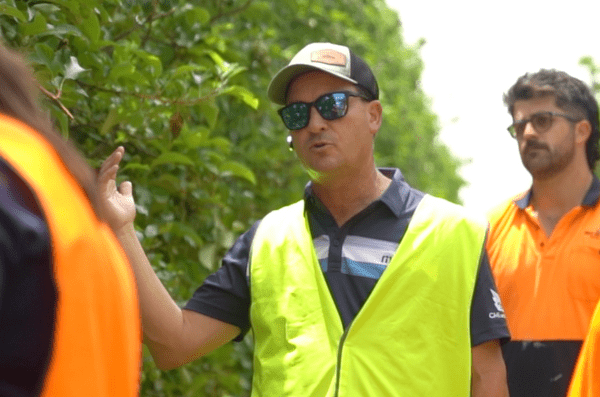
Jeff Cleveringa discusses the chemical and hand thinning processes used at Columbia Fruit with the Future Orchards® spring orchard walk attendees at Fankhauser Apples in Gippsland, Victoria. Photo: ARC Media
Quality lifts all boats
Jeff said the Washington industry worked very closely together, particularly where it came to lifting quality.
“Each of us has our 5 per cent ‘secret sauce’, and the other 95 per cent we are very collaborative on because we’re not going to solve it by ourselves.
“If we can figure out how to produce higher quality fruit, then we love to share that, because quality is like a tide; it raises all boats. It benefits all of us to produce a higher quality piece of fruit.”
Stay on market trends
Columbia Fruit markets collectively with three other warehouses through a single marketing desk, CMI Orchards.
There are seven major apple buyers in the US and Jeff said the number of SKUs they were willing to carry was shrinking at the same time as the volumes of ‘other varieties’ continued to rise.
“There are a lot of varieties. What do you pick? It’s a multi-million-dollar question.”
In Washington, where premiums previously available for three colour-based subgroups of Class 1 have disappeared, Jeff said as a result, there was now more return in hanging doubles to lift production, than in ‘chasing perfection’.
“You hung singles for great sunlight exposure, to get that great colour, because it was worth it, the market rewarded you for that,” Jeff said. “That’s not the case any longer.”
To test if varieties grown were market-aligned, Columbia Fruit compared their variety mix against the variety mix bought by their key buyers, and national Nielsen data.
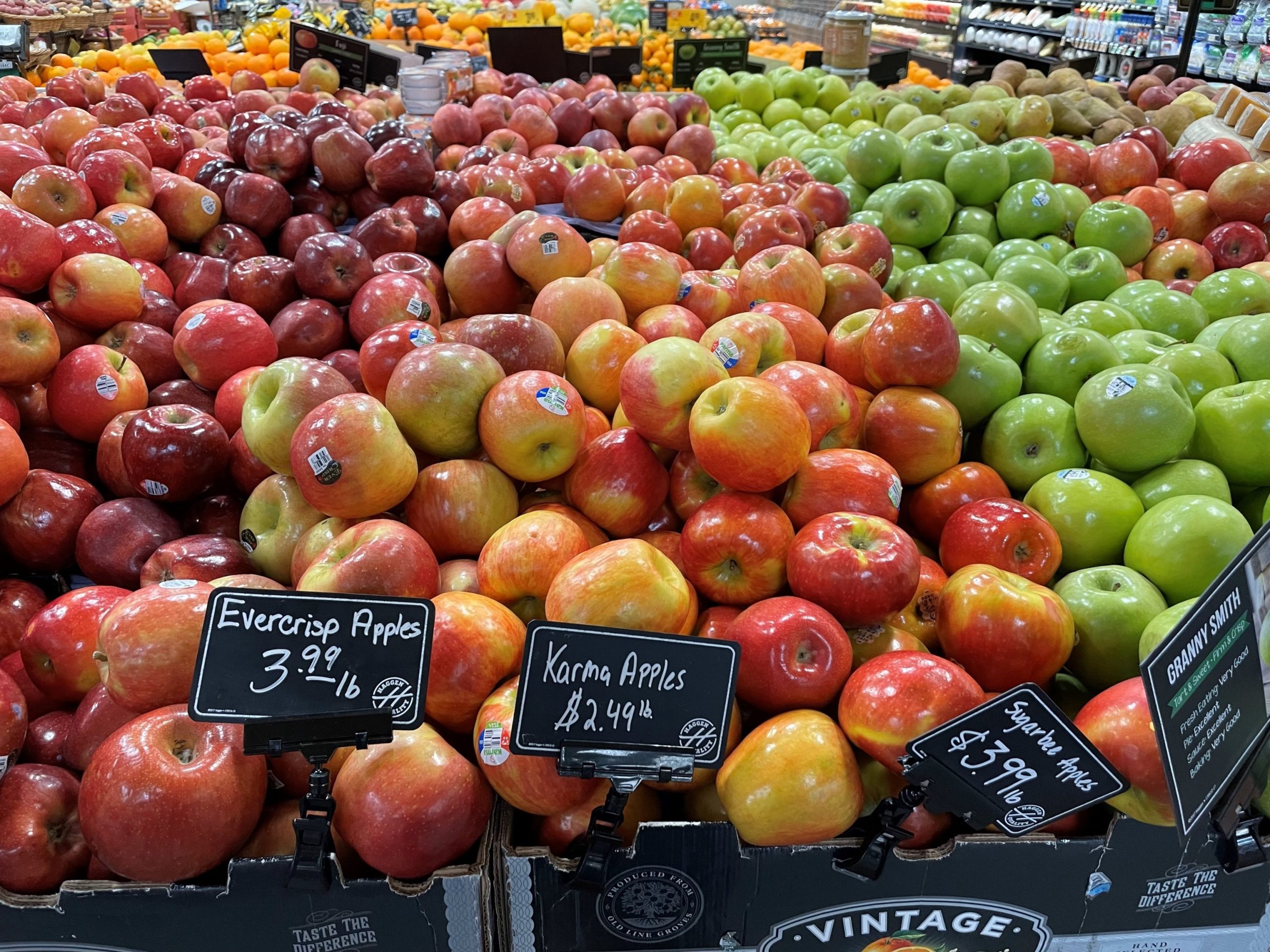
How will you stand out in the crowd? There are seven major apple buyers in the US and the number of SKUs they carry is shrinking at the same time as the volumes of new varieties continues to rise.
Automate, but not too early
One thing successful growers did not do when cash was tight, Jeff said, was dive into the latest automation technology too early.
Jeff chairs the technology committee of the state’s levy-funded R&D body, Washington Tree Fruit Research Commission (WTFRC).
“It’s a bit of a trap when cash is tight and the new technology is really good and really useful, but it has to be reliable and repeatable,” he said.
Instead, industry is taking on some of the role of trialling and testing new technology on growers’ behalf through the WTFRC and an international Orchard of the Future program aiming to digitise all orchard data to drive better decision-making.
Vision systems were being trialled to provide data, but only where it adds value.
“There’s only two times of year that vision systems will make you money, and that is counting buds left behind from my pruning crew and counting apples for my thinning crew,” Jeff said. “So we’re going to be using this technology to give ourselves data for our crew bosses to work with the individual people.”
New technology Columbia Fruit is trialling that Jeff said is working well for them includes Robotics Plus’s Prospr automated sprayer and Phytec’s irrigation scheduling. He sees promise in Agtonomy’s autonomous equipment and he is very optimistic about Advanced Farm’s robotic harvester which Columbia Fruit will have in pre-commercial use in 2025.
Packout reports from manual and robotic picking in 2023 showed the exact same 2 per cent level of damage, he said (Figure 1).
“So, the only difference in culls was that my crew was told that if you pick an apple with a bird peck or bitter pit, an obvious cull, you throw it on the ground, the robot did not do that. They will build that into their platform next year to do that, so that we should be running real close together.”
But he stressed that machines had to be able to see the apples to pick them and getting the orchard systems in place for easy access would be key to success.
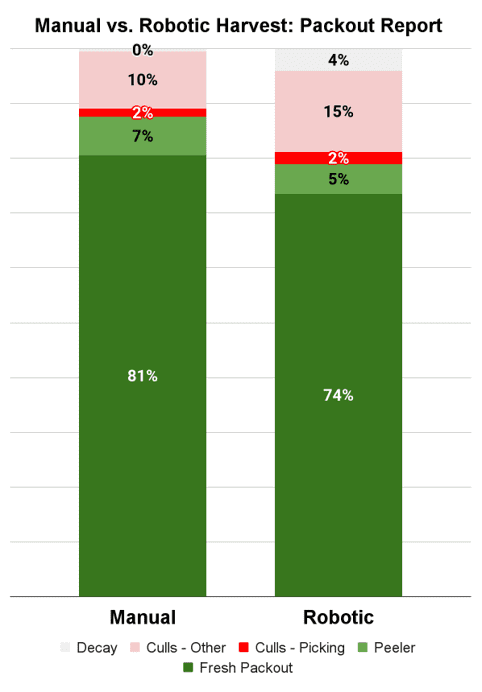
Figure 1: A packout analysis comparing manual versus robotic picking at Columbia Fruit found the level of culls (rejects) due to harvest damage, such as punctures and bruising during picking, was the same.
Cash is king
Jeff said despite having well-managed, productive, high-density new varieties, some of Washington’s best growers had landed in trouble after expanding too quickly where they did not have access to cash.
“Access to cash is really what is separating those growers,” he said. “So don’t get overextended on cash flow; this is a real killer. Cash is king. Stay current with market trends, grow high-quality fruit, but at a really reasonable price.”
This article was first published in the Summer 2024 edition of AFG.



