
Education served to your taste
APAL’s Richelle Zealley speaks to people of varying ages and backgrounds involved in the horticulture industry about how they have chosen to educate and upskill themselves and why they believe it’s important.
Education comes in many forms. Have you recently attended a Future Orchards® walk to listen to knowledge shared by the guest presenters? Maybe you attended the Speed Updating session in Tasmania to learn about current research in the industry; or have watched an APAL video on YouTube featuring a local or international industry expert sharing interesting tips and tricks. Perhaps you’re interested in enrolling in a half-day course offered online or by your local TAFE; or you could be interested in more formal tertiary study.
There are a variety of ways to educate yourself and develop skills in your chosen profession. Here we will explore some of the opportunities for apple and pear growers and their staff to develop knowledge and skills — be it in the orchard or pack shed; for professional or personal development; or as a means of learning about new technology. We’ll discover people both young and old see different merits and benefits in building their knowledge.
Lessons from afar
Recently, Dale Goldy, Director of New Varieties and IP Management for Stemilt Growers in the United States, was the featured international guest during the Southern Loop of the autumn Future Orchards®walks. Future Orchard walks are funded by Hort Innovation as part of the Future Orchards program, using grower levies and government contributions.
During Dale’s time visiting the orchards and meeting with Australian growers he mentioned, on more than one occasion, that he finds the best way to learn new ideas is to participate in international trips where he can experience first-hand what growers around the world are doing in their orchards.
“As the guest speaker, maybe I’m meant to be here to help growers learn but they challenge me and my way of thinking,” Dale shares. “From all the interactions I have, I’m always learning and changing personally and professionally — it really helps my development.
“You can’t participate in a trip like Future Orchards and not go home with something new yourself.”
Dale was exposed to horticulture from a young age but decided to study finance and accounting at university. “I don’t use my educational background much in my current role but it really helps when I’m trying to get horticultural data on a spreadsheet.”
At Stemilt – one of the biggest apple growers in the USA – the team recognises the importance of evolving as a business. “We’ve put some effort into becoming really good at doing the basic things well. We are constantly asking ourselves ‘what should we do, where’s the next step’ – we know we’re not going to stay doing the exact same thing forever, but how do we get to the point where we do that next thing as well as we’re doing what we’re doing today,” he explains.

Dale Goldy is the Director of New Varieties and IP Management at Stemilt Growers, in the United States.
“Any industry you work in is always going to be adapting and changing. In this business, we’ve got new varieties, rootstocks, training systems, techniques for fertilising, monitoring moisture levels in the soil, managing soil nutrition and it’s not any one of those aspects we have to focus on. Our focus is on how we bring all those elements together in a system-type approach which is going to be an ongoing, everchanging process.”
Dale believes it’s important to remain relevant in the industry and says knowing how to manage how they plan to change is key to this.
“It’s also important to accept change as being a fundamental part of the business. What worked last week or ten years ago has to be changed and improved, the people that can do that well have a chance to stay relevant to the industry and make money,” says Dale.
“However, if you’re not engaged in that process you run the risk of being left behind. We’re not influenced directly just by apple varieties, we’re influenced by all kinds of fruits that are also available 365 days a year so they are our direct competitors. Other competition includes snack foods such as Snickers manufactured by Mars who are extremely good at delivering a very consistent product around the world.”
This is where the importance of managed varieties comes into play. The benefit of aligning with a branded or managed variety is the set of guidelines and standards growers around the world who are growing that product must adhere to. This will help in delivering a more consistent product to consumers that they can be confident in purchasing wherever they travel.
“If apples want to be the health food alternative to candy we have to figure out where the best tasting varieties are at and how to grow them well while adapting to environmental, technological and market changes,” Dale says.
Another important point Dale touched on is a similarity between Australian and American orchardists, especially when it comes to younger generations working in orchards. “As a member of the ‘older generation’ I’ve found we’re not great at selling the opportunities on-farm to the younger people who may be interested in joining the industry,” he explains.
“Over the years, I’ve developed a photographic memory as I’ve needed to remember and recall various facts and figures from the orchard and from learnings around the world.
“Nowadays, you go into the orchard and speak to anyone under the age of 30 and they won’t be able to pick a figure from their head but they’ll be able to recall that figure just as quickly with a few taps on their smart phone.”
Technology has developed in leaps and bounds since Dale first started in the orcharding business and he says it’s important we continue to create enticing jobs and opportunities for young people interested in joining the industry.
“Many of the jobs people will be doing in the orchard in the next five to 10 years aren’t even created yet. It’s up to the older generation to understand and accept this, then accommodate and even encourage innovations and ideas to ensure our industry continues to grow into the future.”
There is no ‘right’ or ‘wrong’ path
Adrian Clay is bright, young and enthusiastic, and he always knew he wanted to grow apples which is why he completed his schooling life after Year 11. During his time at high school he participated in various Vocational Education and Training programs to develop his horticulture knowledge and he still hasn’t stopped his learning journey. Adrian, now 26, has recently embarked on the Masterclass for Horticultural Business. The Masterclass is a mini-MBA style program that is part of Hort Innovation’s new strategic partnership initiative. Strategic partnership projects involve Australian Government funds and contributions sourced from a range of co-investors.

Adrian Clay, Orchard Foreman at Montague, Narre Warren, thinks a greater knowledge of the day-to-day for Orchardists could bring more young people into the industry.
Adrian’s grandparents grew apples in the Mornington Peninsula, Victoria, and even though his parents didn’t continue the apple growing tradition (they were emu farmers), he maintained a close connection with the apple orchardists next door and started working for Mark Paganoni at Atlanta Orchards. There he completed Certificates Three and Four in Production Horticulture and he then went to work at Battunga Orchards.
“After I started at Battunga I thought I’d try something a little different and started my own earth moving business,” Adrian shares. But the lure of growing apples hooked him again and he went to work as an Orchard Manager at Jeftomson Orchards in Harcourt. Adrian has recently made another shift to take up the Orchard Foreman role at Montague, Narre Warren, with the vision to become Orchard Manager there.
When asked why he feels younger people aren’t interested in pursuing a career in the apple and pear industry Adrian says there’s a lack of knowledge about what orchardists actually do.
“The job’s not just about picking fruit, I don’t think we’re very good at explaining how the industry and fruit production actually works,” says Adrian. “There are a lot of aspects to consider such as budgeting, financial management, fertiliser and water application, developing tree crop knowledge, monitoring the weather, pest management and how to grow something well.
“I love the fact that I can work outdoors, do something new each day and not just sit at the computer. I feel I’m always being challenged and forced to think on the go which keeps me busy and active. That’s also the reason I’m always looking for opportunities to grow and develop personally and professionally.”
Business and technology – the way of the future
Another promising, young person is Jack Bartels who is pursuing his passion to work in the apple and pear industry and also further his education. Jack, 22, was the successful recipient of a New Horizons Scholarship, a partnership between APAL and Marcus Oldham College for a student to undertake a one-year Diploma of Agribusiness in Geelong, Victoria. The scholarship has been funded by Hort Innovation using the apple and pear R&D levy and funds from the Australian Government.
The $10,000 scholarship contributes towards some of the funds required to participate in the course and students can apply for additional financial assistance via the HECS-HELP scheme.
Jack is from the Huon Valley, Tasmania, and has been involved in the apple and cherry industries for 10 years. His father currently works as a horticultural advisor and agronomist for ServeAg and was previously a manager at Hansen Orchards. From the age of 12 Jack started helping out in the Top Qual packing shed and from there continued to work during his school holidays.
Once he completed year 12 Jack started studying a Bachelor of Arts Degree with intentions to complete a Masters of Teaching at the University of Tasmania. But two years in he decided it wasn’t for him and sought full-time work at Hansen’s Orchard. “It took me a little while to realise I wanted to work in horticulture,” Jack admits.

Jack, 22, was the successful recipient of a New Horizons Scholarship.
“Howard [Hansen] is the one who really encouraged me to apply for the scholarship and course at Marcus Oldham and from there I spoke with Thomas Griggs who also received the scholarship and completed his first year in 2015. I also attended the Marcus Minds weekend which is an opportunity to go there, meet staff and students and learn about their courses.
“I’d strongly recommend anyone even slightly thinking about studying agribusiness or anything horticulture related to participate in the Marcus Minds weekend. It’s a great opportunity to see what the college is all about — there are many differences between studying here and at a mainstream university.”
Students attending Marcus Oldham participate in various local and international study tours – all included in their annual course fees. There’s also a community of over 130 students living on campus, which Jack says creates a really positive environment. “Everyone has the same mindset, there are so many opportunities to talk about business and your goals. And even though we’re not all from the same backgrounds, everyone has a really interesting story to share and it’s a great way to learn from others’ experiences too.”
Jack went to Marcus Oldham with the intention of completing the one year Diploma of Agribusiness but now, just three months into the course, has his sights set on extending his study to encompass three years which means he would complete his studies in 2019 with a Degree in Agribusiness.
Jack has recognised that the focus for the horticulture industry is becoming more dependant on business and technology. “I feel that participating in a Diploma of Agribusiness at Marcus Oldham will help me understand the best of both worlds and without that knowledge it’s going to be hard to move forward as the industry progresses,” he adds.
The experience of a lifetime
When Fiona Hall, an apple and cherry orchardist from Orange, NSW, embarked on her Nuffield Scholar journey two years ago she set out to learn how Australian growers could improve their profit margin. Now, at the end of her ‘official’ journey Fiona has completed her final report on what the family farm in Australia needs to do to thrive, not just survive, in the horticulture industry. Her scholarship was supported by Hort Innovation, with industry levy and government contributions.

Fiona Hall is a Nuffield Scholar. Pictured here with her husband Bernard, children Charlie, Billy and Maggie, and dog Cherry.
As a business owner it can be a difficult decision to make to immerse yourself in any kind of study. And as a mother of three school aged children it’s an enormous commitment to travel both interstate and overseas for weeks on end to build the knowledge and experiences required of a Nuffield Scholar. However, Fiona has succeeded in achieving her goal and even though her original project direction was slightly adjusted, she has been able to provide the Australian industry an insight into how three different regions and countries have become more competitive, productive and efficient.
“I was originally nominated for the award and once I became aware of the nomination I looked into what was involved and thought that could really assist in building my knowledge to help not only our business but other Australian businesses too,” Fiona shares.
“Personal development is really important to me, we can never stop learning which is why we need to invest in ourselves and our staff, not just our land or commodities.”
Fiona’s report was presented as three different case studies — from a big family farming operation in Washington State, USA; to corporate entities in New Zealand; to the small, family owned farms in South Tyrol, Italy, where co-operatives are becoming the norm.
“The Washington apple industry has worked hard to expand exports, having created opportunities to export to almost every country in the world,” Fiona shares.
The growing, production and marketing system in Washington is quite different to that of Australia with growers using services offered by ‘warehouses’ which store, pack, sell and provide advice for growers.
“It seems in recent times, access to global markets has been the major contributor to the growth and success of the Washington industry. Whereas, consolidation, collaboration and innovation have seen the New Zealand industry ranked as the world’s top apple producer in 2015,” adds Fiona.
The number of growers in New Zealand rapidly declined from 2,000 to 400 prior to this and corporate investment has helped boost the industry.
“Many growers have either made a decision to become vertically integrated or focus on doing what they do well, becoming professional growers. These growers then develop strong relationships with local pack houses who market and sell their fruit,” Fiona explains.
“When it comes to South Tyrol, circumstances are a little different. They have embraced modern storage and marketing mechanisms and are always looking for new ideas to be more efficient and effective. They also have a strong co-operative and collaborative structure which enables the industry to effectively market its products.”
The average apple farm in South Tyrol is 2.5ha and land ownership rarely changes with many farming properties (valued at one million Euros per hectare) owned by the same family for generations.
Fiona identified a pattern of consolidation in each of the countries she analysed where the industry is static for many years then a wave of consolidation occurs. “These waves are due to things like changing market conditions, international competition, increased consumer concentration, introduction of new technology and increased capital costs,” she explains.
“There is a great opportunity for the Australian apple industry to progress to the next stage of consolidation. This could be in the form of horizontal mergers to spread capital costs or vertical integration.”
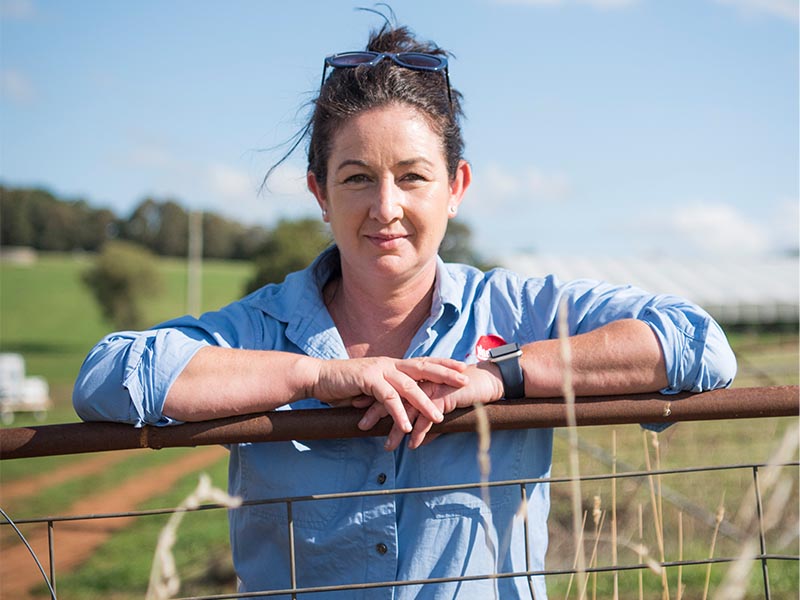
As a Nuffield Scholar, Fiona has completed a report on what the family farm in Australia needs to do to thrive in the horticulture industry.
She says there will always be smaller, independent growers who serve a market niche such as heritage or organic orchardists offering varieties that are not practical or profitable for larger farms to produce. But, at the other end of the spectrum there will be large, vertically integrated suppliers of year-round products.
“The mid-sized producer is viewed as most at risk, as they are large enough to have the scale to capture margin and compete against the larger suppliers, yet too large to capture a niche market. Also at risk is the small producer who does not serve a niche with a superior product,” Fiona shares.
The increased availability of club, or managed, varieties offers the opportunity to consolidate and collaborate. “By growing club varieties, we’re on the same wavelength and through collaboration we’re on the growing journey together,” Fiona says.
“Australian growers have the opportunity to become more competitive and, if we’re going to survive, need to be more cost driven. To do that we need to be more productive and efficient. New Zealand’s growers have done that very well and Australian growers need to do that to survive.
“Something I’ve learned during this journey is to look at your own self first, then your region and your country, until you can look at things from a global perspective. I haven’t found a silver bullet but I now understand that by fine tuning what we’re currently doing and working with what we’ve already got, there is a great opportunity to increase profitability and productivity in our business.”
Learning to lead
This brings me to my journey. This is the fifth year I’ve worked for APAL as part of the communications team. Prior to working for APAL I had worked in the hospitality industry and was not aware of the organisation or overly knowledgeable about the horticulture industry.
When I started at APAL I was studying a Master of Communications and working in hospitality as well as in a casual communications roles.
Since then, I’ve found that my career growth and development has been influenced by the people around me and the support and challenges they offered, which has inspired and encourages me to achieve. I am currently at an interesting point in my career, I’m a female in my early 30s who has chosen to have a family (at the time of writing I’m heavily pregnant with my second child). But that doesn’t and hasn’t stopped me from achieving specific personal and professional goals.
With the support of APAL, I commenced a Women & Leadership Australia Accelerated Leadership Performance Program earlier this year and it has helped me learn more about being a leader and the type of person I would like to become as I continue my professional career.
I also believe that whatever stage you’re at in your life, it’s important to continue learning and developing, you never know what life experiences are around the corner and as I found out, you can be working in hospitality one minute then your journey will steer you in a completely different direction.
Along my professional journey, it’s been important for me to discover where my strengths lie, know where I can personally improve and know where I need to call in assistance. A big part of this has come from learning experiences and also developing greater confidence in my ability as a communications professional.
Opportunities
For course and scholarship information for people in the horticulture sector visit the Hort Innovation website, www.horticulture.com.au.
The $10,000 New Horizons Scholarship is available to undertake the Diploma of Agribusiness course at Marcus Oldham College in 2018. Applications close Monday, 31 July 2017, apply via www.apal.org.auor 03 9329 3511.



