Consumer tracking reveals new insights for apples and pears
Understanding consumer usage and perceptions of fresh produce and analysing the effectiveness of marketing campaigns is key to informing ongoing marketing, communication and research activities.
Key points
- New cross-industry consumer usage and attitude tracking project aims to better understand consumer usage and attitudes and the effectiveness of marketing campaigns.
- Early results show 64 per cent of consumers claim they are likely to purchase apples in the next seven days.
- While only 26 per cent of consumers consider buying pears within next seven days, 88 per cent of people agree that pears are ‘worth what they cost’.
New consumer tracking data shows 64 per cent of Australian consumers claim they are likely to purchase apples in the next seven days, making apples top of mind when people are planning what fresh produce they will buy.
That’s one of the many key insights revealed in a comprehensive new Australian-first project, Consumer usage and attitude tracking 2022–23 (MT21202), now underway.
Insights into consumer
purchase and usage of apples and pears and their awareness of and response to advertising will help inform ongoing marketing, communication and research.
The project is providing a category tracking service to allow a broad range of horticultural categories, including apples and pears, to better understand consumer usage and attitudes and the effectiveness of marketing campaigns. It is funded by Hort Innovation using multi-industry strategic levies, including from the Apple and Pear Fund, and contributions from the Australian Government. The consumer tracking is being undertaken by key research provider, Fifty-Five Five.
While there have previously been a number of separate industry tracking projects with different metrics and frequencies of reporting undertaken, this is the first cross-industry tracking project. Hort Innovation’s General Manager Marketing and Demand Creation, Jane Smith, said the beauty of one cross-industry project is twofold.
“By contracting as one continuous project across industries we get to compare results over time and also to other industries,” Jane said. “We can get a monthly read on changes in consumer usage, attitudes and perceptions rather than a less frequent read and, secondly, we can compare across commodities to understand relative strengths and opportunities.”
What does the consumer tracking involve?
The project involves a sample of 800 Australians being interviewed each month throughout 2022 and 2023, who are the main or shared grocery shopper for their household and have purchased fresh fruit, vegetables or dried fruit or nuts in the past seven days. Interviews are conducted online, and the interview sample is nationally representative by age, gender and location across Australia. The questions relate to their purchase, consumption, usage and perceptions of various commodities and their awareness and reaction to various advertising campaigns. The sample size is large enough to be able to see changes over time and to see the impacts of seasonality and eventually the movements from year to year.
“We have Nielsen data to measure purchase, and we also need to consider usage and perception. There are steps people go through from thinking to buying and we need to be sure we are measuring the right things the right way,” Jane said. “The Consumer usage and attitude tracking 2022–23 project is one of the foundational studies to understand perceptions. We will ask the same perception questions regularly and want to see if we are building perceptions over time. This will help us inform ongoing marketing, communication and research activities.”
Insights for apples and pears
While the project is part of a five-year investment that started in 2022, Jane said the tracking to date had revealed valuable insights for apples and pears.
“We know from this work that apples have very high salience – 64 per cent of consumers claim they are likely to purchase apples in the next seven days, with no prompting at all,” Jane said. “This means that apples are pretty likely to be top of mind when people are writing a shopping list or thinking about what fruits they are likely to purchase.

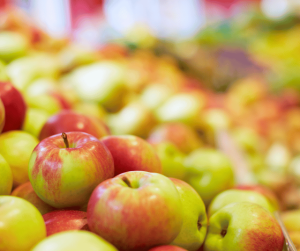
New consumer tracking data indicates apples are likely to be top of mind for many people writing their shopping list.
“On the other hand, pears have only 13 per cent salience compared to 64 per cent for both apples and bananas, and only 26 per cent consideration to buy within the next seven days compared to 68 per cent for apples. This means we need to do more to prompt shoppers to consider pears at the point of purchase as they aren’t top of mind before they shop.
“Pears also have an advantage in that cost is a lower barrier than for other fruits, with 88 per cent of people agreeing that pears are ‘worth what they cost’.”
Grower access to findings
Growers will be able to access findings from the project as it progresses.
“Tricking is most useful when you have a bit of a trend,” Jane said. “We have been waiting to build up a data set over the last 6 months and we are about to have the first presentation on the analysis over that period. This report is available on the Hort Innovation website.
“Going forward we will have a dashboard-style online delivery report where growers can view the data. In addition, we will utilise the data as part of advertising campaign evaluations at the end of a campaign period and in annual planning reviews with industry.”
This article was first published in the Summer 2022 edition of AFG.