Consumer insights reveal opportunities for growth
Despite cost-of-living pressures, Australian consumers still perceive apples and pears as being worth their price, but there are opportunities to increase the fruits’ market share.
Key points
- New research shows 84 per cent of shoppers think apples are worth what they paid for them, and 88 per cent for pears, compared to the average across fruit of 80 per cent.
- For 63 per cent of shoppers, apples remain top of mind when they’re looking to buy fresh produce in the next seven days, but only 14 per cent of shoppers have pears top of mind.
- Opportunity to grow apples and pears beyond snacking occasions through finding new uses and occasions and inspiring experimentation.
That’s among the findings from the Consumer usage and attitude tracking 2022–23 (MT21202) project, which provided a category tracking service to allow various horticultural categories to better understand consumer usage and attitudes and the effectiveness of marketing campaigns.
Led by key research provider, Fiftyfive5, part of Accenture Song, the project assessed attitudes, behaviours and communications impact on over 30 categories of fresh fruit (including apples and pears), vegetables, dried fruit and nuts.
Researchers surveyed 800 people per month, who were nationally representative by age, gender and location. Those surveyed were all main or joint grocery buyers for the household and had all purchased fresh fruit, vegetables, dried fruit, or nuts in the previous seven days. Since the start of the program, over 10,000 consumers have been surveyed.
Perceived value and quality
The project found the majority of shoppers are feeling the impact of cost-of-living pressures, noticing an increase in fresh produce prices and changing their behaviour accordingly. This includes shoppers becoming more sale savvy and substituting cheaper alternatives.
When prices change, relative perceptions of value change; however, perceived value for apples and pears has remained resilient.
For apples, the research showed that 84 per cent of shoppers think apples are worth what they paid for them, and 88 per cent for pears, compared to the average across fruit of 80 per cent.
For two out of three shoppers, or 63 per cent, apples remain top of mind when they’re looking to buy fresh produce in the next seven days, second only to bananas at 66 per cent. However, only 14 per cent of shoppers have pears top of mind.
Hort Innovation Consumer Insights Manager, Wendy Hubbard, said there was more work to be done to grow the desirability of pears and increase top-of-mind awareness.
“Getting on the shopping list as a planned purchase means consumers are more likely to buy more and pay more for them,” Wendy said. “While apples are ingrained in purchasing behaviour and dominate the key occasion of snacking, pears are not.
There is an opportunity to grow the desirability of pears and get them on the shopping list as a planned purchase.

There is an opportunity to grow the desirability of pears and get them on the shopping list as a planned purchase. Photo: iStock, shironosov
“Consumers buy what they love and, while they like healthy, they love taste. Deliciousness is a bigger driver of love than perceived health benefits, showing that if we want to drive emotional connection, taste is key.
“Looking at quality, 48 per cent of consumers were ‘very satisfied’ with both apples and pears, which is on the lower side of the average for all fruits of 50 per cent. This suggests that there’s some opportunity around improving quality.
“We know when consumers have a good eating experience, they come back to buy more. A bad experience can turn them off and impact both how long it takes and the frequency with which someone comes back to buy in that category.
“For pears, consumers might not be confident in being able to identify the right level of ripeness and how to store them to get them to the right level of ripeness, or how to use a soft pear versus a crunchy one.”
Inspire experimentation
Wendy said many fruit categories, particularly pears, can grow through finding new uses and occasions, inspiring experimentation by showcasing them in new and interesting preparations beyond snacking occasions.
Pears are very versatile and offer contrasts of taste and texture – sweet, savoury, soft, hard. Pairing with other foods is unique for pears versus other fruits.
“If you want to grow a category, you need to find another occasion to grow in and you need to ensure that people know how to use produce and encourage people to be creative,” Wendy said.
“A significant barrier across many categories is that many people aren’t confident enough to experiment or try new recipes. Confidence and creativity has a direct impact on consumer behaviour – people who enjoy being creative with food buy seven categories a week, and people who don’t buy 5.2.”
The project measured the average association with ease of cooking and ease of eating, with both apples and pears in Tier 1 of three tiers, showing that consumers view them as ‘very easy’ to eat.
Inspiring consumers to use fruits, especially pears, in new ways presented opportunities to grow beyond snacking into other key consumption occasions, such as dessert.
While there is some anecdotal concern in the apple industry about the broad range of apple varieties on supermarket shelves potentially overwhelming or confusing consumers, Wendy said that’s not reflected in consumer feedback.
“Research into varieties was not part of this project; however, as part of an in-store sampling program we did, consumers did tell us that varieties have the potential to provide excitement.
“There are many benefits of having variety – beyond creating buzz and excitement in the category, it also gives apples additional shelf space in-store. If you look at the shelf space of apples in many stores, it’s usually quite a large area. Shelf space is valuable because it prompts people to notice it and buy it.”
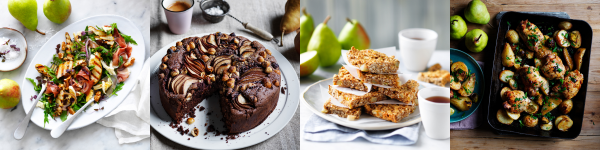
Recipes on the Australian Pears website showcase new and interesting ways to cook and prepare pears, like Grilled pear, rocket, walnut and prosciutto salad; Chocolate pear olive oil cake; Pear and oat slice; Portuguese chicken, pear and potato tray bake. Photos: Hort Innovation
Provenance and sustainability
The project showed while most Australians recognise that we grow some of the best quality fresh fruit in the world and agree that Australian produce is better quality than imported, consumers find it hard to know what is Australian.
“Provenance is much more important to Australians than what it is globally,” Wendy said. “While the majority prefer to buy Australian fresh produce wherever possible, 70 per cent disagree that it’s easy to know where fruits come from when buying them in stores. No category has done a great job of being ‘Australian’ and there’s room for improvement.”
On the hot topic of sustainability, research found while many Australians care about sustainable practices, few let those concerns really influence their behaviour. While 41 per cent are extremely concerned about environmental issues, just under a third are influenced to act as a result.
Wendy said positive perceptions of ‘imperfects’ and concern over plastic packaging reveal opportunities for the sector to improve its sustainability credentials.
“Eighty-one per cent agree they would be happy for supermarkets to sell produce that is not ‘standard’ size or shape to reduce waste, showing that people are embracing imperfects.”
What happens next?
Consumer tracking will continue and findings from the project will inform marketing strategies and form the basis for a new Consumer Insights dashboard.
“This project is part of a five-year consumer insights strategy. Our vision is that by 2026, consumer understanding is at the heart of our thinking and actions,” Wendy said. “Understanding the drivers of demand is crucial to both increasing demand and measuring results, and a fundamental part of informing the marketing strategy.
“The interactive dashboard will enable users to look at this information for themselves and understand usage and attitudes of consumers by category, look at trends and compare results across different categories for different time periods. It is anticipated it will be launched in the first half of 2024.”
In the meantime, resources produced by the Consumer usage and attitude tracking 2022–23 (MT21202) project can be accessed by registering at the bottom of this webpage: https://www.horticulture.com.au/growers/help-your-business-grow/research-reports-publications-fact-sheets-and-more/mt21202
Acknowledgement
The Consumer usage and attitude tracking 2022–23 (MT21202) project was funded by Hort Innovation using multi-industry strategic levies, including the Apple and Pear Fund, and contributions from the Australian Government.
This article was first published in the Autumn 2024 edition of AFG.