Brand Australia: selling premium apples to China’s high-end consumers
Australian fresh produce is highly regarded in China, and quality and branding are key to maintaining this premium positioning.
Jonathan Cox’s relationship with China began at the age of five, when his parents (volunteers and philanthropists) moved to Hong Kong. Since then, Jonathan has lived in China for over 10 years, studied at a Chinese university, and eventually created Stratforms – a company that launches, manages and distributes brands and their products into the China market.
Recently, Jonathan attended several major Chinese food industry events, including the world’s largest seafood expo in Qingdao, the China International Import Expo in Shanghai and the FHC Shanghai Global Food Trade Show, where he showcased everything from Tasmanian rock lobster and abalone to Remedy Kombucha and Minor Figures (oat milk) – all from Australia.
APAL chatted with Jonathan about the opportunities that exist for Australian apple growers in China, his insights into Chinese consumer behaviour and the key to a successful marketing strategy that will help capture space in a premium market.

Jonathan Cox’s company, Stratforms, launches, manages and distributes brands and their products into the China market.
Understanding the premium Chinese market
With China being the world’s number-one importer of fresh fruit, it’s easy to assume that the appetite for Australian produce is unlimited. But the situation on the ground is more complex.
The first thing to understand, says Jonathan, is that an imported apple or pear from Australia sits firmly in the premium product space.
“Australian produce, in general, is highly regarded. We’re not a rice bowl; we’re a gourmet deli. But in the long term, this means we need to be sophisticated in maintaining our premium positioning with quality and branding. The size of the prize is significant, but it isn’t without competition from other countries, margin squeeze and a need for investment to fight for that space,” Jonathan said.
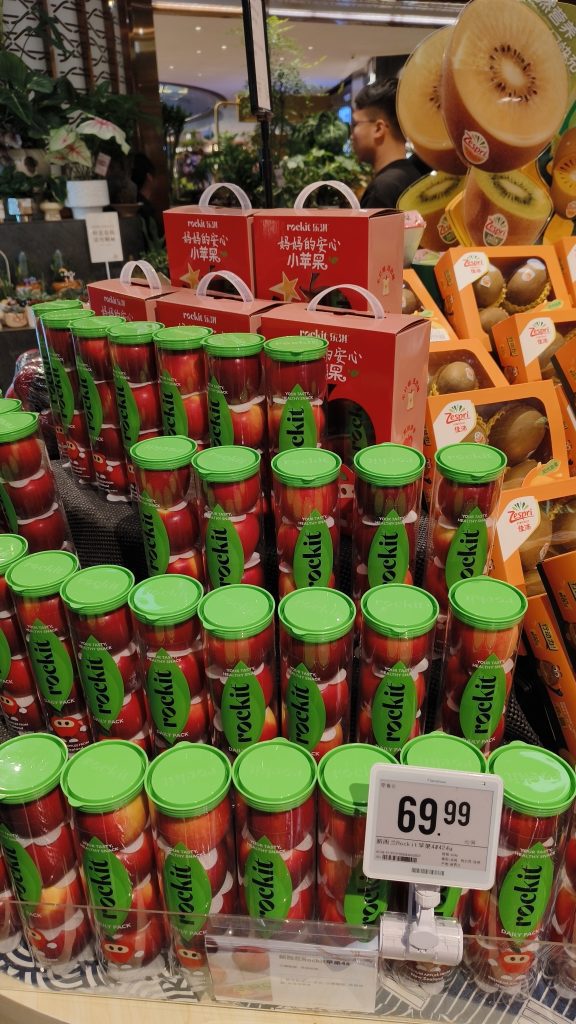
A display of New Zealand Rockit™ apples in a Chinese supermarket.
Only the wealthy?
Only the wealthiest Chinese consumers are likely to buy premium Australian fruit. Due to China’s vast population, the affluent segment of society is several times larger than its Australian counterpart. Does this mean the market potential is immense?
It’s complicated, says Jonathan. “China is the most overestimated market in terms of potential consumers for your product. But it’s also the most underestimated in terms of understanding consumer complexity. We ran an analysis for an Australian oat milk brand, who initially assumed they could sell to 150,000 coffee shops in the region. But our research found that making a coffee with Australian oat milk will raise the cost per cup well beyond the limit of the average buyer. There ended up being only 10,000 potential shops; only six or seven per cent of the initial assumption.”
Jonathan gives the example of a well-known Tasmanian cherries brand which retails in China at up to an eye-watering A$200 per kilo.
“They have worked hard to create something that high-end Chinese consumers want. The cherries that go to China are only 22 per cent of the Australian yield: highly quality controlled, large, juicy cherries are chosen so they can command that price point and position. If they sold cheap and cheerful cherries as an everyday purchase, there is no way they could sustain that premium figure and market position.”
The Victorian and Tasmanian cherry seasons happen to fall right on Chinese New Year, which is a big advantage due to the tradition of giving fruit as a gift. Jonathan spoke of a visit to a regional Chinese village twenty years ago, where he watched people arriving by train with gifts, predominantly quilts and huge boxes of expensive fruit. A lot more people are willing to splash out on premium fruit around Chinese New Year.
Pricing
Beyond special occasions, the Holy Grail in China is for a premium product to become an everyday purchase for these target consumers. Jonathan mentions success stories with Zespri™ kiwifruit, Driscoll’s® berries and New Zealand’s Rockit™ apples.
“Rockit is doing extremely well after a concentrated effort to create that brand,” Jonathan said. “It’s seen as a premium, healthy, everyday product, and extremely active in China where it sells at ¥70, or about A$15 for a tube of four apples.”
Australian exporters should do their homework to understand the pricing and seasonality of domestic apples in China. The harvest primarily occurs from late summer to late autumn, with specific timing varying by region and variety. For example, harvests take place in September in areas like Shaanxi and continue through October and November in northern regions like Ningxia and Shandong. “Australians should understand how our seasonality layers over that – is there an opportunity there?”

A ‘hug bucket’ of premium Chinese Ruixiang Hong apples.
Price check
Jonathan’s team in China conducted a quick retail review for APAL at two high-end supermarkets, Ole’ and Hema. Insights from their snapshot on 19 November 2025 include:
- High-end markets do sell some non-premium imported fruits. Jonathan’s researchers spotted some small unbranded apples from South Africa selling at ¥19.90 or A$4.32 for an 850g box.
- Popular brands are presented in various gift box options with different weights and price points. For example, Rockit apples are available in a five-piece/245g tube for ¥39.90 (A$8.66), a 586g ‘hug bucket’ at ¥79.90 (A$17.30), and a five-piece/500g ‘Gold Selection’ tube also at ¥79.90 (A$17.30).
- Familiar varieties include a five-piece pack of US Envy™ apples which retails at ¥29.90 (A$6.50), while a four-piece pack of New Zealand Pink Lady® apples is priced at ¥19.90 (A$4.32).
- Australian growers will be competing with premium Chinese produce too and it is also sold in four-piece packs. A box of Hema Fresh Fuji apples (approx. 680g) sells at ¥29.90; the same as US Envy apples. A tub of Ruixiang Hong apples (approx. 800g) sells at ¥43.60 (A$9.46).
- High-end Chinese pears are similarly priced: ¥29.90 for four pieces and ¥169 (A$37) for a 4.5kg gift box.
Brand Australia is strong, but forget marketing by state or region
How important is provenance in the Chinese market? Should growers build their brand around states or growing regions?
“In my experience,” Jonathan said, “Chinese consumers only want to know an apple is from Australia. They don’t understand or care about more detail than that and see no differentiation between our states or growing regions, but Australia itself is a strong, premium brand in the target market.”
However, it still pays to include some sort of provenance story on a QR code.
“We’ve found that only 1 or 2 per cent of consumers scan QR codes but having them on the packaging provides a higher level of confidence and seems to discourage the counterfeiters. The rare scans go through WeChat, so the best approach is to create a mini website within WeChat that explains the provenance, story and variety, but again, Australian apples should be the headline.”
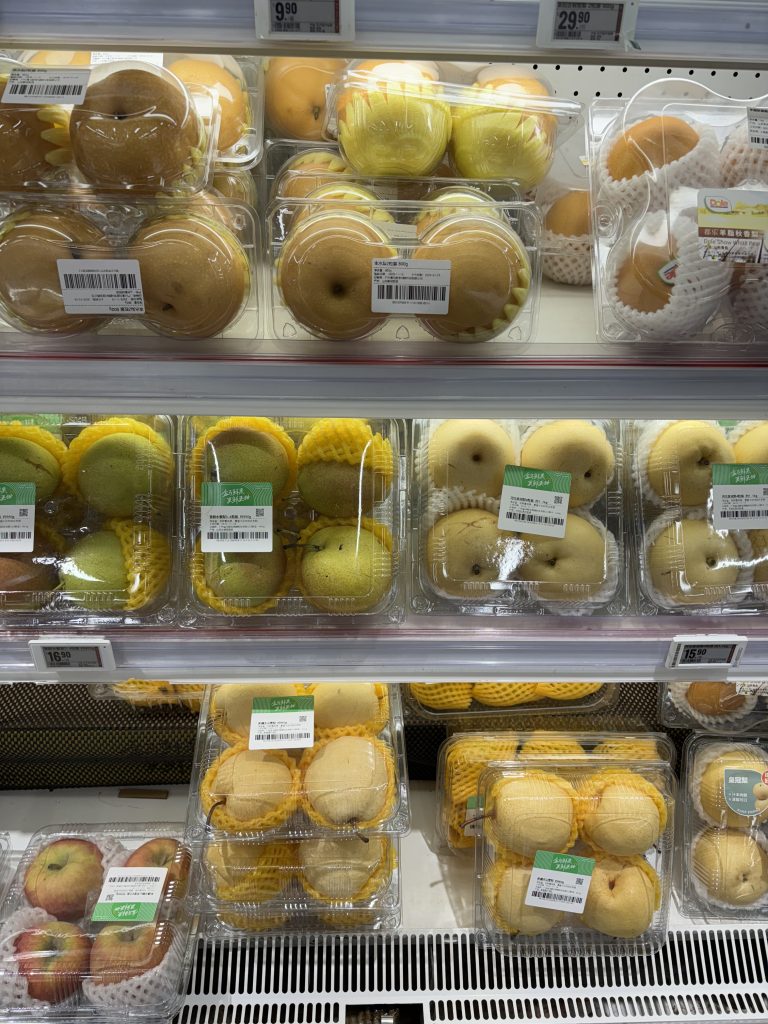
Australian growers will be competing with premium Chinese produce, which is often sold in four-piece packs.
Doing business with Chinese importers
Jonathan estimates there are only around twenty to fifty vetted importers of short-shelf-life fruit and vegetables in China, with a great deal of crossover between industries and categories. Due diligence might involve speaking with other exporting fruit industries (such as cherries), speaking with Austrade or state equivalents, or meeting with the biggest Chinese supermarkets to discover who they buy from.
“Chinese importers, on the whole, are genuine, pragmatic, business-minded and honest,” he said. “Their pragmatism is the key for understanding how to work with them. You need to offer a good price for the value you’ve created. Be honest and trusting of them, and they will reciprocate that.”
Remember, however, that you are vying for Chinese importers’ and distributors’ attention.
“They’re not just sitting there waiting for Australian apples to show up. They will be importing from all around the world. Sometimes we can be insular in our thinking, which is why we need to focus on the message: what are we bringing to the table?”
Further to this point, relationships with importers and distributors need to be cultivated and consistent. This means ‘skipping a year’ would be a very poor strategy, even if domestic Australian prices are good.
“I would say that if you’re trying to build a brand in China, withdrawing supply for a year would really blow a hole in your plan. Others would take up that space and form relationships. You’d lose that space, because it certainly won’t sit there waiting for you. You would need to go back and begin again to reclaim it.”
More information
To learn more about apple and pear exports, contact APAL’s Head of Trade, Jenny Van de Meeberg at [email protected] or 0410 536 269.
Jonathan Cox’s company, Stratforms, launches, manages and distributes brands and their products into the China market.
This article was first published in the summer 2025 edition of AFG.