When do vegetative buds turn into flower buds in pear trees?
Monitoring floral initiation timing in pears aims to inform future research into the triggers of flower development.
To better understand the timing of floral initiation and inform future work on stimulating or inhibiting it, Agriculture Victoria researchers are monitoring floral initiation in pears this season as part of the PIPS 4 Profit project, Pear production systems for future climates (AP22002). Pinning down the timing of floral initiation will allow targeting of future work aimed at identifying the metabolic processes behind return bloom.
Many key phenological stages of pome fruit are visually obvious – from bud swell in spring, through stages of cluster bud, finger bud and white bud to opening of flowers and, later, fruit set (and drop), fruit maturation and finally leaf-fall. Growers can track the phenological cycle and apply appropriate practices to manage their crop.
However, the earliest stages of floral development (known as floral induction and floral initiation) are not easily identified. ‘Floral induction’ refers to the occurrence of external (for example, day length, temperature) or internal genetic and chemical cues that trigger the subsequent ‘floral initiation’. Floral initiation refers to the microscopic, morphological changes that transform buds from vegetative to floral.
Pathways emerging
A number of hormones have been associated with floral initiation, but the pathways from genetic expression to production of these and other compounds – such as proteins, sugars and hormone-like compounds – that provide signals to begin this transformation are unclear.
Recently, studies utilising profiling of chemical compounds have begun to shed light on pathways from floral induction to floral initiation in apple.
These studies have identified differences between cultivar and crop load treatments and aim, ultimately, to lead to better understanding of biennial bearing and improved crop load management.
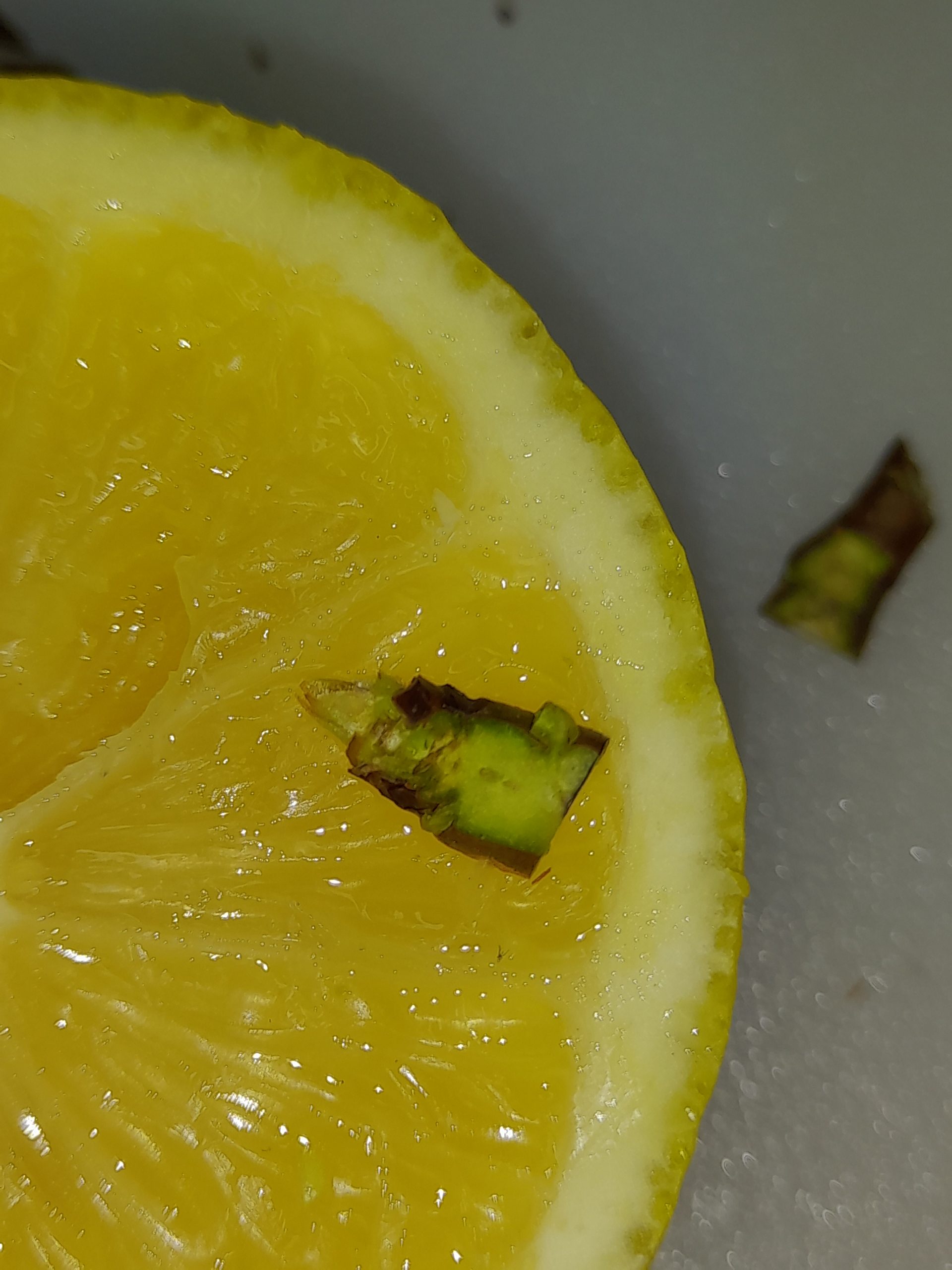
Dissected bud prepared for examination and placed on a cut lemon to decrease browning of the bud.
The PIPS3 Program’s Advancing sustainable and technology driven apple orchard production systems (AP19005) project identified the previously unknown participation of the salicylate group of plant hormones during floral initiation in Nicoter (sold as Kanzi®) apple.
In another study, abscisic acid and members of the cytokinin pathway, and flavanols, hydroxycinnamates and cinnamate derivatives (members of the phenylpropanoid pathway) were positively correlated with return bloom in Ruby Matilda. Precursors of plant hormones in the salicylate group (for example, methoxycoumarin, hydroxycinnamic acid, coumaric acid derivatives and sinapaldehyde) were detected in leaves and up-regulated in buds of Ruby Matilda trees.
Pinpointing timing is key
To study compounds that either trigger or inhibit floral induction, bud sampling should ideally occur prior to and during the period of floral initiation. Knowing the timing of floral initiation is therefore crucial to both identifying compounds involved in floral induction as well as evaluating and improving management options to increase return bloom.
Timing of floral initiation of pears has been observed to differ by over 30 days for different cultivars. For example, floral initiation was reported to occur from 65 (in the cultivar Shinseiki) to 95 (in the cultivar Comice) days after full bloom in New York State, United States. Of the cultivars more commonly grown in Australia, floral initiation was observed to begin in Williams Bon Chrétien more than 70 days after full bloom and in Beurré Bosc approximately 90 days after full bloom. Timing of floral initiation for many cultivars is unknown and regional differences occur due to differences in environmental conditions, for example, temperature. Crop load and use of chemical regulators have also been shown to affect timing of floral initiation of pome fruit.
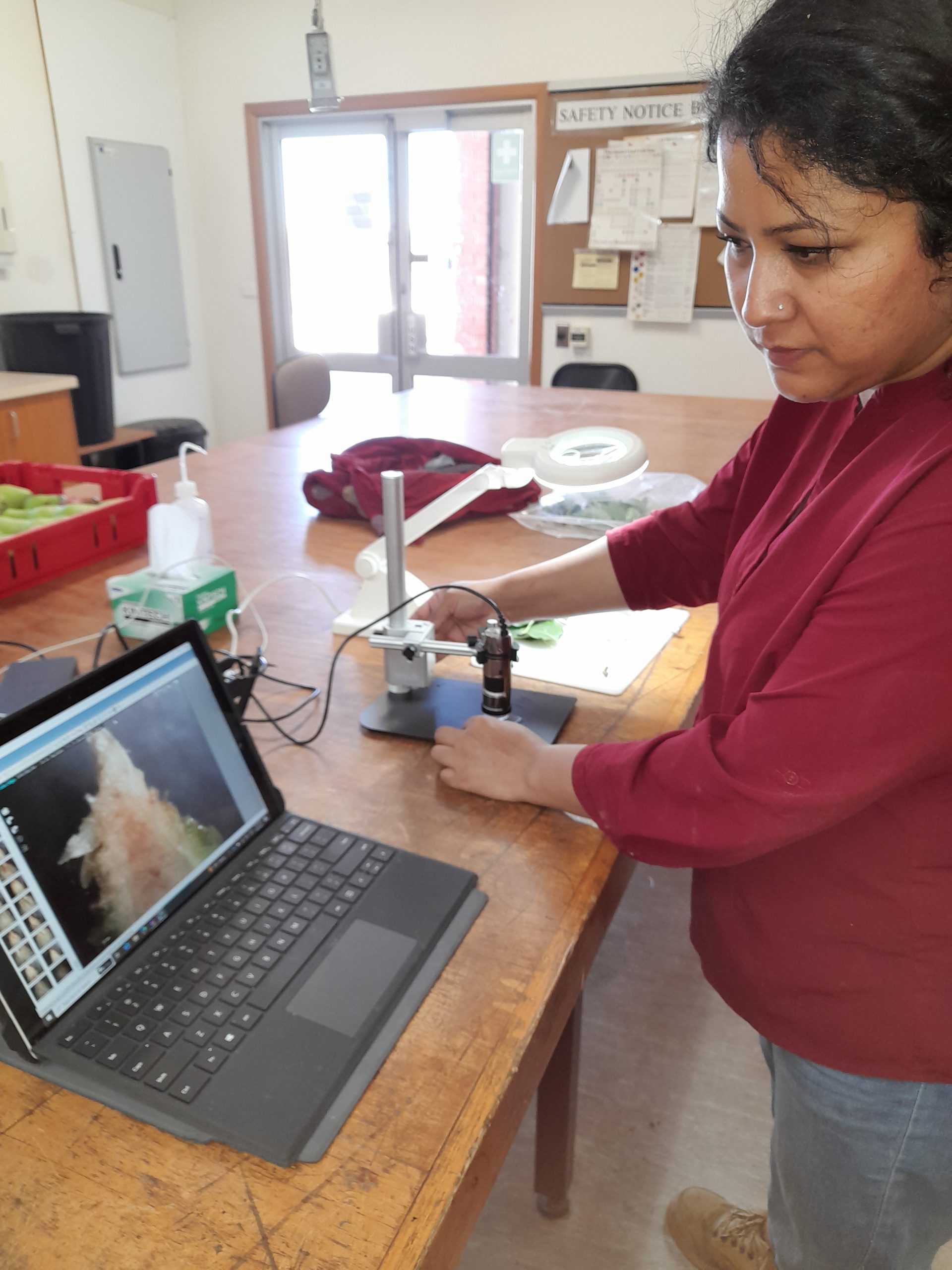
Jyothi Bhandari examining a dissected pear bud.
To identify the timing of floral initiation in three pear cultivars commonly grown in the Goulburn Valley, the Pear production systems for future climates project has been monitoring floral initiation in Packham’s Triumph, Corella and ANP-0131 (marketed as Ricó™) this season.
Sampling of spur buds commenced 30 days after full bloom in spring 2023 and continued at two-week intervals until 120–130 days after full bloom. Shading and fruiting are known to decrease floral initiation, therefore non-fruiting buds from well-exposed positions in the upper canopy were selected. Buds were dissected by firstly removing outer bracts, then cross-sectioning through the middle of the bud and dipping in lemon juice; use of lemon juice was adopted to limit browning of the freshly cut bud and improve clarity of images obtained with the digital microscope. Dissected buds were photographed, at 70 and 130–150 x magnification, for later identification of floral development stage.
The results will guide future studies regarding stimulation and inhibition of floral initiation.
Further information
Reddy P, Plozza T, Rochfort S and Goodwin I (Spring 2022) “Turning off biennial bearing”, AFG, apal.org.au/turning-off-biennial-bearing/
Reddy P and Ezernieks V (December 2022) “Crop load management: Signalling compounds that induce flowering”, YouTube, youtube.com/watch?v=JWQCfJvXfkU
Acknowledgement
 This study is a component of the PIPS 4 Program’s Pear production systems for future climates (AP22002) project, funded by Hort Innovation, using the Hort Innovation Apple and Pear research and development levies, contributions from the Australian Government and co-investment from Agriculture Victoria. Hort Innovation is the grower-owned, not-for-profit research and development corporation for Australian horticulture.
This article was first published in the Winter 2024 edition of AFG.