
Understanding crop load in European pears
Research aims to inform the development of crop load targets and management strategies/tools to aid growers in optimising yield and fruit quality
Crop load management is an important component of pear growing. However, compared with apples, there is limited information available to growers on how to best manage crop loads in European pears, particularly the newer cultivars, to maximise yields and fruit quality. Several strategies have been examined in the Goulburn Valley, Victoria, as part of the PIPS3 Program’s Developing smarter and sustainable pear orchards to maximise fruit quality, yield and labour efficiency (AP19005) project.
The importance of early crop load management
In apples it is well known that there is a negative linear relationship between crop load and fruit size, and this relationship has also been demonstrated in pears. Developing fruit require an adequate supply of carbohydrates to reach their full potential. To avoid wastage of the tree’s carbohydrate resources and obtain maximum benefits in fruit size and quality, removal of excess fruitlets should be done early in the season before the completion of cell division in the developing fruitlets; the longer the delay in removal of excess flowers/fruit, the greater the potential loss in fruit size and firmness.
Another key reason for reducing crop load early in the season is to minimise biennial bearing in prone cultivars as it results in a multitude of issues for growers, from fluctuations in orchard productivity, and hence profitability, through to potential tree damage and limb breakage as a result of excessive crop load.

Figure 1: Heavy fruit set (left) and cluster thinned to a single fruit (right) in ANP-0131 (marketed as Ricó™) pear.
Pears exhibit three waves of natural fruit drop. The first drop, usually going unnoticed, occurs soon after petal fall and is of non-fertilised flowers. The second drop is often the largest, particularly in trees with heavy crop loads, and occurs 6–8 weeks after bloom; this drop is referred to as the ‘November’ drop. The third drop occurs pre-harvest. In heavy bearing trees, the natural shedding that occurs in the first two drops is insufficient to achieve optimum crop loads, fruit size or quality, or to prevent biennial bearing. Where trees are not carrying excessive crop loads there is normally no second drop.
There are several tools available for managing crop load, including hand thinning, chemical thinning, mechanical thinning, pruning or photosynthetic inhibition through shading.
Experimental studies
Field trials have been undertaken over two seasons on ANP-0118 (marketed as Lanya™) and ANP-0131 pears. In the first season several chemicals (ammonium thiosulphate (ATS), naphthalene acetic acid (NAA), ethephon, Brevis® and Surround®), were applied to ANP-0118 during the bloom and post-bloom periods. However, as a result of general low fruit set in that season, there were no differences observed between treated and untreated trees.
Field trials in the second season were undertaken on ANP-0131 and included mechanical, hand and chemical thinning treatments.
Mechanical thinning
Treatments in the mechanical thinning trial included an untreated control, Darwin string thinner at two different speeds (gentle (180 rpm) and moderate (240 rpm)), and a leaf blower set at 6 bar pressure. Treatments were applied at full bloom to a two-dimensional four-leader row of ANP-0131 at the Tatura SmartFarm (Figure 2). One pass was made on each side of the row for both the Darwin thinner and leaf blower.

Figure 2: Darwin string thinner (left) and leaf blower (right).
Some differences in crop load (number of fruit per 100 blossom clusters) were observed between treatments (Figure 3a), with the Darwin thinner having the greatest effect in reducing fruit number. However, there was no significant statistical difference between the two speeds used for the Darwin thinner. Although the leaf blower did reduce crop load compared to the untreated control, it was not as effective as the Darwin thinner.
Fruit size was improved by both the Darwin thinner at moderate speed and the leaf blower. Fruit soluble solids content and flesh firmness were higher in the Darwin thinner treatments, which had a greater thinning effect compared to the untreated control and leaf blower treatments (Figure 3b,c,d).
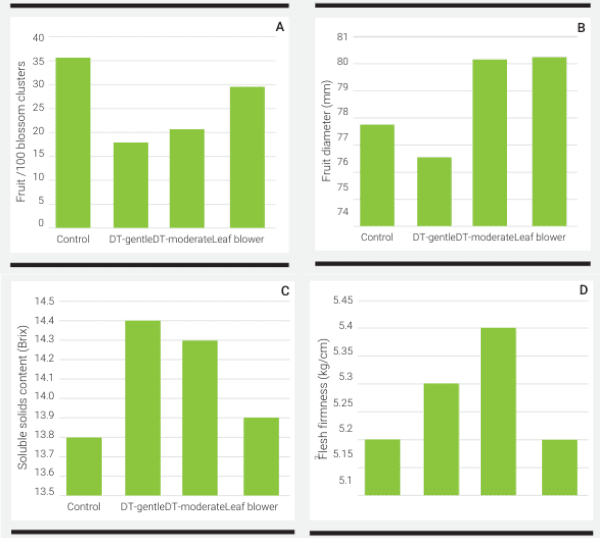
Figure 3: Effect of mechanical thinning treatments on (a) fruit set, (b) fruit size, (c) fruit soluble solids content and (d) fruit flesh firmness in ANP-0131 (marketed as Ricó™) pears. DT = Darwin string thinner.
Hand thinning
The hand thinning trial was aimed at determining the optimal time for thinning and the ideal number of fruit per cluster. Treatments included an untreated control, thinning to either 1- or 2-fruit per cluster at two different times (October or November) and an artificial spur extinction (ASE) treatment. The aim in the 1- and 2-fruit per cluster treatments was to retain approximately 45 fruit per upright. The October treatments were completed in mid-October and the November treatments in mid-November. The spur extinction treatment, performed in mid-September 2022, involved removal of approximately 50 per cent of the flower clusters. Trees in this treatment were hand thinned to single fruit in mid-October.

Figure 4: ANP-0131 (marketed as Ricó™) pear hand thinning trial on Tatura trellis.
Crop load was reduced by all treatments (Figure 5a). The ASE and 1-fruit per cluster treatments had the highest number of single clusters and corresponding lowest number of double clusters.
Mean fruit weight was similar in most treatments except for the ASE treatment which produced fruit 32 per cent heavier than the control fruit (Figure 5c). Fruit soluble solids content was increased by all treatments.
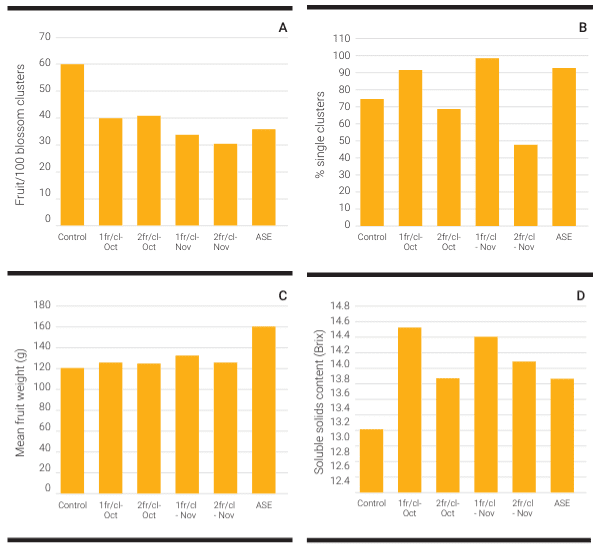
Figure 5: Effect of hand thinning treatments on (a) fruit set, (b) percentage of single clusters, (c) fruit size and (d) fruit soluble solids content, in ANP-0131 (marketed as Ricó™) pear. fr/cl = fruit/cluster.
Chemical thinning
The chemical thinning trial examined three different chemicals (ATS, 1-aminocyclopropane-1-carboxylic acid (ACC) and Ecocarb® Plus (potassium bicarbonate and potassium silicate, Organic Crop Protectants)). ATS and Ecocarb® Plus were applied as either a single application at 20 per cent bloom or a double application at 20 and 80 per cent bloom, while ACC was applied once at 80 per cent bloom or twice at 80 per cent bloom and 20mm fruit size.
As there was no treatment effect on crop load, this trial was not harvested, but field assessments of russet and fruit size were undertaken. There was a high level of russet in all trial trees, with no difference between the control and chemically treated trees.
Compared to the control, fruit diameter was increased in both ATS treatments and the double ACC treatment, while fruit length was increased in the double ACC treatment. Fruit L/D ratio (shape) was reduced by both ATS treatments, but other treatments had no significant effect compared to the control (Figure 6).
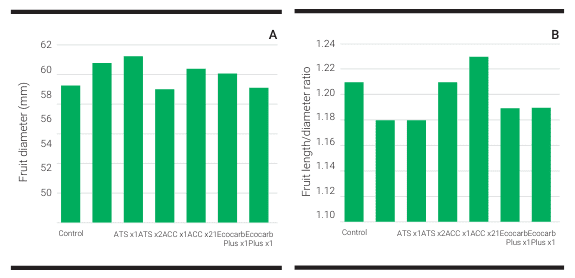
Figure 6: Effect of chemical thinning treatments on (a) fruit size and (b) fruit shape in ANP-0131 (marketed as Ricó™) pear. ATS = ammonium thiosulphate, ACC = 1-aminocyclopropane-1-carboxylic acid.
Conclusions
These trials have demonstrated that mechanical thinning has potential for managing crop load in pears. With further work to refine spindle rotation and tractor speeds, results with the Darwin string thinner should be improved. Performance of the leaf blower is likely to be improved by making two passes at different heights to cover the entire tree and altering pressure and/or tractor speed. The leaf blower also has the advantage that there is no physical damage to the tree.
The hand thinning results confirm that fruit quality can be improved by earlier thinning. In particular the removal of flowering spurs by artificial spur extinction early in the season can lead to increased fruit size without compromising quality, giving potential to carry heavier crop loads.
While the chemical thinning results were disappointing, it is worth pursuing some of these chemicals, particularly ACC. Noting that initial work on apples with ATS recommended the use of a non-ionic surfactant with this chemical, the inclusion of a surfactant with ATS may also improve performance in pears, but, as the label does not include addition of a surfactant, this strategy requires further work and a change of label.
These studies will be continued as part of the upcoming project PIPS 4 Profit – Pear production systems for future climates.
Further information
Videos on the chemical thinning trials can be found on the PIPS3 Program webpage: https://apal.org.au/programs/more-industry-programs/pips3program/pips3resources/
View a crop load management research update, filmed at Calimna Orchards, Ardmona in November 2022: https://youtu.be/7kutuTaRn9E
Watch “Potential thinning agents for pears”, filmed at Tatura SmartFarm Laboratory, Tatura in November 2022: https://youtu.be/z4Cgt2ot1Us
The PIPS3 Program’s Developing smarter and sustainable pear orchards to maximise fruit quality, yield and labour efficiency (AP19005) project is funded by Hort Innovation, using the apple and pear research and development levy, contributions from the Australian Government and co-investment from Agriculture Victoria. Hort Innovation is the grower-owned, not-for-profit research and development corporation for Australian horticulture.
Many thanks to Matthew Lenne for granting access to Calimna Orchard, Ardmona, Victoria.

–
This article was first published in the Winter 2023 edition of AFG.



