
Tree insights trigger turnaround in problem Rosy Glow block
Insights from irrigation monitoring introduced on a problem block in the Yarra Valley prompted a complete change in practice, which was a key factor in returning the block to profit.
Despite one of the driest years in decades, no water has been delivered to Sanders Orchards’ ‘M’ block of Rosy Glow this year.
Thanks to new irrigation monitoring technology introduced to get to the bottom of poor performance on the 1.5-hectare block at Three Bridges, Peter Sanders has the data at his fingertips to show fruit size is increasing and the trees don’t need more water.
It’s just one of the surprises that came from the Phytech system that measures tree water usage and uptake using dendrometers to inform precise water requirements, deploys fruit sensors to provide daily fruit growth data and monitors local weather, water pressure and soil moisture.
The ‘M’ block was one of four on the impressive and productive orchard viewed as part of the second day of the Future Orchards® walks in mid-January.
Initially a very good block – the central leader system on M26 cropped 85t/ha in 2019 – walk attendees were told yield had slipped back to 59t/ha in 2020, 41t/ha in 2021 and 38t/ha in 2022, with excess vigour and poor bud development persistent issues.
“It didn’t crop, it just wanted to grow,” Peter said when APAL spoke to him again in early March. “Summer pruning was just ridiculous.”
Extra hives were initially introduced to address poor pollination, and root pruning, combined with reduced fertiliser application, carried out to tackle the vigour with some success, but it was the insights from tree monitoring that led to the most effective changes.
While the block is low-lying on river flats, Peter said they had not realised the extent of available water until they took on a Phytech system in 2022 and put dendrometers and fruit sensors into the block.
“I’ve been over-watering and over-fertilising, expecting an 80-tonne crop, and I’ve only been getting a 40-tonne crop,” Peter said.
“It had good access to water as we’ve found out, somehow accessing water underground. We’ve been using the Phytech system lately to cut down on watering. I’m looking at the app every day and I’m giving the blocks no water. I’m still getting increases of fruit size every day, and the trees aren’t yellowing or anything like that. We’ve turned the water off completely for them, even for the last three weeks [late February/early March].”
Another change triggered by the insights into tree water use was the timing of watering. Like many businesses looking to take advantage of off-peak electricity rates, Peter said the practice had been to water for an hour every night, but with better understanding of tree water use they had shifted to daytime watering, with different blocks getting different schedules as required.
“It’s the complete opposite of what we were doing,” he said. “We are giving them a 30-minute watering two to three times a day and not sending water down too deep.”
Phytech’s Daniel Free told orchard walk attendees that holding water back until it was needed was important to make the tree ‘work’.
“It’s not to say stop watering. It’s to slow down the water and then try and apply water at the right time,” Daniel said. “Some of those right times are nighttime, some might be first thing in the morning, some in the afternoon. It depends on your block, and what your tree is actually responding to, and soil type will play a factor in that as well.”
Block watering needs are displayed via the app and website interface as a green, yellow, orange traffic light system.
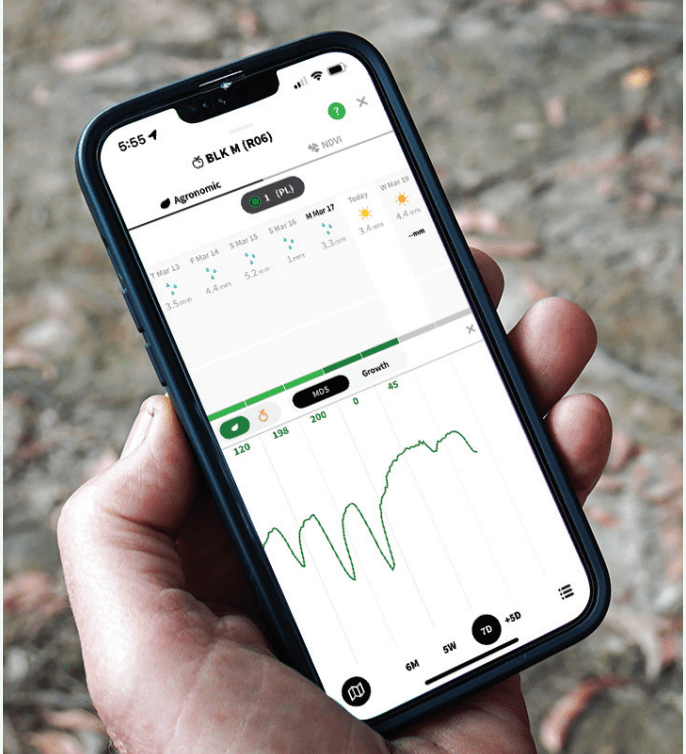
Peter uses the Phytech app daily to check block watering needs, including the timing of watering.
Less costs, more fruit
Peter said the main cost saving had been in reduced summer pruning. Better tree structure was also contributing to increased bud development, return cropping and yield.
“Now we are getting more pendulum-type branches,” he said. “Once you turn the branch into the downward position, you tend to get large fruit buds developing behind the terminals and you’re getting a good, constant crop, year after year. Turn the branch back up again and you turn the tree into a dinosaur-type situation – they just cost you money.
“If you don’t have enough strong fruit buds develop that get enough light, you are never going to get to an 80 to 100 tonne crop.

Better tree structure in the Rosy Glow ‘M’ block has contributed to increased bud development, return cropping and yield.
“If you’re not getting 80t, it’s very hard to make good money. At 60t/ha you’re just breaking even. You’ve got to manage that vigour.”
To maximise the light at the bottom of the tree, Peter said they had also gradually removed the larger limbs, taking out two to four each winter.
“We are just taking out what I call the ‘costly limbs’, the ones that you have to pay someone a lot of wages to keep cutting back,” he said. “We take the whole branch out and renew, so we have got some nice three- and four-year-old wood coming through now.”
In 2023 the block yielded 66t/ha, before delivering a bumper 91t/ha last season. An additional benefit of less watering in 2024 was fruit quality.
“The fruit kept firmer; it was much, much better and that crop was bruise free,” Peter said. “It also had very good colour, because we put Extenday® [reflective fabric] down.”
Peter said the current crop was looking a little lighter, perhaps impacted by the big crop in 2024.
Fruit sizing
Big fruit that overshot the target weight – Sanders Orchard aims for 170g – was also another issue in the Rosy Glow block.
Peter said the ability to monitor growth against a target fruit size in the Phytech app was providing welcome confidence growth was on track. Having been in the practice of taking the callipers out to measure an apple a block weekly across the orchard to calculate growth per week, he said the daily data popping up on his phone had become ‘like a bible to me’.
“Every morning I can see how the fruit is growing. The Granny Smiths were looking a bit small, but now it’s picked up to 0.4, 0.5, 0.7mm growth a day, which is a lot. It’s probably a millimetre behind my goal at the moment, so I’m pretty happy with that. If I get 110t/ha, which is what the estimate of that Granny Smith block was, I think that’s pretty good.”
Cost vs return
Daniel said the cost of the Phytech system for Sanders Orchards for the 2024–25 season is $6,000 across 20 hectares on six sites at two different locations. For Peter the Phytech system is definitely good value
He is not using it in every block, but at the start of the season tries to put it into a variety on each of the locations he is either having trouble with or thinks might be a problem, but says it would have to be a situation where he felt it could make a difference.
“There’s no point putting it in a $30t/ha block, that wouldn’t be viable,” he said. “With the Granny Smiths this year, I knew that there was a lot of fruit and I thought, well, if it’s going to be over 100 tonne, let’s put the Phytech system into that, and I’ll be able to monitor it every day and make sure that I get to the target size.”
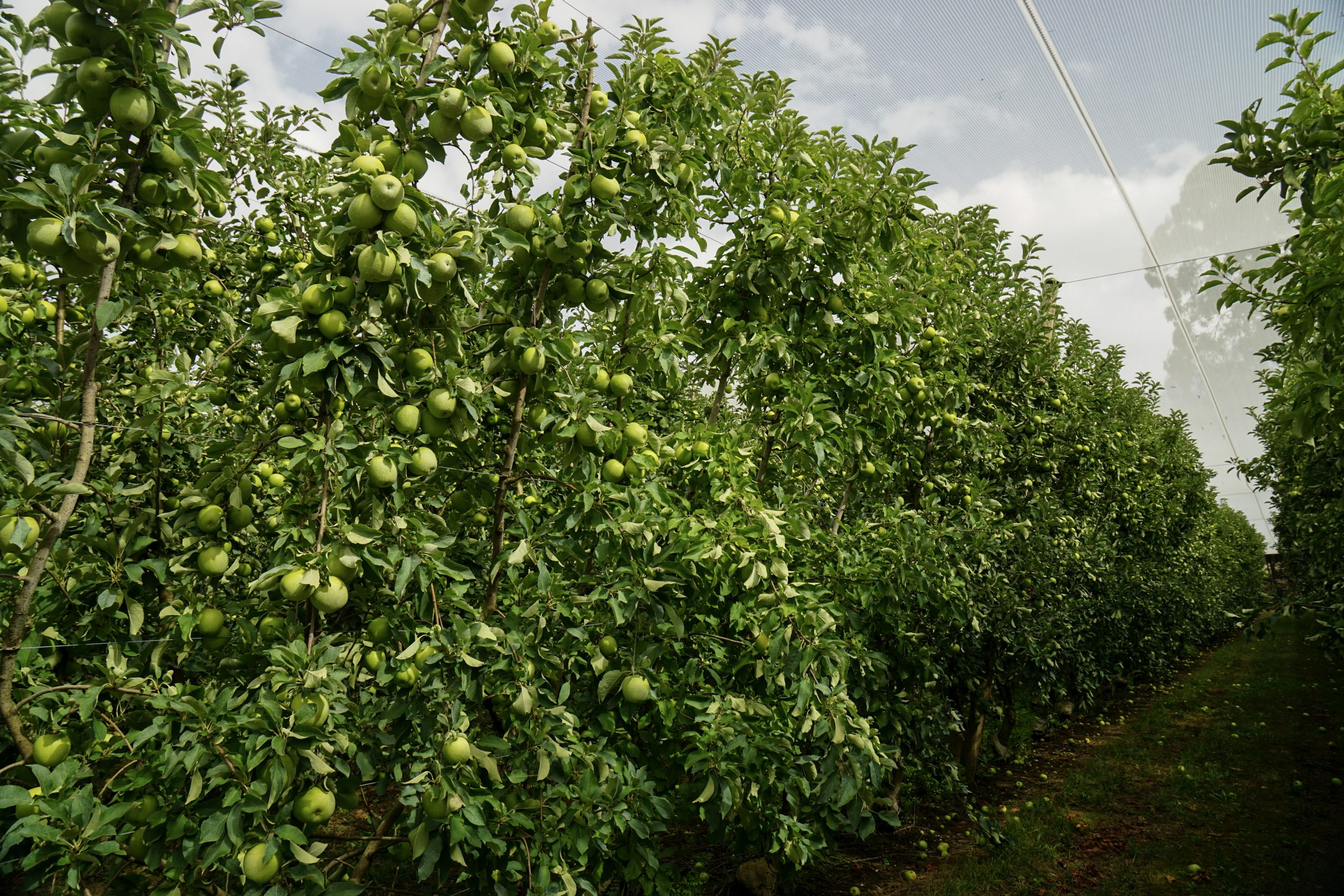
Peter put the Phytech system into his Granny Smith ‘L’ block in 2024 so he could monitor the fruit to ensure it got to the target size.
A numbers whiz who has his orchard tasks costed down to c/kg, he is quick to calculate that across the 20ha, assuming a conservative 60t/ha, the system adds $5.00 a tonne to his costs or less than 1c/kg.
“The biggest saving for me wouldn’t be the water saving, it would be the summer pruning, being able to control that shoot growth, so that I can terminate it before Christmas and turn that into a fruit bud rather than a vegetative bud and, in theory, increase the amount of fruit buds and the yield.
“It’s the balance, getting the balance right and being confident and sitting back and watching the fruit size grow.”
Further information
Peter is happy to hear from growers who have further questions about his experience of the Phytech system.
The Phytech system is provided via a service agreement for each year, in which the equipment is maintained, looked after and updated by Phytech. The latest up-to-date equipment is supplied to ensure growers are not using old equipment.
The base service is a minimum of 10ha and this comes with three dendrometers per site, three fruit size sensors per site, one irrigation sensor per site and one soil probe per site, which has been added for the coming season. Visit www.phytech.com to find out more.
This article was first published in the Autumn 2025 edition of AFG.



