
The right tool for the right job: getting the most out of Harvista
Author: Dr Hannah James, R&D Manager, AgroFresh
Harvista™ is a powerful harvest management tool. As with any tool, knowing what it is intended to do is the first step to using it effectively.
Harvista is a “real time” plant growth regulator (PGR) that is applied in the orchard, near to harvest, to slow ripening, reduce fruit drop and hold fruit on the tree longer to promote better colour and fruit size.
Harvista works by regulating the production of the plant hormone ethylene. The active ingredient of Harvista, 1-methylcyclopropene (1-MCP), binds to the fruit’s ethylene receptors. By binding to the ethylene receptors, 1-MCP blocks the ability of the fruit to perceive ethylene.
As is typical of climacteric fruit, apple fruit ripening is regulated largely by ethylene. Ethylene controls the physiological processes that relate to fruit ripening. These ripening processes include starch conversion, firmness loss, degradation of acid and background colour change. When fruit is still attached to the tree and in a period of active growth and maturation, the fruit will continue to produce new ethylene receptors which allow fruit ripening to continue.
Optimal timing
As Harvista targets ethylene receptors in the fruit, the application window starts at around 21 days before harvest when the fruit will be just starting to produce ethylene. Applications can be made up to three days before harvest at which time ethylene production will likely be progressing to an autocatalytic phase (this means that any ethylene produced in the fruit triggers further ethylene production and ripening is accelerated) as fruit ripening continues to progress.
What is the “optimal” timing for an application of Harvista? The expected outcomes of an application of Harvista are dependent on the physiological maturity of the fruit at the time the application is made. The “optimal” application will depend on the orchard and fruit conditions and the requirements of the fruit grower. These conditions can change rapidly during the harvest window and Harvista can be applied at different fruit maturities as a tool to help manage these changing conditions. Depending on fruit maturity at the time of the application, expected outcomes of an application of Harvista include:
- Maintain fruit firmness, before and after harvest
- Extend fruit’s time on the tree for better colour and size
- Bring consistent, high-quality fruit into storage
- Consolidate harvests of multiple pick varieties
- Slow starch conversion and acid loss
- Minimise fruit drop
- Delay/minimise watercore.
Generally speaking, applications can be classified as “early” or “late” along the spectrum of fruit maturation in the lead up to harvest or “just in time” to respond to changing maturity, weather or labour conditions. Regular starch/maturity testing during the lead up to and during the harvest period will help to ensure maximum fruit quality after storage. These tests can also help in determining the best time to apply Harvista and in predicting and monitoring the effect of Harvista applications on maturity timing.
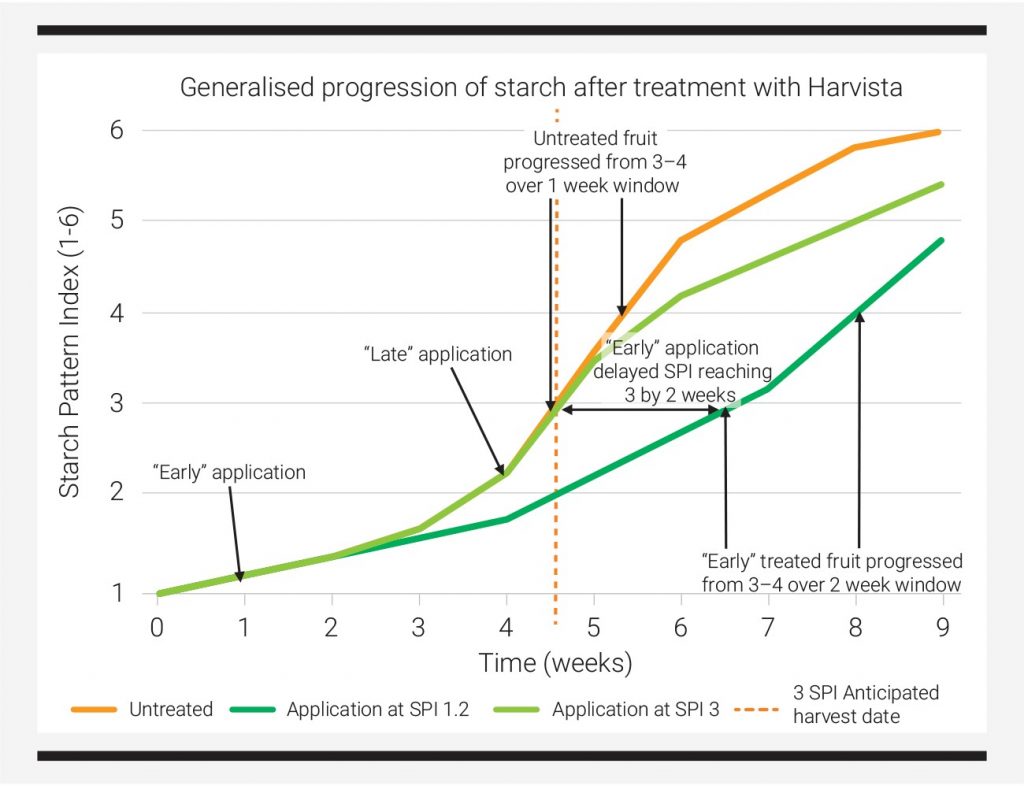
Generalised progression of starch after treatment with Harvista.
Early applications
An application that is “early” on the fruit maturity spectrum is approximately 21–14 days before anticipated harvest. Often this coincides with a starch score of 1.5 to 2 on a 1-6 scale (starch is clearing in the core of the fruit and some clearing may have begun in the cortex). At this time, ethylene production would have only just commenced in the fruit. When applying Harvista at the commencement of fruit ethylene production, the following benefits can be seen:
- Harvest management
- Ethylene is the physiological driver of fruit maturation and ripening. Stopping the perception of ethylene as it is commencing will effectively slow fruit maturation as evidenced by slowing starch breakdown
- Slowing down of fruit maturation extends the time before fruit will reach optimal harvest maturity
- Slowing down the rate of maturation also means that harvest of optimal maturity is not only delayed, but that the window in which the fruit will be at optimal harvest maturity is also extended
- Harvest consolidation
- As multiple pick varieties approach maturity, the crop on the tree will begin to split into the different maturity bands that become the first, second and additional picks. By targeting ethylene production at this early stage of development, the variability of maturities present is reduced. This results in a tightening of maturities present on the tree and results in the need for less picks to harvest consistent fruit
- Bringing consistent, high-quality fruit into storage
- By slowing fruit maturation, fruit quality can be maintained both at harvest and during subsequent storage, increasing storage and marketing opportunities for the fruit. Blocking ethylene perception early in fruit ripening will help to maintain green background colour
- Early applications may hold back blush colour development in line with the other maturity indicators. However, the delay in maturation may also give more time on the tree in optimal maturity allowing time for additional blush colour development before harvest, particularly if the delay coincides with ideal colouring weather
- Less variability in maturity on the tree also means that it is easier to avoid storing overmature apples
- Minimising fruit drop
- The process of pre-harvest fruit drop is accelerated by ethylene. By preventing ethylene perception early in the fruit maturation window, before any fruit drop has commenced, the volume of fruit drop experienced can be minimised.
-

- Untreated tray. Photo: Hannah James
-

- Later application. The late was at an SPI of around 4 (4 days before main harvest) Photo: Hannah James
-

- Earlier application. The early application was at an SPI of around 1.5 (18 days before main harvest) Photo: Hannah James
Figure 1: Starch tests taken in New Zealand on the day of harvest of Gala treated with Harvista show both ‘early’ and ‘late’ application timings delay the maturity, but that the earlier application delivers a more consistent hold on a multi pick variety.
Late applications
Applications that are made “later” along the fruit maturity spectrum are typically within 7 days from anticipated harvest. However, what this coincides with in regard to fruit physiology is harder to define as ultimately the “optimal” fruit maturity at harvest will depend on the storage and marketing plan for the fruit.
For example, fruit destined for long term, controlled atmosphere storage may be harvested at an SPI of less than 2 whereas fruit being harvested for the fresh market may be harvested at an SPI of 4–5. There is a wide band of fruit physiological maturity between these harvests and the effect of Harvista would be different on each.
When applying Harvista after the commencement of fruit ethylene production, the following benefits can be seen, though it is important to keep in mind that the more advanced the ethylene production is, the less effect there is on blocking its perception due to the autocatalytic nature of ethylene production (see Figure 1.):
- Harvest management
- While ethylene production will have commenced as the harvest window approaches, blocking ethylene perception at this stage is still effective for delaying the progression of maturation giving additional time for harvest.
- As the rate of fruit maturation will have accelerated over time, the resulting delay will not be as long as when applied before the climacteric rise in ethylene production seen in earlier applications.
- Keep in mind that for multiple pick varieties, the more mature segment of the crop will not be significantly delayed compared to the less mature segment.
- Later applications may hold fruit on the tree allowing for additional time for blush colour development.
- Minimising fruit drop
- Fruit drop can be effectively slowed, even after commencement, through blocking the perception of ethylene. Just in time applications “Just in time” application for delaying fruit maturity can provide a tool for managing unexpected situations that arise during the optimal harvest window.
- Labour management
- Delaying and slowing down the rate of fruit maturation gives time to get back to a block for a second pick
- Blocks can be split to allow the efficient movement of the labour force through the orchard
- Fruit maturation and weather events
- Warm weather can accelerate fruit maturation. An application of Harvista can help to manage fruit quality through this period
- Wet weather events can delay the opportunity to harvest fruit. An application of Harvista can manage maturity over the delay before dry weather returns.
Conclusion
- Harvista slows fruit maturation by blocking the perception of ethylene.
- Fruit maturity is closely aligned with fruit ethylene production. As fruit maturity advances, ethylene production increases.
- By blocking ethylene perception early in fruit ripening, larger delays in ethylene production and associated fruit maturation can be seen.
- Blocking ethylene perception after its production has commenced will still have an impact, but it will be less than if commenced early in fruit ripening.
- Harvista is a tool to help manage orchard conditions and fruit quality. The “optimal” timing for an application will depend on the individual marketing and storage plan for the fruit.
For more information:
Contact AgroFresh for the Harvista technical reference guide.
Further reading: Post-harvest quality: slowing down the ‘ticking clock’



