
Steady purchasing points to more consistent buying patterns
This autumn, APAL Industry Data Manager Lauren Mann takes a look at trends in apple consumption volume and price, and what might be expected for the coming season.
A look at retail apple consumption – which accounts for around 73 per cent of trade by volume1 – shows consumption has steadied over the last three years at ~150,000t each year.
Over the same period, consumption is also noticeably more consistent month to month, as can been seen in the gradually reducing variation between annual peaks and troughs in volume in Figure 1. Could this be a reflection of a focus on quality delivering a more consistent eating experience and apples gaining traction as a more habitual snacking option?
However, while the consumption volume for all apples has steadied, this conceals a shift in popularity across varieties. Consumption of Gala and managed varieties, largely comprised of Jazz™, Kanzi®, Modì®, Bravo™ and Envy™, has increased in the past three years, offset by a decline in the sales of Granny Smith, Red Delicious and Fuji.2
Overall apple category performance
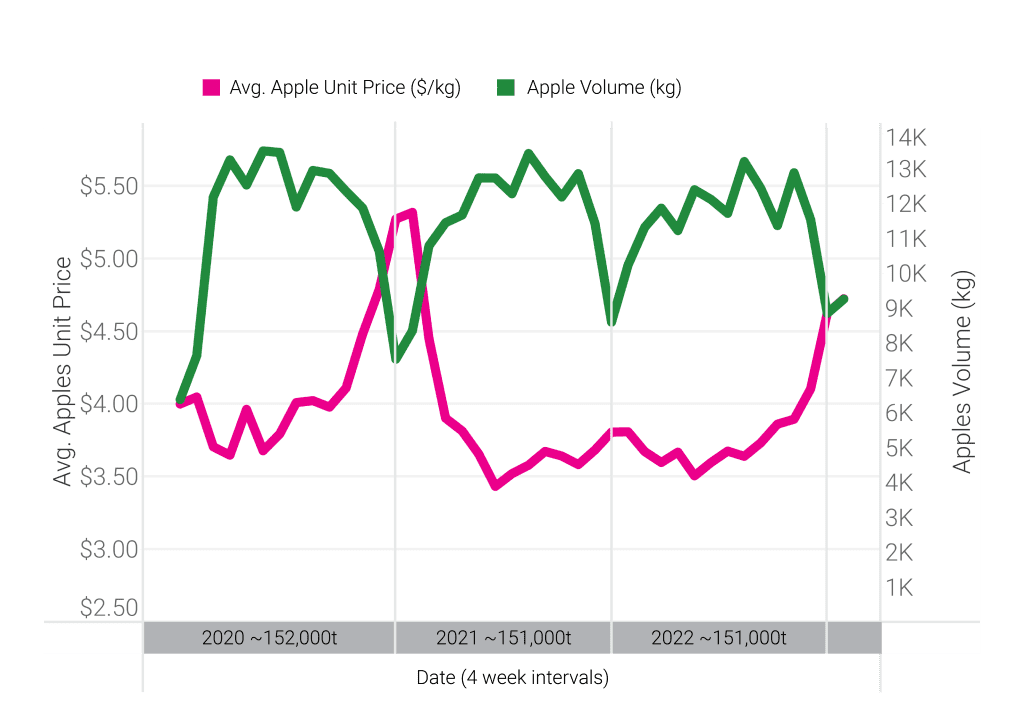
APAL calculation based in part on data reported by NielsenIQ through its Homescan Service for the fresh fruit category to 29 January 2023, for the Total Australian market, according to the NielsenIQ standard product hierarchy. Copyright © 2021, Nielsen Consumer LLC
Retail apple consumption has steadied in annual volume and become more consistent month to month over the past three years, however there have been shifts in popularity across varieties
What is in store for 2023?
The national apple crop in 2020 was affected by bushfires and hail, impacting Class 1 packouts and crop volume. As can be seen in Figure 1, by the end of the year prices had spiked to $4.28/kg, the highest average kilogram price for major retailers over the period recorded, and to $3.25/kg for wholesale markets, reflecting lower residual stock levels.
Class 1 volumes in 2021 were up some 15 per cent on the previous year. As can be seen in Figure 1, the volume being purchased at the end of 2021 is still well above the level at the same point in the two previous years, with the price low, consistent with higher than usual stock levels for the end of the year.
The Australian Apple and Pear Crop Estimate 2023, announced in early March, indicates a Class 1 apple crop of ~188,000t, ~6,000t more than the 2020 crop.3
While historical performance does not guarantee future performance, given these volumes, and assuming the steady apple purchasing trends highlighted above remain in place, it is not unreasonable to expect that apple retail and wholesale prices should be in line with or surpass the 2020 averages.
Sources
1. Harvest to Home, Retail Volume (KG) share of trade, NielsenIQ Homescan for the 52 weeks ending 14 August 2022, www.harvesttohome.net.au/fruitmushroomnuts/retailer-overview/apples.
2. Australian Apple and Pear Crop Estimate 2023, Nic Finger and Eric Zhang, FruitHelp.
3. The Australian Apple and Pear Crop Estimate 2023 referred to in this article does not take into account the Goulburn Valley hail event of 23 March 2023, the impact on production of which, at the time of going to print, is yet to be determined.
This article was first published in the Autumn 2023 edition of AFG.



