
Santa Rita harnesses data to power smarter decisions
Having timely data is at the heart of day-to-day decision-making for the Martella family in Western Australia.
Key points
- Timely decisions save money
- Data must be fit for purpose
- Make sure base data is accurate
Kirup grower Mark Martella recalls the point at which he knew the focus on getting timely data was really starting to pay off in cost savings to the bottom line at the family’s Santa Rita Orchards.
“We had just done a skim pick on our dwarf Pink Lady block because it had some colour issues and we went back to do a second pick,” Mark said. “We picked, I think five bins, and then Basil and I got together and looked at the numbers coming through and we said ‘nup, drop it, it’s costing us a fortune and the fruit is not that good anyway’.
“If we hadn’t had the data right there, we’d have got to the same decision eventually, but it wouldn’t have been until we’d had time to look through the data later and then it would have been ‘we shouldn’t have done that’.
“What it boils down to is decision-making. It’s knowing on the fly what we need to do, whether it’s chemical thinning, or trying to work out how long it should take to pick a block, or anything like that. You have to be able to have the information quickly to answer the question you are asking.”

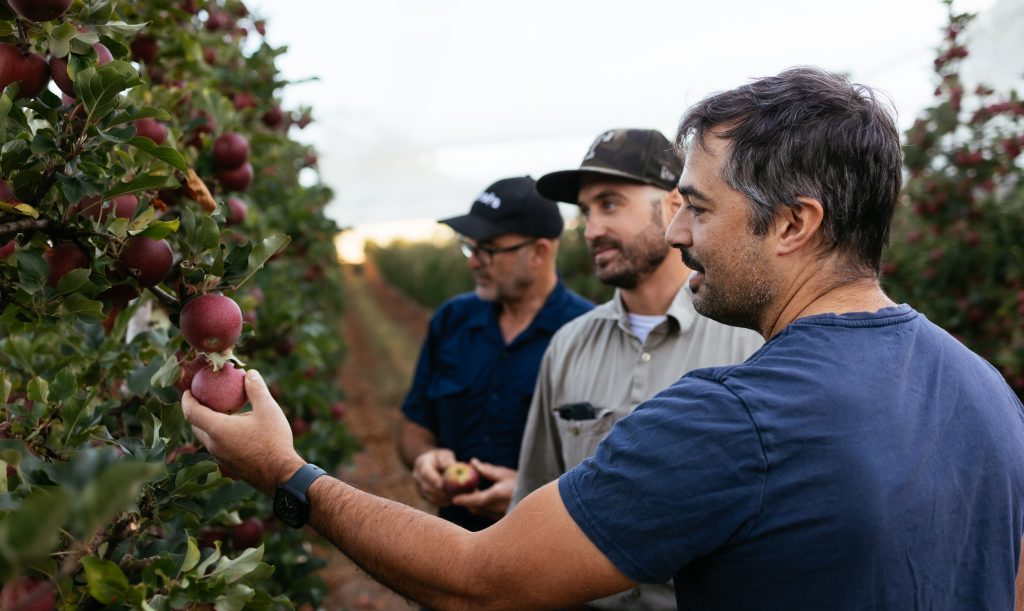
Instant access to data helps with estimating labour requirements and objectively assessing the merits and costs of different management options. Photo: Victoria Baker
That Mark, his father Terry and cousin Basil had the numbers needed to make that call in-orchard at the press of a button is the result of a collective mission to better harness data to improve business decision-making and profitability.
Longstanding innovators – Terry was awarded APAL’s Innovation Partner award in 2018 – Santa Rita had recognised the power in the growing levels of data demanded by banks and collected to track multiple grades and categories of fruit sold to retail. Terry said that, until recently, the time taken to crunch and interpret that data after it was collected was a barrier to it being useful for timely decisions.
“There’s a million different ways you can collect data,” Terry said. “Spreadsheets are great. But you end up with pages and pages of raw data. And it’s like raw food, you know, you can try and eat it, but it doesn’t go down too well. If you can’t use it, it’s a waste of time.
“Time, that’s the biggest killer. We’re all hands-on growers. So whatever time you spend sitting at that computer screen, something else is not getting done. That’s what has driven us to where we are now.”
Figures put fact into gutfeel
A review of the future of some once-profitable plum blocks, for which the export market had closed, proved a catalyst and the opportunity for Mark to apply his self-taught computer programming skills, automating the data-crunching to give Basil the numbers he needed to analyse.
Block data provides insights within a variety into which growing systems are working best. Photo: Victoria Baker
“I remember asking a question about the plums and Basil said ‘well, yeah, but it’ll take me six hours to get the information for that’,” Mark said. “I kind of stopped in my tracks and thought that’s our bread and butter, that question, we should know the answer at the click of a finger.”
Basil and Mark sat down to prioritise what they needed to see and how quickly they needed to see it. Mark then set to work writing a program that could ‘do Basil’s six-hour job in 10 seconds’ and enable them to make orchard decisions on the basis of the impact on profit/hectare.
“When you read the story the data is telling you, the next challenge is what you physically do about it,” Terry said.
“When you look at a business or a commodity that just doesn’t have the right bottom line and, if you are honest with yourself, you know you had the gut feeling it wasn’t good.
“I didn’t think they were making us that much money. But if you’re growing quite a few different commodities, one can be subsidising the other. When you’ve got some debt, you get razor sharp on that.”
The last block of plums was picked in February and will be bulldozed this year.
Earners and opportunities
As well as making clear which are the loss-making blocks that need prioritising for removal, Terry said block data also confirmed which were making the money, as well as providing insights within a variety into which growing systems were working best.
Santa Rita grows Granny Smith, Gala, Cripps Pink, Lady in Red, managed varieties ANABP 01 (marketed as Bravo™) and Italian-bred CIVG198 (Modì®) on systems ranging from central leader to high-density 2D Bibaum®.
The ability to view block data has proved a powerful tool for establishing linkages between management actions in one area and costs in another, pinpointing opportunities for cost savings.
“You start to notice all those little trends and how much they actually make a difference, especially crop loads,” Mark said. “The amount of fruit that one person can get just standing there without having to move just makes such a difference to how quickly they’re filling a bin.”
After first ensuring static data such as tree numbers, row spacing and hectares of each variety were up to date, Mark set out to identify baselines to easily assess whether tasks such as thinning and picking were being completed in a cost-efficient way.
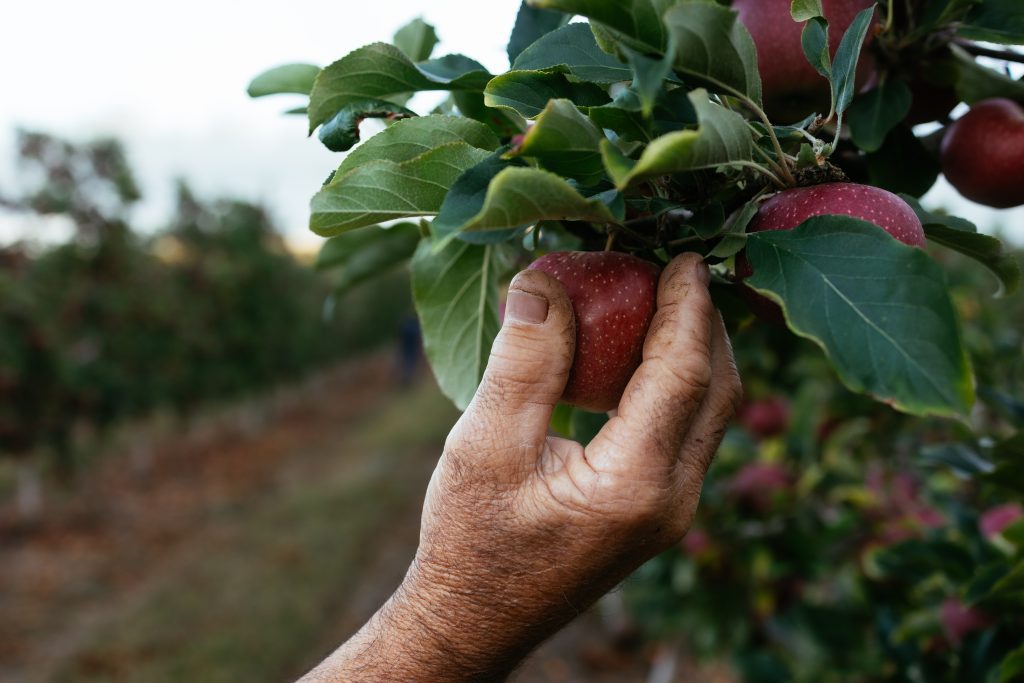
Santa Rita grows a number of apple varieties, including managed variety ANABP 01 (marketed domestically as Bravo®). Photo: Victoria Baker
“When we first started tracking the picking, we would just get a printout of everyone’s speeds for the day,” Mark said. “We needed to set a line to easily say: ‘Alright, these guys are above and beyond, this lot are okay, and these ones are no good, not just they’re all picking at the same speed’.
“We’re trying to do that with crop load, keeping track of the speeds and what we are paying per hectare,” Mark said. “The more of these 2D plantings we do, the easier it gets because it’s so uniform.”
Data is also now being used to identify the ‘sweet spot’ between crop load and packout at Santa Rita. By overlaying crop load data with historical summer pruning costs and doing fruit counts pre and post thinning, Mark said they would then have a crop load estimate from which they could estimate future labour requirements and costs.
“Once we get an accurate count of fruit while we are thinning, we’re hoping to get a lot more solid targets in order to be able to walk into a block and say ‘Right guys, we know what’s on the tree. We should be picking ‘x’ bags in a day’.
“At the moment, the data we get comes in at the end of the day because the phone signal is garbage. If that was live it would be awesome because data would come in at smoko or lunchtime. I’m looking for a way to do it more offline.”

Access to fit-for-purpose and timely data plays a key role in Santa Rita’s ability to evolve and remain sustainable. Photo: Victoria Baker
Although commercial orchard management programs do exist, Mark said with every growing business being different and the complexity of tracking returns from different grades and batches of fruit as well as picking costs back to block level, none were tailored for exactly what they wanted to do.
Innovate and evolve
Removing the plums might open an early season window for more Gala, Terry said, but with escalating costs and stagnant prices, continuing to find better, more cost-effective ways of growing fruit would be essential.
Having access to fit-for-purpose and timely data will play a key role in Santa Rita’s ability to evolve and remain sustainable.
“It has gotten tougher,” he said. “The apple business is not really returning enough for the way everything is going up around us. We’re a small grower. Even with the some of the better stuff, it is still not that good. Most businesspeople would look at that bottom line and say this is not worth doing. But we’re here.”
Further information
Read “Dive into data” from the Autumn 2023 edition of AFG: https://apal.org.au/dive-into-data/
This article was first published in the Autumn 2023 edition of AFG.



