
Ripening pears after 1-MCP treatment
Gordon Brown reviews Portuguese research investigating the use of 1-NAA to reverse the inhibition of ripening in pears caused by 1-MCP.
Apples and pears are climacteric fruit where, when mature, the fruit produces ethylene which acts on ethylene sensors causing the activation of many enzymes that cause fruit ripening. The plant growth regulator 1-MCP (SmartFresh™) has dramatically changed storage and marketing procedures of apples. It works by attaching to the ethylene sensors within the fruit such that ethylene cannot get to them and activate them to stimulate fruit ripening. This has been extremely effective at improving the storage and eating quality of apples.
While also effective on pears, problems often occur with fruit failing to ripen normally after removal from storage and on the supermarket shelves. This is not desired by most pear consumers and is particularly problematic for Packham pears, a major pear cultivar in Australia. To date, no reliable method of ripening pears after 1-MCP treatment has been identified.
The Portuguese pear variety Rocha is a significant commercial pear in Europe and has Protected Designation of Origin certification. Since the banning of DPA in Europe, 1-MCP has become important for preserving Rocha fruit quality during storage. Unfortunately, after 1-MCP application Rocha pears, like many pear cultivars including Packham, don’t go soft and juicy with the high levels of aroma favoured by consumers.
In this edition we will be looking at Portuguese research on the use of 1-NAA to reverse the inhibition of ripening caused by 1-MCP to allow for desirable pears to be marketed. This follows on from research that demonstrated that 1-NAA treatment of 1-MCP treated apples stimulates fruit ripening. 1-NAA is the same material that is used for thinning apples and pears at flowering, commonly available as a 20g/L product.
Method
In these trials pears were harvested from a commercial orchard at the optimal ripeness recommended by the grower. After a week in cold storage, all fruit were treated with SmartFresh, followed by cold storage for two months and then a further two months of CA storage.
After storage, fruit were either dipped in 1-NAA (0.75g/L) for two hours or left undipped. They were then kept at 20°C for 15 days which is the current industry practice to ripen pears prior to marketing in Portugal. As well as the 0.75g/L solution, a 0.37g/L solution was also tested but was not as effective so it will not be looked at in this article.
During the ripening process fruit were tested for ethylene production and the rate of respiration. After ripening the fruit colour, firmness, sugars and aroma – all characters that are inhibited by 1-MCP application – were measured.
Results
Figures 1 and 2 clearly show that dipping fruit in 0.75g/L of 1-NAA after storage dramatically restored the rate of fruit ethylene production as well as the rate of respiration by seven days after treatment. The increase in respiration is a response to the ethylene produced by the fruit and indicates that the blocking of ethylene sensor sites by 1-MCP has been overcome, allowing for normal fruit ripening. Therefore 1-NAA restored the fruit to its normal climacteric ripening process.
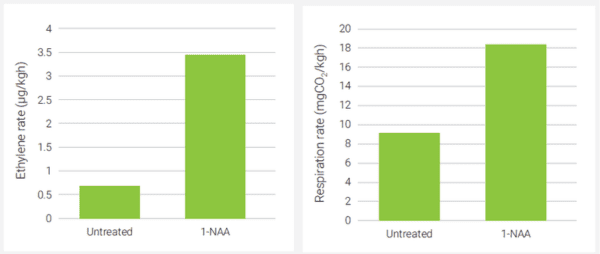
Figures 1 and 2: The rate of fruit ethylene production and the fruit rate of respiration at seven days after treatment with 0.75g/L 1-NAA.
Fruit colour, firmness and sugar content were measured after 15 days of ripening. Dipping of the fruit in 1-NAA caused a change in the colour of the pear skin from a green yellow to a desirable ripe yellow colour (Figure 3). At the same time, this treatment caused the firmness of the fruit to decrease to a desirable softness for the consumer (Figure 4). While the 1-NAA treatment did not have a significant impact on the levels of glucose, fructose or sorbitol sugars in the fruit, the treatment caused a four-fold increase in the level of sucrose in the pears (Figure 5).
Due to the 1-MCP treatment, the fruit not treated with 1-NAA did not substantially change colour, firmness or sucrose level during the 15-day ripening period, indicating the postharvest 1-MCP treatment was still blocking the normal ripening process of the fruit.
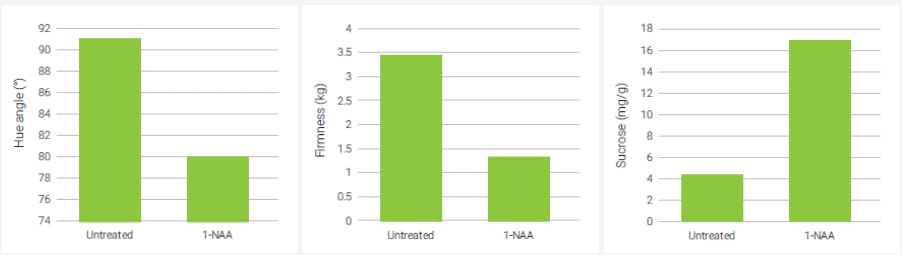
Figures 3, 4 and 5: The impact of 1-NAA on fruit colour, firmness and sucrose 15 days after treatment.
In addition to fruit colour, firmness and sucrose, the production of aroma compounds in pears does not recover after postharvest 1-MCP treatment. In this trial the total quantity of aroma compounds nearly trebled with the fruit dipped in 1-NAA (Figure 6). Nine of the thirteen aroma compounds detected increased, including those associated with ripe pear aroma. This occurred while four aroma compounds, including acetone and ethyl acetate, associated with off flavours in fruit decreased. Therefore 1-NAA dipping of fruit restored the ability of the fruit to develop the ripe fruit aroma.
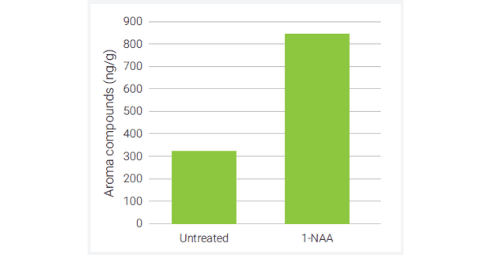
Figure 6: The total concentration of aroma compounds in 1-MCP treated and 1-MCP + 1-NAA treated fruit after 15 days of ripening.
While a treatment where pears were not treated with 1-MCP was not included in this trial, the authors do state that they have previously made measurements to characterise ripe Rocha pears. These earlier studies demonstrated similar responses in non 1-MCP treated fruit to those observed here for the 1-MCP plus 1-NAA treated fruit. This indicates that 1-NAA treatment after storage truly did restore the ability of the fruit to ripen normally.
This research indicates that post-storage dipping of 1-MCP treated pears in 1-NAA for two hours restored the typical ripening process of Rocha pears. As expected, 1-MCP treatment limited fruit ripening, evidenced by lower ethylene production, as well as reduced softening and yellowing levels in the fruit, as observed in other pear cultivars. Following treatment with 1-NAA, pears treated with 1-MCP softened to firmness levels characteristic of the eating ripe stage and had a desirable skin colour and aroma after being held at 20°C for 15 days.
Further research is now needed to confirm the reliability of this treatment and to develop a practical method of applying it.
Take home messages
- 1-MCP can cause problems with post-storage ripening of pears to consumer requirements.
- A post-storage dip in 0.75g/L NAA for two hours restores the ability of pears to ripen normally.
Further reading
“Recovery of ripening capacity in Rocha pears treated with 1-MCP through the application of 1-NAA: Physiological and molecular analysis insights”, https://doi.org/10.1016/j.plaphy.2025.109921
Supplementary data: https://ars.els-cdn.com/content/image/1-s2.0-S0981942825004498-mmc1.docx
This article was first published in the Summer 2025 edition of AFG.



