
Quality focus pays a premium at Priests
This article originally appeared in the Summer 2021 edition of AFG, available online here.
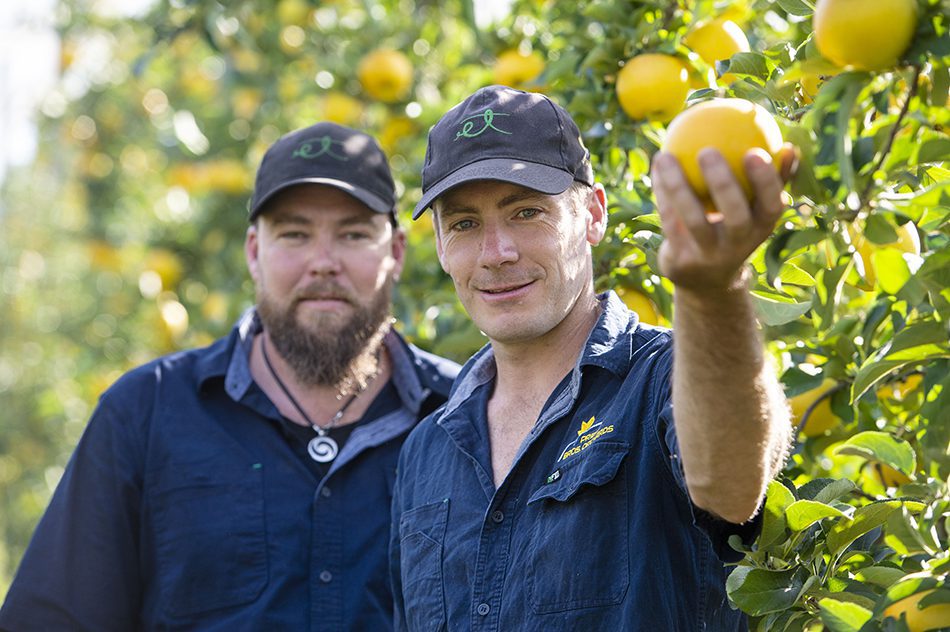
Shane and Paul Priest of Priest Bros, in a block of yello® apples in April 2021. Photo: Zoe Phillips / Newspix.
Key points
- Consumer focus
- Eating quality prioritised
- Packout goal of 98pc
Premium fruit commands premium prices and delivering it consistently is paying off for Victoria’s Priest Bros. Orchards.
A precision approach to producing top quality apples is rewarding the effort for Priest Bros. Orchards, delivering premium prices, good margins and market options.
Fourth generation Victorian growers, and brothers, Paul and Shane Priest, who market through their own Priest Bros. Marketing stall at Epping Wholesale Market and through agents in Brisbane, Sydney and Perth, are sharply consumer-focused, prioritising eating quality, setting target fruit sizes to match customer demand and thinning ‘aggressively’ to achieve consistency year in year out.
The result is packouts that are hitting 95 to 98 per cent and apples of good size, colour, appearance and great taste that attract a healthy premium.
Priest Bros. grows predominantly open varieties on 27 hectares at Pakenham, on the edge of the Gippsland region. Granny Smith is the main variety grown, alongside Golden Delicious, Fuji, high-colour cultivars of Gala (Galaval) and Cripps Pink (RosyGlow), and smaller plantings of two managed varieties, the early SweeTango® and yello®.
“The objective is to grow top quality fruit, the best we can grow,” said Paul, who manages the orchards.
“It’s got to be good because we want people to buy it week in week out. We’re doing it because we like to do it, but there’s a lot of a lot of work and effort that goes into it, so we do also want to see a reward at the end of it.
“Premium prices for a premium product.”

Paul Priest oversees a thinning team at the Pakenham orchard in early January. Photo: Darren James Photography.
Size over yield
Attention to detail right across the growing season is a key part of hitting the quality goal at Priest Bros.
“A lot goes into getting the desired piece of fruit we’re after,” Paul said. “It’s not just one thing. You can’t say it’s just thinning or just pruning, it’s a combination of all these things and just trying to do everything when it needs to be done.”
The orchards are fully-netted to the ground and a range of the latest tech is put to use to protect and enhance quality, with a bird laser, picking platforms and a defoliator all in use.
“Down this way everyone is netted, but still get bird damage,” Paul said. “We did the figures on a block and we were losing 10 apples a tree to birds. At a dollar an apple, that’s a lot of money. After one season with the laser, we were down to losing an apple a tree.
“Clearly it doesn’t pollinate as well under net. We have pollinators through the blocks – about every 12 trees – and we are importing bees every year to get as good a pollination as we can.”
The orchard is drip irrigated daily, with soil sensors in place, and fertilised every 7–10 days depending on the season.
Paul said using data to inform decisions was critical.
“With these dwarfing rootstocks, and the varieties we are currently growing, you have to know it down to the number,” he said. “The guesswork is gone now because a lot of these new varieties are so sensitive. If you have too much fruit on this year, you’re going to have nothing next year. You’ve got to get the consistency.”
Crop loads are tightly managed to avoid biennial variation and ensure consistency of yield and quality, year in year out.
“With what Paul is doing, we are not biennial and we don’t vary much,” Shane said.
Paul said they were using the Pixofarm mobile phone app to count fruit and measure size, backed up with manual measurement.
Fruit size rather than yield is the driver at thinning.
“We’re not doing anything different,” Paul said. “But with the sizing and numbers that we want on the tree we probably can afford to be a little bit more aggressive, because we know our customers want a big juicy apple and we’re targeting a lot bigger fruit than most growers.”

Paul and Shane Priest know their customers want ‘a big, juicy apple’ and manage crop loads tightly to ensure they meet customer demand. Photo: Zoe Phillips/Newspix.
Target sizes are variety dependant ranging in size from Pink Lady apples of medium count size 65/70 into the 90s to 54/60 for Golden Delicious and 44 to 50/54 for Fuji and yello.
“We know if we get size where it needs to be, then our fruit numbers on the tree are going to be where we need to be and the quality is going to be there. Then the yield just sort of falls into place,” he said.
“Yes, we can push for a higher yield, but we’re not going to get our size and it doesn’t fly then with the marketing side. You can’t get the quality every year. We can get 100 tonne, but we only pack 60 percent of that as premium and the rest is no good. But if we can get 70 or 80 tonne and pack 95 or 98 percent of that as premium we’re in front.”
Managed varieties
Paul and Shane work alongside parents Norm and Jeanine, while sister Tracey manages the accounts.
The orchards were first established in the 1880. Paul said the lower density orchards of 600–1000trees/ha were slowly being replaced by higher density modern systems, most at around 3500trees/ha to prepare for future mechanisation.
There is a mix of single row spindle, V-trellis and two-dimensional systems.
The 2 ha SweeTango block has been planted at 6500/ha – ‘our most intense yet’ – on a new V-shaped Eco Trellis to maximise light. Total block establishment including trellis, netting and trees cost a total outlay of around $200,000/ha.
“We’ve still got some older trees. We want to try and replace them to have everything so it suits platforms.
“We decided if we are going to do it, we have to do it properly, there is no point half doing it, so if we can’t afford to net or irrigate, we wait.”
Although open varieties are working well, Paul said they were trialling yello and SweeTango, both managed in Australia by Montague, to see how they performed.
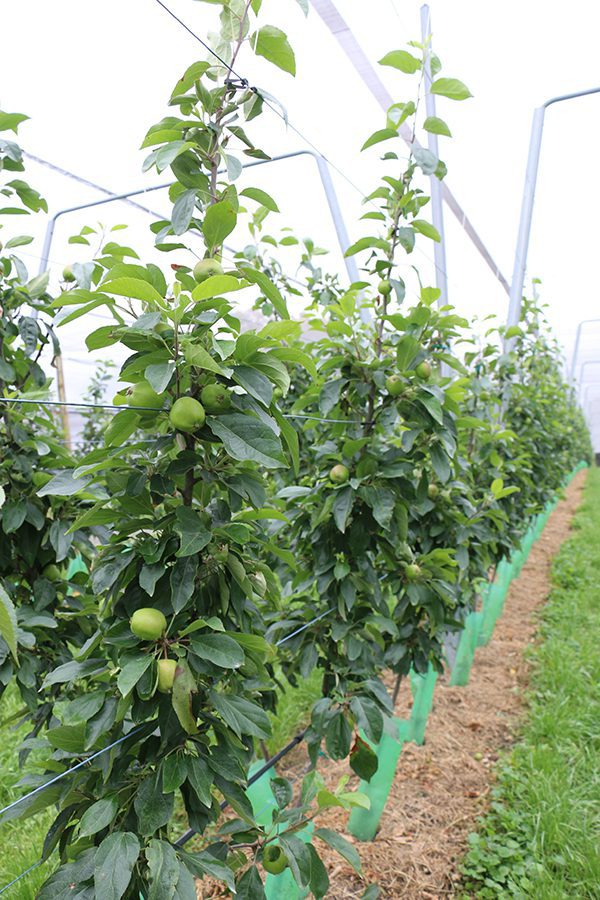
The new SweeTango® block is the highest density yet at Priests at 6,500 trees/ha, on a V-shaped Eco Trellis® to maximise light and fully netted.
As marketers, consumer experience plays a big part in the selection of new varieties.
“Do we think the product is going to be any good? Can you eat it? It has to be really good now because there’s just so many. If it’s just another red apple then why bother? That’s one reason we ran with the yello because there’s no other yellow apple out there. And it actually eats really, really well.
“There are huge crops around [of open varieties] so the price is not going to be great. With the club varieties it should be a set price within reason, so you sort of know what you’re going to get. We’re sticking with yello, and we are looking forward to seeing how SweeTango performs.
“There’s no point with any of these varieties putting in the work and the money if you are not going to get something out of them. We may as well grow more yello, or something we can do in one pick, where you don’t need to get the higher return to make the money and there is a lot less work involved.”
Getting quality right
…if we wouldn’t eat it, we don’t pick it… we wait… – Paul Priest
Priest Bros. moved to the wholesale market in 2008, having previously taken fruit to the growers’ market two days week.
Shane said being in the market all week gave continuity with buyers, increased sales, provided first-hand insights into what the market wanted and helped drive premiums.
“We are in the market, we are talking to customers, we know what quality we need to do, it keeps us on the ball,” he said.
He said premiums came from having top quality fruit and a reputation for consistently doing so week in week out and year after year.
“We aim to be in the top 10pc at the beginning of the year and stay there,” he said.
Fruit is graded and packed in Priests’ own packing shed, where a grader, locally-designed and made by Melbourne-based GP Graders, sorts for colour and size and internal defects.
Shane said some hand sorting of fruit coming off the grader was still used to ensure only the best-looking fruit reached the customer.
As well as their own fruit, Priest Bros. packs for a number of growers across Victoria, South Australia and Tasmania, packing around 15,000 tonnes a year.
All fruit is waxed, unless it is being packed for a grower for a supermarket line.
“It’s about presentation,” Shane said. “I can do a line of unwaxed fruit, and the same fruit waxed in the same box will bring $5–10/box more.”
But he said fruit that looked good had to taste good also.
“Good eating quality always brings people back,” Shane said. “It needs to look good too. If it doesn’t look good, it can be the best eating apple, but they won’t pick it up to start with. So, you want presentation first and foremost, and obviously you need a good eating apple for return sales.”
Paul said fruit was taste tested prior to harvest to ensure it was ready to eat.
“We have a philosophy that if we wouldn’t eat it, we don’t pick it,” he said. “We think we can store it as well as anyone, so we might wait and pick it a little later.”
Shane said the chase for early market premiums led to poor quality fruit hitting the market to the detriment of everyone.
“Quality is in the worst thing in our industry at the moment. People are saying we need to sell more fruit, but we need to pick better fruit. Don’t pick it too green, don’t pick it too early.
“If a customer picks up a piece of fruit at this time of year and they think Grannies are no good this year, or Gala is no good, it might be just one grower or one area, but it will be six to eight weeks before they pick up another piece.”
Coming season
Priest Bros. expects to start harvest with SweeTango in February, finishing with Pink Lady apples in May with both labour and Covid-19 again looming as harvest issues.
The defoliator will take some pressure off labour required for removing leaves to improve colour which had previously been done by hand.
“The machine did more in an hour that 12 people could do in a day. The savings were huge,” Paul said.
Priest Bros. has traditionally paid hourly rates but Paul said this year would look at paying piece rate in some circumstances to manage labour availability.



