
Poor-performing pears pushed as Redland turns to export for new Dazzle
Pushing out just under a quarter of their orchards in 2023 was a big decision for Goulburn Valley-based Redland Apples, but it was also a sound business one – they were losing money.
Sharing insights at the recent Future Orchards® winter orchard walks into the company’s decision to push out 200 hectares of predominantly pears, Redland Apples General Manager Brent Reeve said it wasn’t hard to justify.
“The returns from pears weren’t covering the costs of growing and harvesting them,” he said. “Our overhead costs alone were $11,000 per hectare; pruning costs were $3,000/ha, chemicals and fertiliser $3,000/ha and thinning at up to $6,000/ha. The cost of removal has been $6,000/ha, versus the growing costs to harvest and the potentially low return.”
Blocks were assessed for profitability as part of the purchase in 2023 of the long-standing Geoffrey Thompson (Jeftomson) business by Redland Premium Fruit. The new investors had no interest in retaining blocks dragging down business returns, with little or no prospect for improvement. A further 70ha of non-profitable Gala, Red Delicious and Granny Smith apple blocks were removed over winter this year.
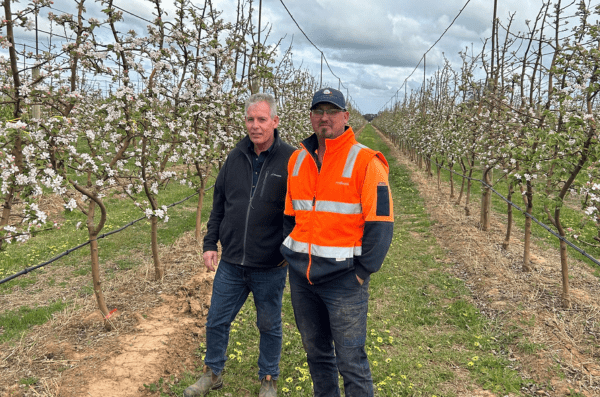
Redland Apples General Manager Brent Reeve and Merrigum Orchard Manager Cliff Bramich in a five-year-old Dazzle™ (PremA129) block. Image – Supplied.
Brent said in identifying unprofitable blocks for removal, he had looked at variety, packouts, row width, missing trees, historical tonnes/ha and whether there was opportunity for improvement.
Compounding poor productivity, he said, pear prices – impacted by the decline of the once-significant cannery market which had pushed more pears onto the domestic market – had remained low. Not all pears were pushed. Twenty hectares of Packham pears planted as a central leader system at 1,000 trees/ha were kept.
“They are planted under netting so have a better Class 1 packout and yield between 60 and 70 tonnes per ha,” Brent said.
He said there were still some marginal older blocks of Cripps Pink that might be removed, and the goal for future block renewal was 5–10 per cent a year. The length of time an underperforming block was kept depended on its ability for improvement.
“We are looking at a minimum of 45 tonnes per ha of Gala with an 80 per cent Class 1 packout and a 60 tonne minimum for other varieties,” he said.
Growing for the consumer
Redland has export markets in Asia squarely in its sights, with new plantings chosen for their appeal to the Asian consumer and the opportunity to diversify away from the oversupplied domestic market.
PremA129 (marketed as Dazzle™) and PremA093 (marketed as Sassy™) were both bred by the New Zealand Plant and Food Research breeding program, which is also responsible for the varieties behind such well-known apple brands as Jazz™, Envy™ and Rockit™.
First selected from trial plantings, Dazzle and Sassy have been grown in the Redland orchards since 2018 and 2019 respectively, when they were licensed in Australia to former owner Jeftomson.
The two varieties have performed well in the region, colouring through the high 30-degree summer heat, supported by overhead foggers to reduce sunburn and tree stress, and leaf blowers to assist colour development.
Expansion of the Sassy area is already underway with 30ha planted as a high-density, narrow Bibaum® canopy at 3.5m (row) x 1.2m (tree) spacing under nets and foggers. From 2025 Brent said rows would come in further to 3m for a more cost-effective canopy that could still be easily managed.
Rootstocks are predominantly CG202 and the main variety is alternated with a full row of a high-colour Cripps Pink strain polliniser every seventh row aimed at improving pollination.
Brent said Sassy was achieving 60t/ha and Dazzle 70t/ha, but crop load is tightly managed for quality and to hit the optimum size profile of 80 to 85mm for the best return.
“We monitor crop loading from pruning right through to harvest, with bud/fruit counts done at pruning, pre-thinning and post-thinning, and fruit size monitored throughout the growing season with Aerobotics,” Brent said. “Hitting the correct size for the market we are looking at supplying is extremely important.”
Export market development is a notoriously fickle and painstaking process, but Brent said early signs were promising. The first containers of Dazzle were exported to Thailand this year following on from a New Zealand program and achieved strong pricing, with returns back to the orchard ‘more than matching’ domestic returns.
This article was first published in the Spring 2024 edition of AFG.



