Plant pest surveillance goes mobile in the Adelaide Hills
In early spring, a new, smart plant pest surveillance tool was deployed in its first ever trial in an apple orchard in South Australia’s Adelaide Hills. This new technology is part of a suite of mobile surveillance units developed in a step towards a nationally coordinated approach to plant pest surveillance aimed at informing grower pest management and providing early detection and improved market access.
The ‘Sentinel’ mobile unit is part of a nationwide R&D collaborative initiative between Australia’s major plant industries with the goal of developing a way to rapidly monitor and report the presence of airborne pests and diseases for multiple agricultural sectors, including viticulture, grains, cotton, sugar, forestry and horticulture.
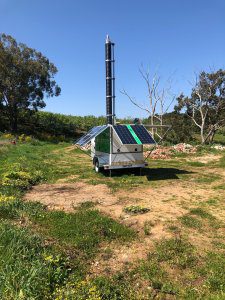
The mobile Sentinel unit is being developed to detect disease spores and insects to provide an early pest surveillance and warning system.
This Sentinel unit is the second in a suite of smart surveillance units developed by Primary Industries and Regions South Australia’s research division, the South Australian Research and Development Institute (SARDI), as part of the iMapPESTS program. The suite of six Sentinels has been adapted to provide a more-effective, flexible range of options to meet various industry needs. The units’ range in size, deployment method (trailer, skid, modular unit) and composition of traps and other features (see imappests.com.au for more information). These features are being explored to cater to different environments and industry requirements and will be deployed at strategic locations around the country in 2021 for trialling.
The Sentinel unit is equipped with several airborne samplers, power supply, a climate sensor, telemetry and an industrial computer to remotely control and m
onitor the unit, including automated robotics to change pots on the samplers according to the day or capture criteria.
Sentinel 2 is a revised prototype that features three different air samplers:
- Two spore samplers, which are high-volume air samplers specifically designed to collect airborne spores
- A two-metre insect suction trap to monitor localised insect dynamics
- A six-metre insect suction trap, for monitoring of long-distance migratory insect flights
Adelaide Hills surveillance
The mobile nature of the Sentinel units enables the surveillance technology to provide localised information that impacts a specific region, which might not apply to growing regions in other parts of the country. To explore the dynamics of pest and disease pressure pome fruit orchards, the iMapPESTS team consulted with local growers services in the Adelaide Hills region to identify an orchard to trial a Sentinel unit in its first pomefruit pest surveillance trial. With the diverse range of crops grown in the region, the unit can monitor for targets across multiple horticulture industries.
Gully View Fruits apple grower, Louis Chassiotis, welcomed a trial of the smart surveillance tech in his orchard during the crucial early spring period when pest and disease management is a high priority.

Louis also grows strawberries and has worked with Biological Services to implement an IPM program to manage pest and diseases in the patch and is now working with DJ’s grower services to develop an IPM program in his apple orchard. Louis highlighted codling moth as a high priority for control this season. This provided an opportunity for iMapPESTS researchers to trial a real-time imaging lure-trap for monitoring pests such as codling moth. One of these devices was installed alongside the Sentinel unit at the Carey Gully orchard and data was compared with traps placed within the orchard to understand the spatial dynamics of codling moth flights in and around an apple orchard. In addition to the lure-based traps, iMapPESTS reported the presence and prevalence of green mirids and western flower thrips to agronomists to support their pest management.
Over the remainder of the iMapPESTS program, the R&D initiative hope to deploy Sentinel units in several trials across Australia’s growing regions, sharing information growers can use to support decision-making in the orchard. It is hoped that by providing access to timely information about pest and disease dynamics, growers can reduce the number of pesticide and fungicide applications, save money, and reduce growing agrichemical resistance. By the end of the project in 2022, the team hopes to have a demonstrated a proof-of-concept surveillance system that is suitable to different regions and supported by the appropriate rapid diagnostic tests for key insect pests and pathogens across industry sectors.
The outcomes of the plant pest surveillance trial at Gully View Fruits are available on the iMapPESTS website (www.imappests.com.au). Growers are encouraged to contact iMapPESTS Communication & Extension coordinator, Shakira Johnson, to express their interest in the project and stay up to date on where and when the sentinels will be deployed in their region.
Further information:
Sentinel a step towards national pest surveillance (Feb 2020)
iMapPESTS website www.imappests.com.au
Project contact:
Shakira Johnson
Communication and Extension for iMapPESTS
M: 0433 937 564
Acknowledgement: iMapPESTS is supported by Hort Innovation, through funding from the Australian Government Department of Agriculture as part of its Rural R&D for Profit Program and AgriFutures Australia, AUSVEG, CSIRO, Cotton Research and Development Corporation, Forest & Wood Products Australia, Nursery & Garden Industry Australia, Plant & Food Research, Rothamsted Research, PIRSA-SARDI, Sugar Research Australia, DJPR, the Western Australian Department of Primary Industries and Regional Development, Wine Australia and Burkard Agri Limited.