New national report on Australia’s pollination system
Australia’s pollination system could face a shortfall of commercial honey bee hives during peak pollination periods, according to a new national report.
The Pollination Security Status Report 2026, published by the Wheen Bee Foundation, identifies growing pressure on Australia’s pollination system, with new modelling showing how Varroa mite and rising demand for pollination services could widen gaps between hive supply and crop requirements in key agricultural regions.
Wheen Bee Foundation Chair Peter Knoblanche said the report provides an integrated national holistic assessment of pollination in Australia.
“This is the first time Australia has looked at pollination as a whole system, not just for agriculture, but also for biodiversity, ecosystems and socio-cultural values,” Peter said. “Pollination is often invisible because when it works, everything functions as expected. Yet it is essential to Australia’s food production, natural environment and the economy.”
He said the findings highlight the need for coordinated long-term planning.
“The new modelling in this report is a major step forward. For the first time, we can begin to understand the scale of future pressure on Australia’s pollination system as Varroa mite impacts both feral and managed honey bee populations.”
The modelling compares demand for pollination services from key horticultural industries with the estimated availability of managed honey bee hives during peak flowering periods.
One scenario modelled in the report, based on the US experience, suggests Australia could face a shortfall of 290,000 commercial honey bee hives during peak pollination periods across eastern Australia if feral populations decline and managed hive numbers fall significantly.
“The scenarios in this report highlight why Australia needs coordinated planning, investment and action to strengthen pollination security and prepare for future risks.”
Peter said the report marks an important step toward a coordinated national approach.
“What excites us most is that Australia finally has a baseline. It’s an evidence base to move into the consultation phase of the Australian Pollination Strategy with far greater clarity and focus.
“The consultation phase will be critical in testing assumptions, gathering additional evidence and ensuring the final strategy reflects practical experience from across Australia.”
Everyone involved in pollination, including apple and pear growers, is invited to contribute to the development of the Australian Pollination Strategy.
Visit pollination.org.au to read the Pollination Security Status Report 2026 and to submit feedback for the Australian Pollination Strategy.
A case study from Bilpin
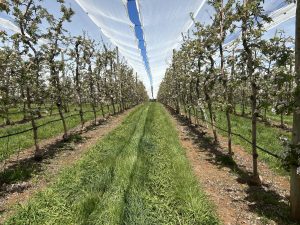
In 2025, orchards in Bilpin, NSW, experienced a severe pollination failure, with some apple crops reduced to less than 5 per cent of average yield. The pollination failure affected multiple orchards across the region and had significant impacts on local fruit production.
Research and local observations indicated that Varroa mite had significantly reduced feral bee populations in the region, while cool weather limited the activity of native stingless bees.
Although managed hives were introduced for pome fruit, pollination remained poor, with evidence suggesting that surrounding eucalypts may have diverted bees away from orchard crops. It was also observed that self-pollinating quinces produced normal yields, while non-self-pollinating apples largely failed.
The Bilpin case demonstrates the vulnerability of Australian agriculture to pollinator declines and highlights the growing need for reliable managed pollination services, stronger pollinator resilience and increased beekeeper capacity following the loss of feral bee populations.
Source: Pollination Security Status Report 2026
About the Australian Pollination Strategy
The Australian Pollination Strategy is a five-year national initiative led by the Wheen Bee Foundation in collaboration with industry, research institutions, environmental organisations and government stakeholders. The project aims to strengthen pollination security through improved coordination, evidence-based planning and long-term strategic action across both agricultural and natural systems.
Acknowledgement
The Australian Pollination Strategy project is being funded by The Ian Potter Foundation, along with support from Hort Innovation, Australian Farming Services, Stahmann Webster and Fresh Country Farms. The project has also received support from Bush Heritage Australia, Plant Health Australia, Australian National University, Australian Honey Bee Industry Council, University of Sydney, Monash University, CSIRO, AgLive, Australian Seed Federation, Berries Australia, Northern Territory Government, Beechworth Honey, Australian Native Bee Association, Balliang Consulting and Hive IQ.