Making the most of our tiny egg parasitoids
Research results suggest that two species of Trichogramma could be important for controlling LBAM and codling moth in Australian apple and pear orchards.
One way of maximising grower profitability through optimal pest and disease management is to enhance the impact of beneficial insects such as egg parasitoids, while reducing pesticide inputs.
Biocontrol agents such as Trichogramma can provide valuable pest management services during flowering and subsequent fruit development. This may require the release of multiple species to control pests and the judicious use of pesticides. Agriculture Victoria’s research, undertaken throughout iterations of the PIPS program, has highlighted the importance of understanding the role of existing parasitoids in apple and pear orchards, and how habitat manipulation – for example, through orchard floor management – and integrated pest and disease management (IPDM) can support populations.
Egg parasitoids of the family Trichogrammatidae have been successfully used worldwide as biocontrol agents of pests in the family Lepidoptera (Hassan 1993; Desneux et al. 2010; Tabone et al. 2010). Two of these tiny parasitoids, Trichogramma carverae and Trichogramma pretiosum, are sold commercially in Australia to control light brown apple moth (LBAM; Epiphyas postvittana) and codling moth (Cydia pomonella). Of these two parasitoids, T. pretiosum is known to parasitise the eggs of both codling moth and LBAM, while T. carverae is effective against LBAM eggs (Li 1994; Paull and Austin 2006). However, T. carverae is also claimed to control codling moth, despite there being little to no quantitative evidence of the efficacy of T. carverae against codling moth eggs.
Agriculture Victoria assessed the potential contribution of T. carverae to codling moth control by conducting replicated laboratory experiments with both codling moth and LBAM. The research confirmed that codling moth is a suitable host for T. carverae under laboratory conditions. Indeed, percent parasitism of codling moth eggs and those of LBAM, a known host, were not statistically different. Furthermore, the number of emerged codling moth or LBAM larvae from eggs exposed to T. carverae was almost zero. Trichogramma are known to use egg contents as a food source as well as for parasitism, hence a combination of parasitism and egg feeding may have contributed to the very low larval emergence from both host species. The results suggest that both species of Trichogramma could be important for controlling LBAM and codling moth in Australian apple and pear orchards.
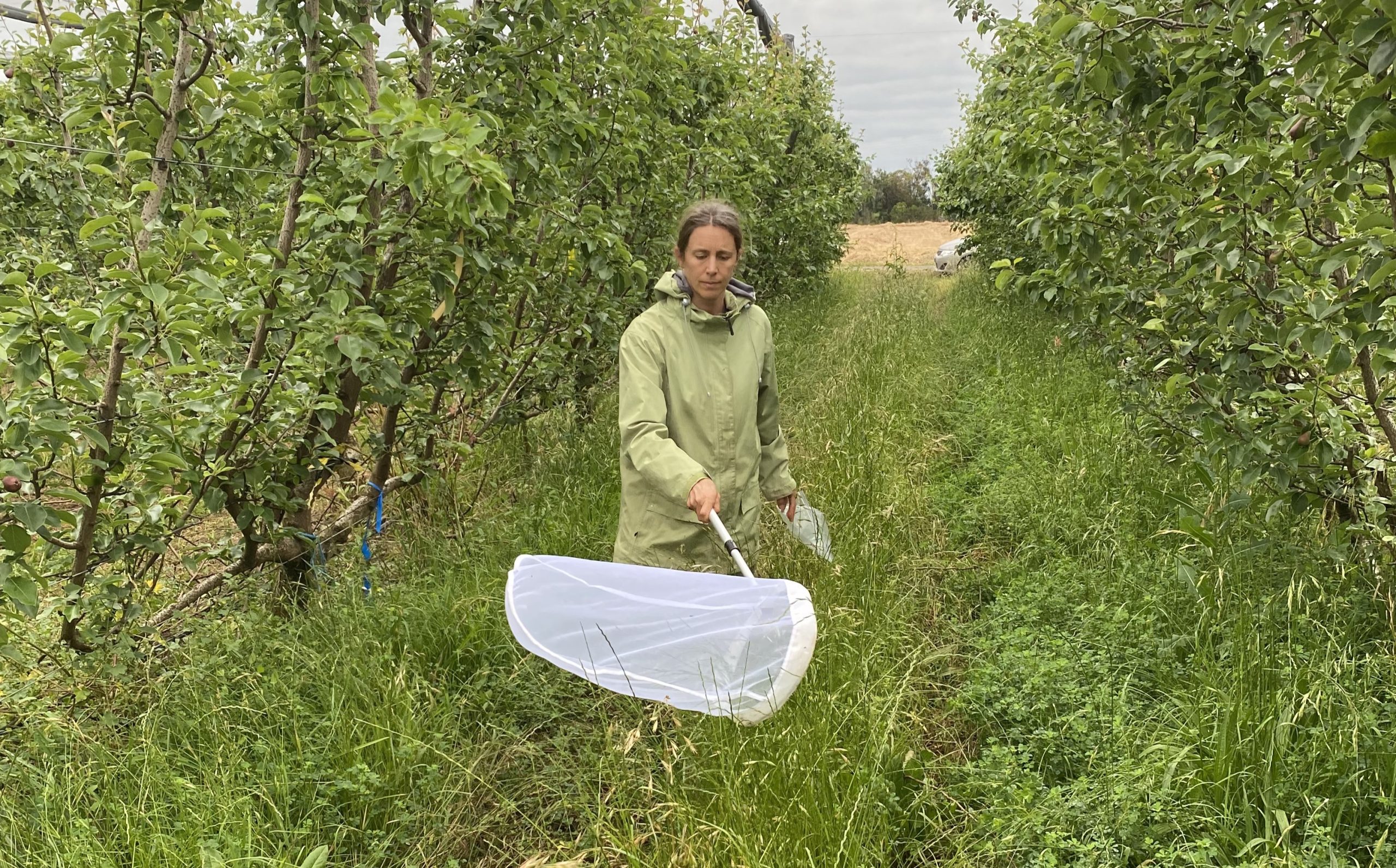
Agriculture Victoria’s Dr Alana Govender sampling for Trichogramma and other invertebrates.
In PIPS 4 Profit, Agriculture Victoria is extending Trichogramma research to Western Australia and conducting releases of T. pretiosum and T. carverae in experimental orchards. Baseline monitoring of LBAM populations by Pomewest is already underway alongside the establishment of different orchard floor management treatments. Orchard floor management includes the provision of flowering plants that provide food and shelter for beneficial insects such as parasitoids. Learning what conditions or treatments favour beneficial insects such as Trichogramma, but not pests, can give growers greater confidence when making IPDM decisions.
Monitoring of an orchard floor management experiment at Agriculture Victoria’s Tatura SmartFarm has revealed unexpected diversity among the Trichogramma taxa occupying the orchard. Using vacuum sampling and DNA barcoding methods, we found the egg parasitoid Trichogrammatoidea cryptophlebiae occurring within the inter rows. This was a first for the orchard and, to our knowledge, T. cryptophlebiae has not previously been recorded anywhere in Victoria. Trichogrammatoidea cryptophlebiae parasitises the eggs of tortricid moths and is sold commercially for the biocontrol of the macadamia nutborer (Cryptophlebia ombrodelta) in northern NSW and Queensland. It’s not known whether the presence of T. cryptophlebiae in Victoria was due to an unintentional introduction (for example, through misidentification or as a contaminant in the release of one of the other Trichogramma species); as an intentional, unrecorded release in the local area; or through natural spread from NSW. The parasitoid has been shown to parasitise codling moth in laboratory experiments (Kaspi et. al 2019) but its potential for controlling codling moth in Australian apple and pear orchards is not known. The contribution of T. cryptophlebiae to general pest control within apple and pear orchards and possible synergistic relationships with the other apple and pear orchard Trichogramma species (T. pretiosum and T. carverae) requires further investigation.
This work is just one component of an extensive program of research underway through the PIPS 4 Profit program’s Pest and disease management (AP22001) project. The project is also releasing and assessing Mastrus ridens, a highly specialised parasitoid of codling moth, in Victoria, NSW, South Australia and Tasmania; supporting a PhD into biological control and orchard floor management at the University of Tasmania; and investigating possibilities for biocontrol of disease-causing pathogens.
Keep up to date with the activities of the Pest and disease management (AP22001) project by visiting apal.org.au/projects/ap22001.
This article is based on new research planned in the PIPS 4 Profit program’s Pest and disease management (AP22001) project and information published in the final report of the PIPS 3 program’s Strengthening cultural and biological management of pests and diseases in apple and pear orchards (AP19002) project, available for download from Hort Innovation at horticulture.com.au/growers/help-your-business-grow/research-reports-publications-fact-sheets-and-more/ap19002.
Acknowledgement
 The PIPS 4 Profit program’s Pest and disease management (AP22001) project has been funded by Hort Innovation, using the apple and pear research and development levy, contributions from the Australian Government and co-investment from Agriculture Victoria. It is supported regionally by the Tasmanian Institute of Agriculture, Pomewest and NSW Department of Primary Industries. Hort Innovation is the grower-owned, not-for-profit research and development corporation for Australian Horticulture.
References
Desneux N, Wajnberg E, Wyckhuys K, Burgio G, Arpaia S, Narváez-Vasquez C, González-Cabrera J, Ruescas D, Tabone E, Frandon J, Pizzol J, Poncet C, Cabello T and Urbaneja A (2010) “Biological invasion of European tomato crops by Tuta absoluta: ecology, geographic expansion and prospects for biological control”, Journal of Pest Science, 83:197–215.
Hassan S (1993) “The mass rearing and utilization of Trichogramma to control lepidopterous pests: achievements and outlook”, Pesticide Science, 37:387–391.
Kaspi R, Steinitz H, Nemny-Lavi E, Lebedev G, Melamed E and Gazit Y (2019) “Nontarget host risk assessment of the egg parasitoid Trichogrammatoidea cryptophlebiae (Hymenoptera: Trichogrammatidae) for classical biological control of the false codling moth (Lepidoptera: Tortricidae) in Israel”, Journal of Economic Entomology, 113(2):1023–1027, https://doi.org/10.1093/jee/toz327
Lefoe G, Hossain M, Rahmani H, Govender A and Kwong R (2023) Technical Report: Biological control of key apple and pear pests using Trichogrammatidae parasitoids, accessed 8 July 2024. https://www.horticulture.com.au/globalassets/laserfiche/assets/project-reports/ap19002/ap19002-final-report.pdf
Li L (1994) “Worldwide use of Trichogramma for biological control on different crops: a survey” in Wajnberg E, Hassan S (Eds) Biological Control with Egg Parasitoids, CAB International, Wallingford, 37–54.
Paull C and Austin A (2006) “The hymenopteran parasitoids of light brown apple moth, Epiphyas postvittana (Walker) (Lepidoptera: Tortricidae) in Australia”, Australian Journal of Entomology, 45:142–156.
Tabone E, Bardon C, Desneux N and Wajnberg E (2010) “Parasitism of different Trichogramma species and strains on Plutella xylostella L. on greenhouse cauliflower”, Journal of Pest Science, 83:251–256.
This article was first published in the Spring 2024 edition of AFG.