
How many leaders are ideal in an apple orchard?
Gordon Brown reviews research investigating early performance of multi-leader apple training systems in Korea.
When planting a new orchard, a large consideration has to be made for what sort of tree training system you are going to use. With existing and future orchard automation in mind, a 2D or fruiting wall approach is sensible. However, do you select a slender spindle tree at a large number of trees per hectare or a multi-leader system such as 2-axis (Bibaum®) with slightly fewer trees per hectare?
Research has been conducted in South Korea on the early performance of slender spindle trees versus 2-, 4- or 6-axis trees at lower tree densities. This trial used Fuji trees on M9 rootstocks. While this study only looked at the first four seasons after planting, research reviewed in the Spring 2021 edition of AFG showed that high yields with dense plantings continue as the trees mature.
Method
The nursery trees used in the trial varied with the training system to be used. For the slender spindle system, nursery trees had a single main stem about 1.8m tall. For the multi-leader systems, 2-axis nursery trees were used that were between 1.4 and 1.5m tall and shoots were trained to provide two, four or six leaders in the first season, as outlined in Table 1.
Table 1: Nursery tree and planting specifications.
| Nursery tree | Tree spacing (m) |
Tree density (trees/ha) |
Vertical leaders (#/ha) |
Leader spacing (mm) |
|
| Slender spindle | Rod | 3 x 1 | 3330 | 3330 | N/A |
| 2-axis | 2-axis | 3 x 1.2 | 2770 | 5540 | 600 |
| 4-axis | 2-axis | 2.8 x 1.6 | 2230 | 8920 | 400 |
| 6-axis | 2-axis | 2.8 x 2.4 | 1480 | 8880 | 400 |

Figure 1: A multi-leader tree in Stanthorpe, Queensland.
While data was collected for the four seasons following planting, this research review will predominantly focus on the fourth season. For the full data refer to the online paper here: hst-j.org/articles/xml/O9aa/.
Results
Tree vigour
This trial identified that the most vigorous trees were those of the slender spindle training system (Table 2). As expected, with each increase in number of leaders per tree there was a reduction in the tree vigour. If a pedestrian orchard is desired, then, on the basis of tree height only, the trees with six leaders were within reach from the ground. This is despite the 4-axis trees having a higher number of leaders per hectare which should have provided greater tree-to-tree competition and hence more compact growth. This may be a reflection of the 6-axis trees being the most modified from the 2-axis nursery trees, potentially delaying their orchard development. This is real data; however, as it is not possible to obtain 6-axis trees directly from nurseries, they will always need to be developed in the orchard.
Table 2: Fuji tree vigour after four seasons of growth with increasing number of leaders.
| Tree height (m) |
Leader cross-sectional area (cm2) |
Shoot/feathers (#/tree) |
|
| Slender spindle | 3.25 | 9 | 76 |
| 2-axis | 3.10 | 5 | 125 |
| 4-axis | 2.95 | 3 | 160 |
| 6-axis | 2.10 | 1.8 | 114 |
Light interception
Light interception of the trees was measured at noon on the north–south facing rows. After four years of growth the light interception of the slender spindle, 2-axis and 4-axis treatments were all at about 35 per cent, while the 6-axis trees were lower at 25 per cent, reflecting the reduced tree height and number of feathers on these trees.
Fruit yield
This is a critical consideration when deciding on the training system to use. In this trial, initially the 4- and 6-axis training systems did not perform as well as the 2-axis and the slender spindle trees, which may be a reflection of the need to develop additional leaders on these trees in the first season after planting (Figure 2). However, the 4-axis system developed without difficulty and by the fourth year after planting had the highest yield of the four training systems. By the end of the trial the 2-axis and slender spindle were still similar and there was a poor yield from the 6-axis trees. On a cumulative yield basis for the first three harvest seasons, the 4-axis training system had the highest yield (104t/ha), 14 per cent greater than the slender spindle, while the 2-axis training system yielded 99t/ha, 8 per cent greater than the slender spindle.

Fruit quality
In the fourth season no meaningful difference was found for fruit weight, firmness, sugar content or acidity between the training systems. There was, however, a dramatic impact of tree training system on fruit colouration.
Looking at the percentage of fruit with more than 80 per cent colouration (Figures 3 and 4), the slender spindle trees had just under 60 per cent of their fruit with excellent colour and the poorly coloured fruit was dominantly in the lower metre of the tree. While this is a poor result it must be remembered the use of reflective cloth would dramatically improve fruit colouration within this zone. The multi-leader tree training systems, however, without the use of reflective cloths, produced fruit with superior colouration, with the 2-axis system being marginally better than the systems with additional leaders.
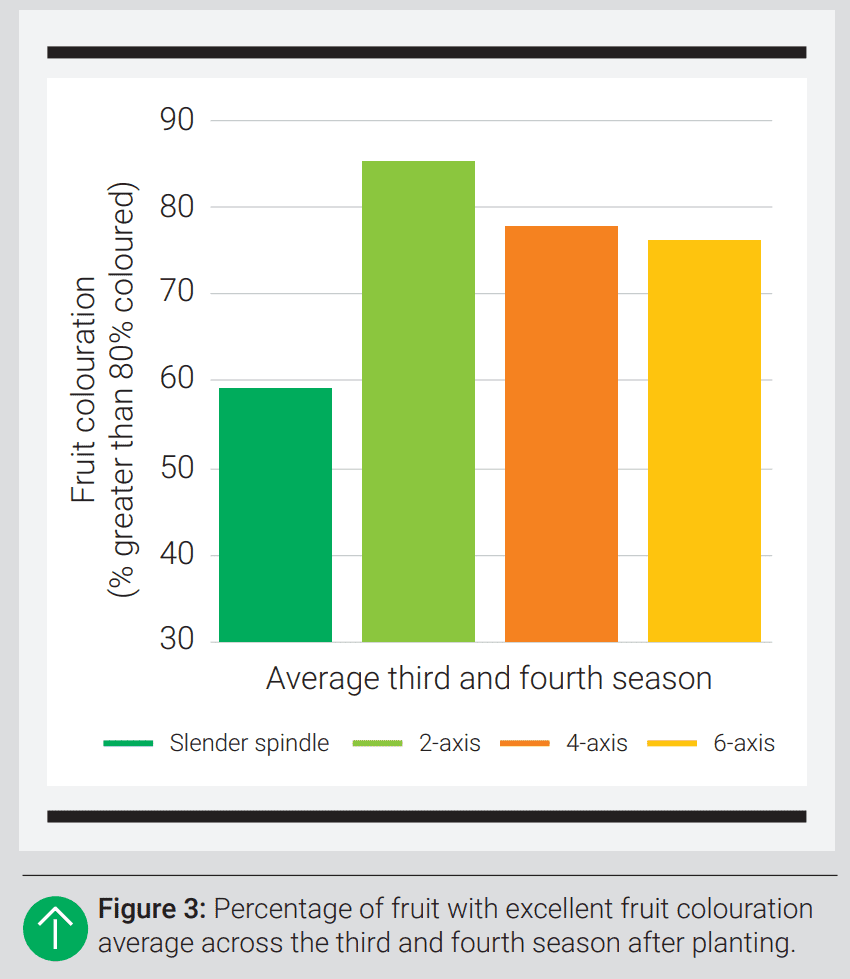
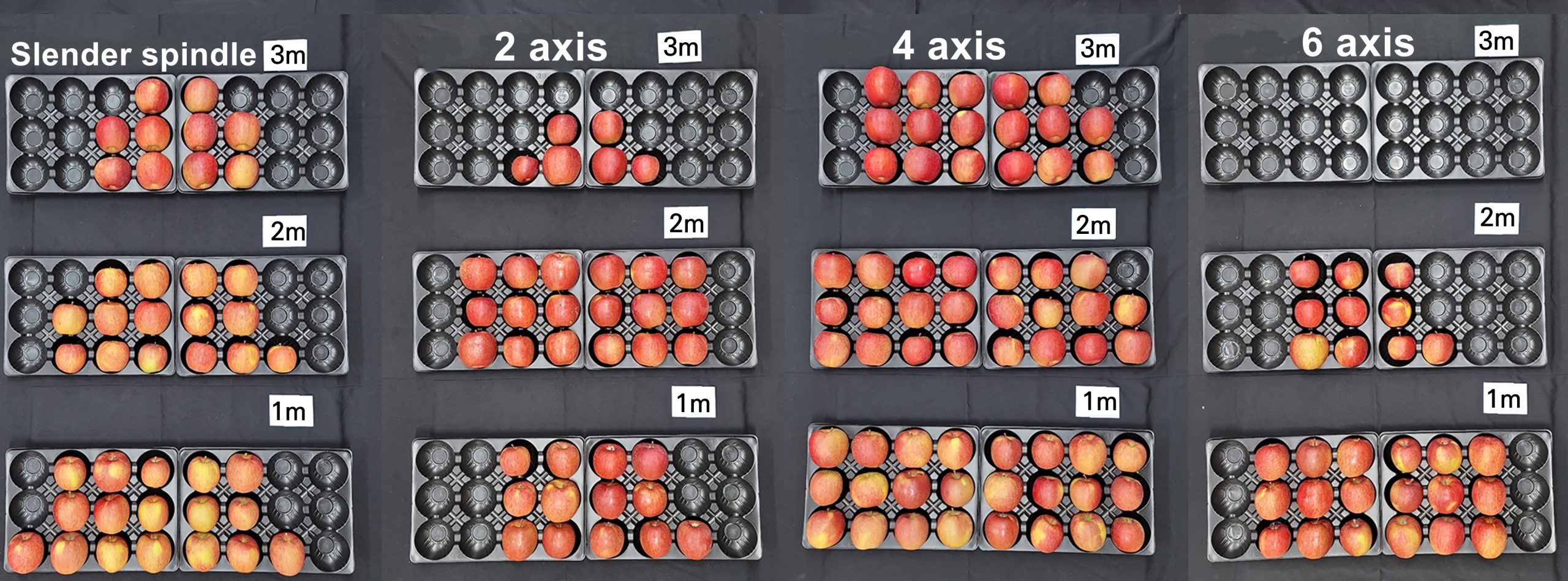
Figure 4: Colour of fruit with height in canopy for the four tree training methods in the fourth season after planting.
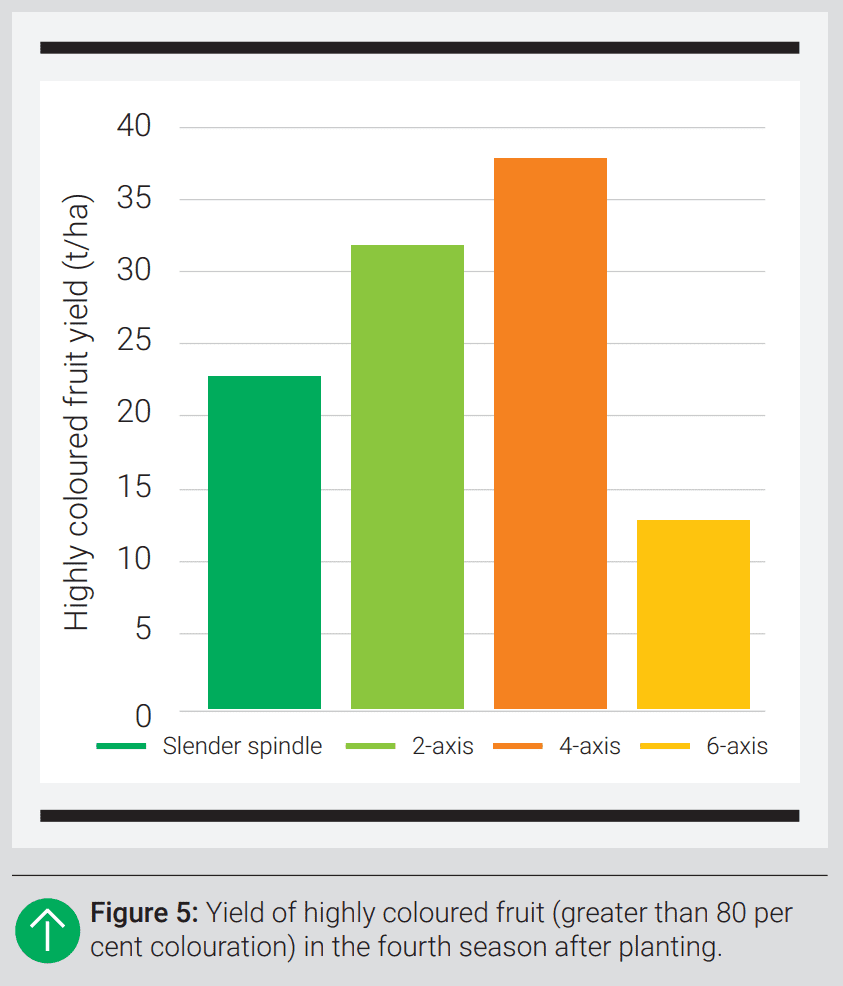
It is possible to combine the results from Figures 2 and 3 to estimate the yield of highly coloured (greater than 80 per cent colouration) fruit in the final year of the trial (Figure 5). While the 4-axis training system still produced the highest yield of fruit, the 2-axis system is now 15t/ha superior to the slender spindle trees without the use of reflective cloths.
Take home messages
- Under these trial conditions the 4-axis training system produced both the highest total yield and highest yield of highly coloured fruit.
- Both the 4- and 6-axis trees had to be developed in the orchard from 2-axis nursery trees in the first season.
- The 2-axis trees produced a similar total yield of fruit to the slender spindle trees, although the 2-axis trees produced higher quality fruit without the use of reflective cloth.
- In this trial the 6-axis trees did not perform well and failed to deliver the required yield of fruit.
Further reading
- Park I-H, Han S-G et al. (2024) “Early performance of multi-leader apple training systems in Korea”, Horticultural Science and Technology, 42(1):104–116, hst-j.org/articles/xml/O9aa/
- Kerer U (March 2015) “Multi-leader trees and mechanical pruning in Europe”, Australian Fruitgrower, apal.org.au/multi-leader-trees-mechanical-pruning-europe/
- Brown G (Spring 2021) “Planting density effects on growth, yield and quality”, AFG, apal.org.au/planting-density-effects-on-growth-yield-and-quality/
This article was first published in the Winter 2024 edition of AFG.



