
Future Orchards Active Community Orchard Groups
Author: Sarah de Bruin, AgFirst Consultants
As part of APAL’s Future Orchards® program, Active Community Orchard Groups (ACOG) have been established in each of the eight apple and pear growing regions.
What is an ACOG?
ACOGs are groups of six or more growers that, together with their regional Front Line Advisor (FLA), actively participate in the local evaluation of a topic of interest. This involves getting together with other ACOG members, their FLA and an AgFirst representative to discuss ideas for the study, identify a topic and how the study will proceed, monitoring progress and interpreting the outcomes. The goal is to address locally relevant issues that can assist with objective decision making.
A short summary for each of the eight regional ACOG studies is outlined below.
Orange
The study identified for Orange this season aims to understand the differences in labour requirements during thinning, using different technologies. The ACOG will compare the efficiencies of using different hand thinning equipment. The outcomes will help growers and orchard managers to make more informed management decisions at thinning time. At the completion of this study, videos and flyers will be made available, detailing the findings.
Batlow
The Batlow ACOG study will calculate and benchmark nutrient inputs across a selection of orchards. The study will also monitor leaf nitrogen status and evaluate the use of a SPAD Chlorophyll meter as an alternative to leaf tissue analysis for estimating leaf N at key times during the season.
Northern Victoria
Northern Victoria’s ACOG is comparing different methods to manage vigour in apple and will monitor tree vigour, shoot length and harvest drop. The impacts of different vigour control methods on fruit quality including colour, fruit firmness and fruit size evaluated.
Southern Victoria
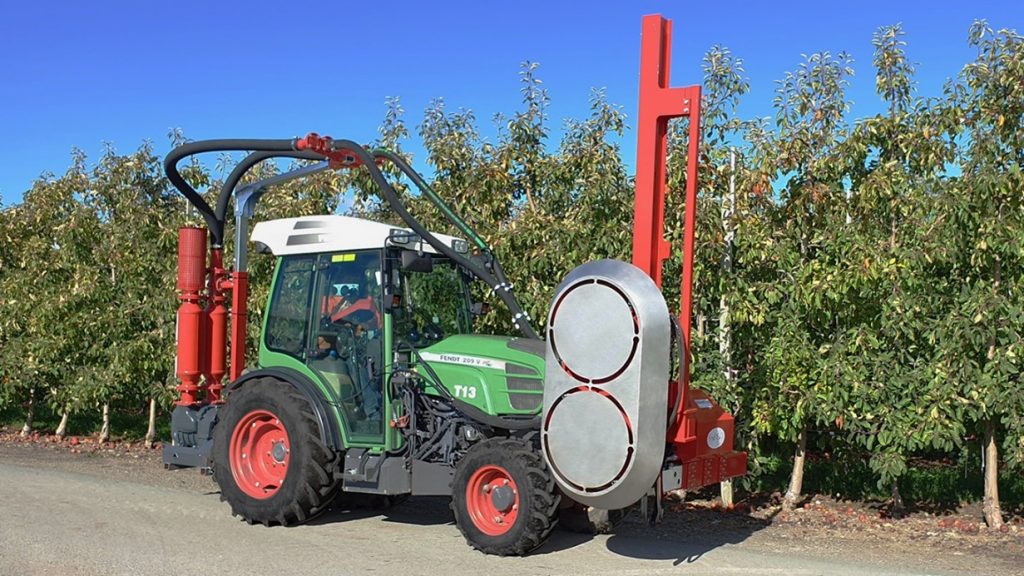
Red Pulse pneumatic defoliator that will be used in the Southern Victoria leaf defoliation trial.
Considering the costs, benefits, and risks of leaf defoliation in Pink Lady is the focus of this season’s ACOG study in Southern Victoria. Pneumatic leaf defoliation effects on blush, block profitability, fruit maturity, ethylene levels and return bloom will be assessed at a single trial site. These metrics will be compared to a control, to evaluate the effects of defoliation.
Image Source: https://fruit-tec.com/en/redpulse-duo-en
Tasmania
The Tasmanian ACOG are investigating the limiting qualities of long-term apple storage in Tasmania. Participating orchards will select two blocks of Gala, Jazz or Kanzi. From these blocks, nutrient and irrigation application, crop loading, yield, size and harvest maturity will be monitored. Postharvest maturity progression throughout storage and at marketing will also be examined. The limiting quality factors of each block will then be identified and reported upon.
Western Australia
The Western Australian ACOG are comparing the labour benefits and cost effectiveness of picking a block of Pink Lady apples, using either a platform or a bag and ladder. This study will determine which method is quicker and whether the platform will allow a wider labour demographic. Any other benefits the use of platforms may enable will also be reported on.
Queensland
The Queensland ACOG have some target surveys and studies in mind. Once the group finalise their topic and create a work plan, they will begin data collection.
South Australia
In South Australia, the ACOG has met and brainstormed numerous study topic suggestions. Once their study topic is finalised, they will begin planning the trial setup and design.
The current ACOG program will run until May 2022. Keep your eye out for ACOG study updates in future editions of Industry Juice. The results of each ACOG study will be made available via the Future Orchards pages.
If you would like to know more about the ACOGs please contact Rose Daniel [email protected] or (03) 9329 3511.



