
Benchmarking apple nutrition inputs and tree nitrogen status
ACOG Study Update March 2022– Batlow, New South Wales
Prepared by Blair Elliot, Steve Spark (AgFirst) and Kevin Dodds (NSW DPI)
Acknowledgements: A big thank you to the Batlow ACOG members J Smith, J Taylor, H Blume, B Brennan, I Robson and A Desprez. This trial will be available to be read in full on the APAL website when complete.
Benchmarking apple nutrition inputs and tree Nitrogen status across the season
The most common and reliable method currently used to determine leaf nitrogen content is [destructive] leaf analysis, which involves a sample of leaves being taken from the orchard block and sent to a lab for analysis.
The analysis will determine the level of each essential element available in the plant leaves. These leaf test results when combined with soil sample results can greatly assist agronomists to establish more accurately what the nutrients requirements are in the soil and trees.
Usually, soil samples are taken in the winter and leaf samples are taken in the spring/summer.
It is well known that Nitrogen (N) is the main component of chlorophyll (Chl) which is essential for plant photosynthesis and tree growth.
It is important for growers to be able to estimate the plant nitrogen content, so that they can determine the appropriate amount of nitrogen needed for optimum tree nutrient management.
What is the purpose of the trial?
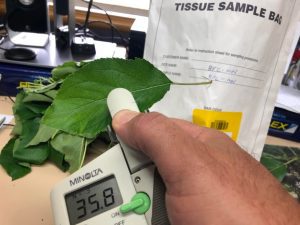
Chlorophyll (SPAD) Meter, in use.
The purpose of this trial is to determine whether a SPAD chlorophyll meter can be used as an alternative tool for estimating leaf nitrogen in apple trees, at key times during the season.
A SPAD chlorophyll meter is a tool that is used to estimate leaf chlorophyl and nitrogen content in a simple and non-destructive way.
How does this trial work?
For each grower participating in the trial, a mature block of Gala apple trees will be selected to be monitored.
For each of these blocks, growers will supply records of their fertiliser inputs for the full season, from the autumn into the following harvest. These inputs will then be collated and converted into units of actual nutrient applied per hectare.
Leaf tissue samples will be collected from each block at three key timings of the season, this being December, January, and February. These same samples will be tested using the chlorophyll meter (SPAD) and then sent off to a laboratory for nutrient analysis.
Once the results are received from the laboratory, they will be compared with the readings collected using the chlorophyll meter. This will provide an indication of the correlation between the SPAD readings and the leaf nitrogen content from the lab analysis.
This trial is well underway with November, December and January testing already completed. The remaining testing will be completed this season and a final report submitted mid-winter.
Visual observations will be made on the mature blocks to assess crop outcome. These observations will be supplemented with photographs.




