Gender diversity and best practice lead at Ladycroft
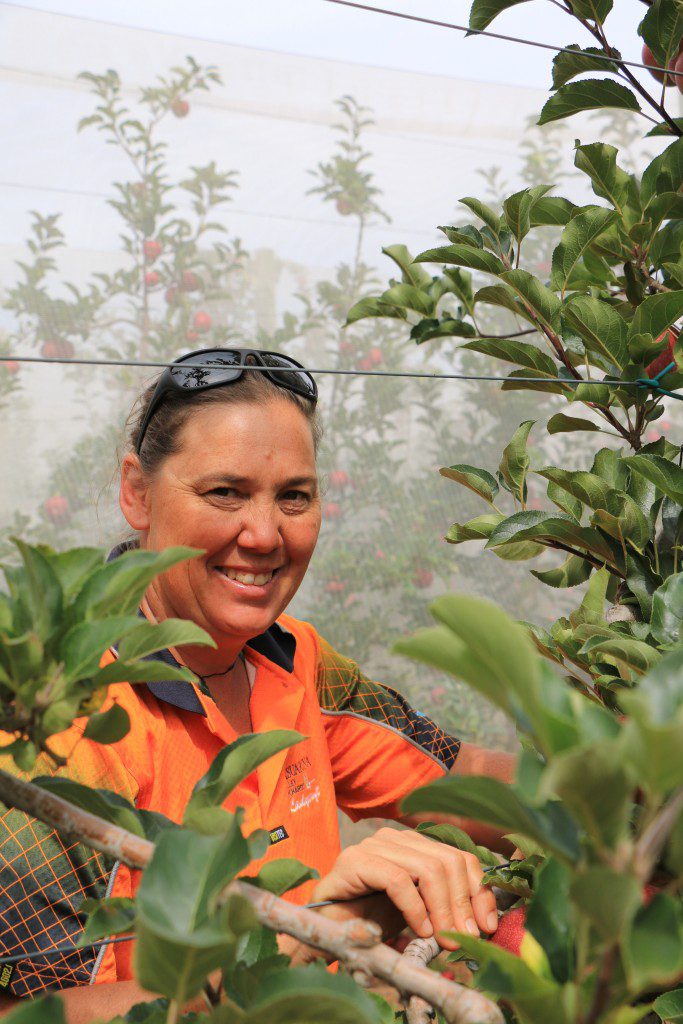
Bec Whittaker
When it comes to developing a horticulture team at Ladycroft Orchard in the Manjimup region of Western Australia, Bec Whittaker is clear – females, together with males, must be trained and encouraged throughout the farming enterprise!
As the orchard manager Bec has been strategic in developing a balanced team of young women and men performing roles across the organisation structure.
“We have 10 dedicated staff, most of whom have been with us several years or more – five girls and five boys,” she said.
“I’m a strong believer that offering training opportunities, and all orchard jobs without gender prejudice improves staff retention and efficiency.”
Improving efficiency is also central to the Ladycroft management team’s strategy of shifting to more intensive orchard systems.
Higher yields per hectare, more uniform colour and size, reducing the number of picks and a reduced dependence on labour are all outcomes planned for in the implementation of more two-dimensional, closer plantings at Ladycroft.
“We’re moving more to the intense planting of three and a half metre row spacing by 0.8 tree spacing,” Bec said. “It’s about efficiency.
“This will be driven from more efficient close-planted spindle, multi leader and 2D orchard plantings.”
At the picturesque orchard nestled amongst State Forest-clad hills west of Manjimup, improved productivity should also address a more physical limitation – shortage of land to expand.
“I’d like to go in there,” Bec says of the forest with a glint of mischief, “but I’m not sure what would happen if apple trees suddenly started popping up. Maybe by the time they noticed I’d chopped the trees down I could claim squatters’ rights…interesting.”
The quick humour, enthusiasm and ability to rapidly identify, weigh up and apply new opportunities or techniques for improvement are all hallmarks she brings to managing Ladycroft on behalf of one of WA’s largest pome and stonefruit growers Casotti Group, which also owns the nearby Casuarina Valley Orchard, run by orchard manager Dave Stewart.
Scope for development
Ladycroft is a relatively new orchard, converted from vegetable growing when it was bought by the Casotti Group in 1996 and planted predominantly to the then-new Cripps Pink (marketed as Pink Lady). There are now 44 hectares under apples and 7ha of vineyards.
A casual at Casuarina at the time Ladycroft was bought, Bec worked briefly on the set up of new orchard and in 2005, after a stint fish farming in the east with aquaculturalist husband Shaun, asked to return there.
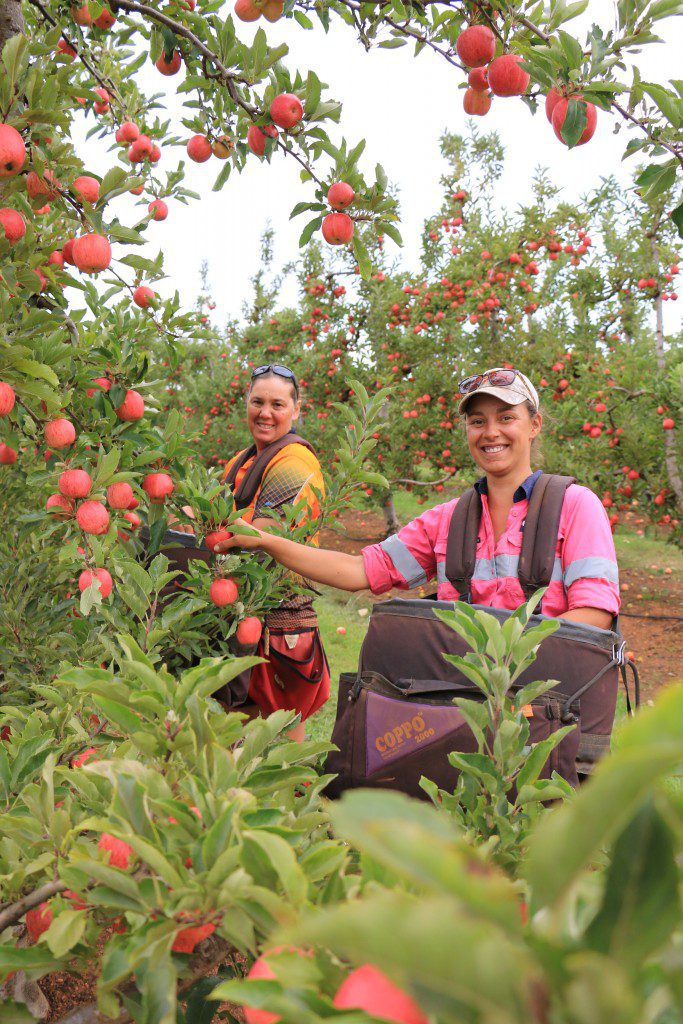
Ladycroft Orchard manager Bec Whittaker (lt) and Leila Galega (rt), from Italy, who joined Ladycroft as a casual picker, completed a Diploma of Horticulture and is now an orchard supervisor.
“This is such a beautiful orchard,” she said. “At Casuarina they were doing really cool things, but you were part of a very large group and I think I saw more scope for personal development here. I have worked hard to earn the respect of the general manager to now be the orchard manager here.”
High-level business decisions across the group such as variety choices, orchard strategy and marketing are made by Casotti owner and general manager Mario Casotti, in conjunction with Casuarina orchard manager Dave Stewart, leaving Bec to focus on keeping trees healthy, costs down and doing her own ‘cool things’ producing better fruit.
There is a sense of rigour and rapid evolution on the clean, productive orchard where new 2D- multi leader plantings sit alongside trials of techniques picked up from study tours to the United States and Europe and traditional central-leader Granny Smith plantings.
The first 2D-multi leader blocks were set up in 2017 motivated by a desire to reduce costs and produce high quality fruit.
Bec is a keen observer of international orchard management developments and is quick to see opportunity to try something new in the need to rework an underperforming block.
A block of out-of-favour-with-retailers, Sundowners on M106 rootstock on V-trellis was cut off two years ago, regrafted to Galaxy and transitioned to a fruiting wall. “I saw it during an industry study tour to Washington State and wanted to see whether it would deliver more uniformity of fruit colour and size through better light penetration, and allow for easier management,” Bec said.
“We train to fill the gaps and each one of the spurs carries a piece of fruit. These have had great growth as they’ve already hit top wire and we have had to trim back. The Sundowners were calm, but I think because we’ve grafted on such a robust rootstock they have taken off.”
Most new plantings are on M9 or M26 in line with the shift to more intensive systems.
“We won’t be planting any more 106, as 106 produces a tree which is too big and grunty and hard to work with when you’re doing intensive plantings,” Bec said. “You want a smaller, less vigorous tree like an M9 produces, that still grows to three metres, and supports high yields.”
Boundary stretching
Bec said a Diploma of Horticulture undertaken via external studies while at Ladycroft had given her the confidence to try new approaches.
“It gave me a better understanding of the trees,” she said. “It also gave me the insight to stretch my own boundaries and try different things, rather than being regimented.
“Tree styles have changed a lot since I first started in horticulture. We’ve gone away from the old vase tree and central leader, to slender spindle and now we’re doing some blocks on 2D-multi leader.”
Pink Lady apples still account for the largest share of production at Ladycroft, with 16ha of the 44ha under apples, but the Cripps Pink is being replaced by higher-coloured cultivars Rosy Glow and Lady In Red. Similarly, high-colour Galaxy and Alvina Gala are replacing Royal Gala, Sundowner and Fuji.
“We have a small block of Alvina gala on slender spindle at second leaf that I cropped this year,” Bec said. “Admittedly it was very light, but the colour was absolutely awesome. I’ve never seen such good colour on any of the Royal Galas or the Galaxies as we did on the Alvina.
“I cropped them at second leaf as a bit of an experiment, trying to save costs in tree training based on something I saw in Italy. I hung one piece of fruit on the end of the branches I wanted to keep and the weight of the fruit has pulled the branches down and it’s just hung beautifully. I am really happy with the growth of the trees and still expect the trees to reach top wire at 3.2 metres in third leaf.”
“We went through thinning and I wasn’t planning on picking the fruit as I thought it would be over sized, I just wanted it to do the job shaping branches. We ended up getting a really good pick and a great pack out of that fruit. It was beautiful fruit and it did the job of shaping branches. Tree training is a significant expense in developing slender spindle in the early years so I thought it would be worth a shot.”
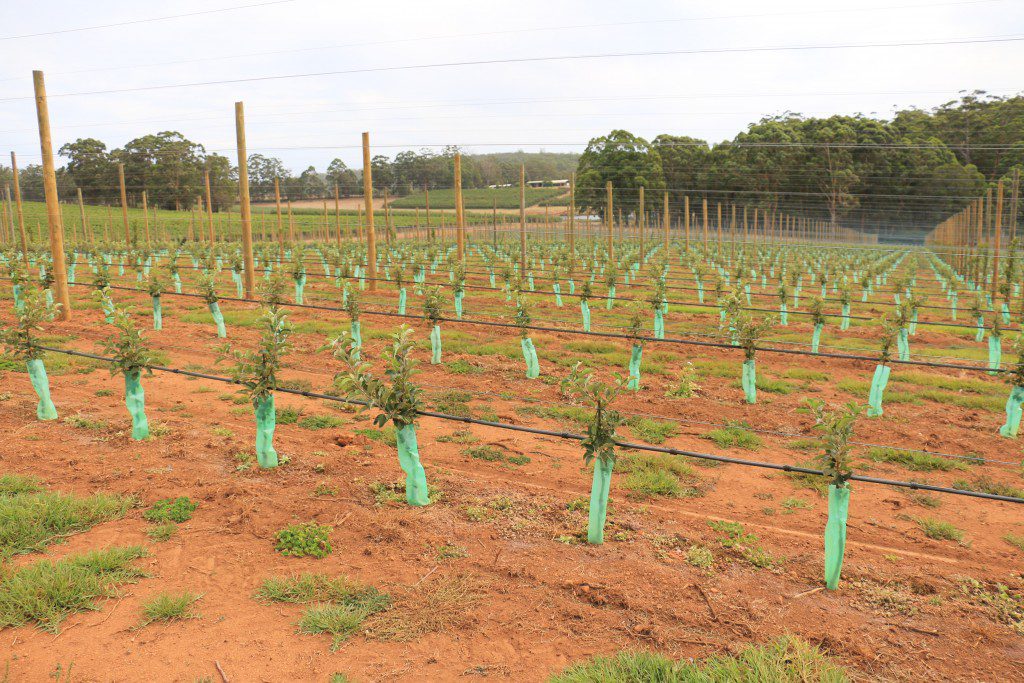
A block of Sundowners regrafted to Gala Galaxy and trained into a fruiting wall have shown such strong growth they have had to be trimmed back.
Bravo®
The Casotti Group is the largest grower in the state of the locally-bred ANAPB01 variety which produces the distinctive burgundy-coloured apple Bravo®. The Cripps Red x Royal Gala cross variety was bred by WA Department of Agriculture apple breeder John Cripps and first released for commercial plantings in 2014.
Casotti general manager Mario Casotti was an early backer of the variety, seeing in its striking colour, firm, crisp, juiciness, ability to store well and not brown when cut, a distinctive apple that ticked all the boxes needed to be a consumer success.
Bravo dominates new plantings at Ladycroft where it is being grown on slender spindle and 2D-multi leader. Bec said the first blocks were yielding well at four-leaf stage and she was hopeful of at least 70t/ha in full production. A further four hectares of Bravo is under development at Ladycroft.
“I’ve found it, like its parent Sundowner, quite an easy tree to grow,” she said. “You have to feed it as a young tree. In our karri loam soils, it is very manganese and magnesium hungry. I’m quite happy with the growth that we’ve achieved. We thin quite late to hold the size back and the fruit seems to be quite a reasonable quality coming off.”
This is the fourth year of commercial production for Bravo. Local Fruit West Co operative has been licensed to commercialise ANAPB 01 and is already exploring export opportunities for the apples.
“It’s a really nice crisp apple, and doesn’t brown when cut,” Bec said. “Mario brought a half-eaten one in from the car and left it on the bench and days later it still hadn’t gone brown.”
Colour is helped by the cool valley location which provides plenty of chill. “One of my Bravo blocks is planted in the back corner and gets a bit of shade, even the shaded trees still have really good colour,” Bec said. “We haven’t had a lot of hail, but we definitely get a lot of frost in winter. Eight years ago we had ice on the trees while we were picking Pink Lady apples.”
Although hail has not been an issue at Ladycroft, the south was hit badly in 2013 and at that time the decision was made to put all new trees under netting.
“All new planting has netting budgeted,” Bec said. “It doesn’t matter if its Granny Smith or Bravo, we have white drape netting so if there is a chance of hail it’s covered. The fruit still colours up underneath and you can see that when you look at the Bravo.”
Empowering staff
Decision-making in a high-performance orchard requires good data. Bec recently issued iPads to key staff to ensure data is captured more easily in field, from where it is uploaded to iCloud and can be picked up on the office computer by office administrator Dee and entered into management software or excel spreadsheets.
Staff are very much part of the collaborative decision-making process, with regular team meetings to discuss what’s coming up. They are also given their own trees to manage.
“We are after quality,” Bec said. “When everyone has responsibility for their trees, they have an investment in high performance of their sections. It gives everyone an incentive. They take great pride in it.”
Bec says getting skilled staff is a challenge so she wants to make sure she keeps them. Everyone has been there for a minimum of three years including husband Shaun and son Mallee.
Having benefited from study herself, Bec is a keen supporter of upskilling and empowering staff. “Training is so important, it brings such a different perspective,” she said.
Leila Galega, from Bergamo, Italy, originally joined the orchard as a casual picker before being sponsored by the company for a permanent role under the Regional Sponsored Migration Scheme. She has completed her own Diploma of Horticulture and is now an orchard supervisor.
“Leila has a key role in the orchard, she’s working with the crew every day, hand’s on in the trees,” Bec said. “We have a trainee Jasmine, working alongside her who is heavily involved in the new 2D-structures that we’re creating.”
Casotti is an approved employer under the Seasonal Worker Programme and pruning and thinning last year was done by a team from Timor Leste. “They did an awesome job and we are hoping to have them back this year,” Bec said. “Some of them had never seen an apple tree, but once we trained them they didn’t stop. Language has been a barrier, but we found this group of people very willing workers who were excellent at mimicking. (“First I show you, now you do!”)
“With picking, we’ve gone with a team of Ni-Vans (from Vanuatu) who have had previous experience in New Zealand as well as Australia and they’ve proved very good.
“The mindset of these lovely people is different from most working holiday employees. These people are under contract to us for the sole purpose of work to earn money for a pre-determined period of time. They feel privileged to be offered the opportunity to work and earn a good wage.
“The seasonal worker program has been a game changer for us in terms of maintaining a dedicated labour force through each part of the production cycle. Where we had a constant turnover of backpacker labour throughout the year, we now have consistency and greater work efficiency to a higher standard and the best bit is, most of them will return the next year!”
Future focus
Bec sees cost of labour as an ongoing challenge. The current focus is to restructure the orchard to be very uniform and develop tree structures which are simple to prune and require minimal tree training. This will also support more ergonomic and efficient platforms and other developing mechanical technologies which will minimise the need for casual labour. Another up-side to this is a more consistent quality apple, and higher yields.
“Labour costs are creeping up and with occupational health and safety an ever-present issue we are going to be pushed away from ladders,” she said. “I’d like to see more platforms and mechanical technologies applied to pruning thinning and picking. I think robotics will play an important role in future.
“I have an ambitious goal, to produce a block of apples with a first-grade pack out averaging 100 t / ha.
“Working with a diverse skilled team, who propagate intensive 2D multi leader production systems and utilise efficient mechanical technologies could bring another goal within reach.”
Key messages:
- Focus on orchard efficiency and 2D-systems
- Empowering staff
- Rigorous trialling of new systems and ideas
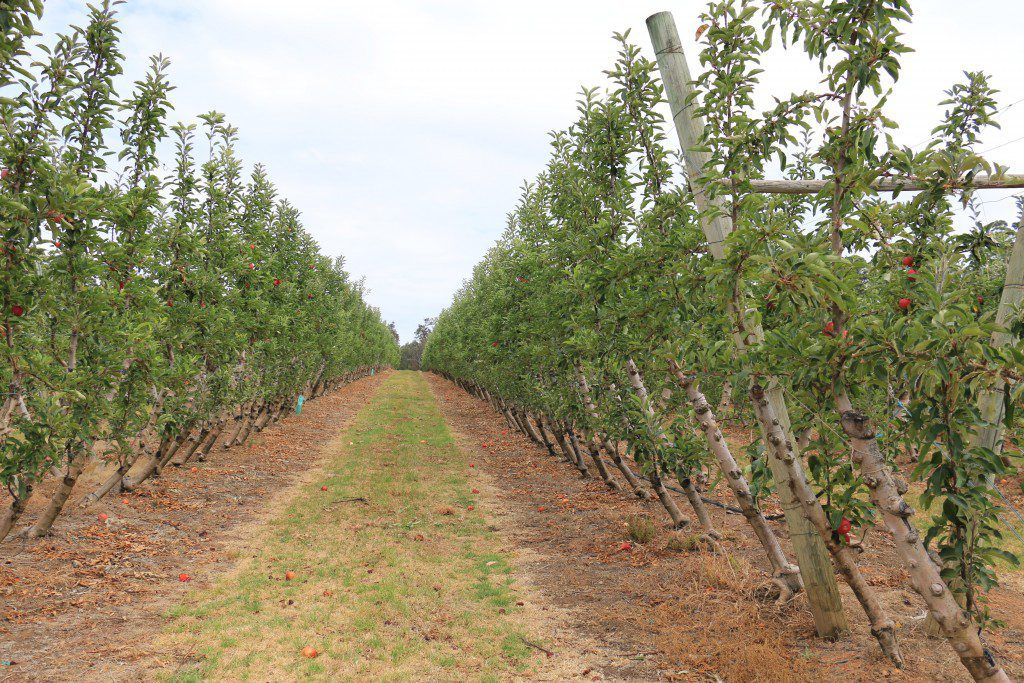
Fruiting wall at Ladycroft.