Potential to improve crop quality and yield supports case for variable rate spreader
Can the practical application of precision horticultural technologies improve returns in apple and pear orchards? A trial in Victoria put it to the test.
Variable rate fertiliser application looks likely to be worth the investment in orchard environments to improve fruit quality and, ultimately, profitability, a trial in the Goulburn Valley concludes.
Using integrated soil and vision technologies, the trial was able to identify correlations between key soil chemistry properties and fruit characteristics such as colour, indicating potential for precision-guided fertiliser applications to improve apple quality and production, and optimise nutrient use efficiency.
The trial was designed to highlight costs, potential benefits and further options for exploration of these types of technologies for growers.
Further emphasis on managing soil nutrition is also justified, to manipulate crop load and fruit quality metrics such as size and colour (Table 1).
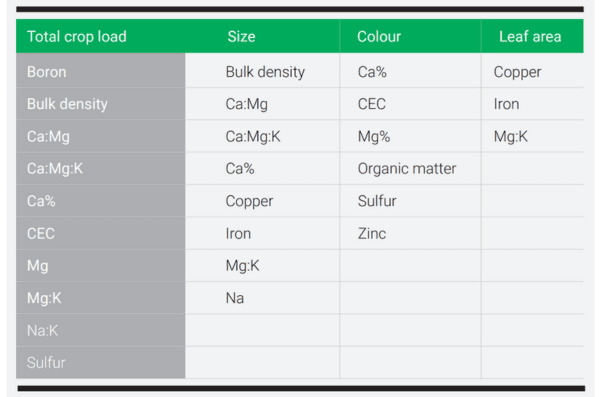
Table 1: Soil factors consistently correlated with the colour, crop load and size in apple orchard as determined in this trial. A positive relationship was found for these factors (>0.5 in both sites) and the relevant crop quality/yield factor. This is not to say these are the only factors that matter, merely that a consistent correlation was observed. Abbreviations: Ca%, calcium percentage; Ca:Mg, Ca to Mg ratio; CEC, cation exchange capacity; K, potassium; Mg, magnesium.
Mapping technologies
For the trial, APAL and Fruit Help completed demonstrations of orchard scanning and grid-based soil mapping on two commercial apple orchards in the Goulburn Valley. Fruit size and soil nutrition data were collected on two apple blocks at Calimna Orchard (site 1) and Plunkett Orchards (site 2). Both 5–6-hectare blocks were mature high-colour Cripps Pink strains (marketed domestically as Pink Lady) and managed as a single management unit by the growers.
Green Atlas Cartographer mapping was carried out at fruitlet (mid-summer) and pre-harvest growth stages. Cartographer is a ground-based scanning system that uses LiDAR (laser imaging, detection and ranging) and camera technologies to measure tree and fruit characteristics, namely:
- fruit number, size, colour and degree of clustering (how close fruit are together)
- tree size (height, canopy area, leaf area, canopy density).
Soil was also sampled on a 50m grid basis throughout the orchard within each block. These samples were analysed using the service provider Gridfarm™ to produce grid-based data across the sampled blocks, demonstrating the variability in individual soil nutrients and ratios, as well as suggested ameliorants for variable rate application across each block.
Patterns identified
The resulting datasets from Green Atlas and Gridfarm were then layered in geographic information system (GIS) software to allow for correlation analysis. Patterns of tree and soil parameters, such as colour and crop load, were identified, highlighting the effects of underlying soil nutrient variability on both fruit and tree characteristics. This information will help to develop the business case for growers investing in variable rate fertiliser application within orchard environments by identifying the extent of variability and likely costs involved to implement.
By establishing correlations between Green Atlas and soil test data, factors affecting blush colour in apple varieties sold as Pink Lady were explored in the trial. Some elements showing a consistent correlation for red colour enhancement – such as the level of soil organic matter, cation exchange capacity, percentage of CEC of both calcium and magnesium as well as the soil zinc levels – were observed across both sites. This highlights these elements as potential areas for focus when considering variable rate application and suggests that colour enhancement may be related to their role in nutrient retention and calcium uptake to the plant.
This preliminary study shows the high potential of using Green Atlas Cartographer and soil test data to guide precision orchard management before harvest to improve fruit quality and consistency by addressing soil requirements at a higher resolution than is currently done, such as by using a variable rate fertiliser spreader.
While these correlations do provide some findings toward improving colouration, the single most critical factors for colour development were tree size and canopy density and, as such, this should always be the first area for focus. Consider whether the correct pruning technique is being used and if pruning is being used effectively for vigour management.
The data collected was also evaluated to see how it might help growers improve the accuracy of crop estimates and prediction of packhouse outcomes ahead of time. Prior to harvest time (March), fruit size and colour were assessed again to confirm that data outputs were consistent between scan timings.
Crop estimation
In addition to the two Cartographer scans (which provide a relative crop load across each site), calibration counts were completed at each site to estimate total fruit per hectare. In total, 30m of trees were counted at each site per scan and a calibration curve relative to detections was produced and extrapolated.
Meaningful information for accurate crop estimation can be achieved through this process; however, accurate hand counts (used for calibration) are critical to ensure accurate estimation, as is the case with standard (average of x trees per hectare) methodology.
Using the Cartographer scan data enables the grower to account for crop load variation across the block to allow for more precise and targeted crop estimation. In addition, fruit size data and extrapolation is showing good potential for estimation of the fruit size at packing, allowing for intervention prior to harvest (for example, by using Retain™ or Harvista™ to delay harvest and potentially gain more fruit size) or respond to large fruit size with reduced irrigation.
Fruit colouration
As expected, fruit colour increased from the first Green Atlas scanning in January to the second scanning in March/April in both orchards as fruit approached harvest.
Figure 1 shows the colour index pattern of apples acquired by Green Atlas scanning in Site 1 in April 2022. This data was then averaged to 10m grids to allow correlation analysis against soil property data at the same grid size. A lower number indicates an apple with less red colour; this is also indicated by more yellow shading in the scan diagrams in Figure 1. When comparing the two sites, it was evident in both cases that the variation in colour intensity throughout the block is highly variable.
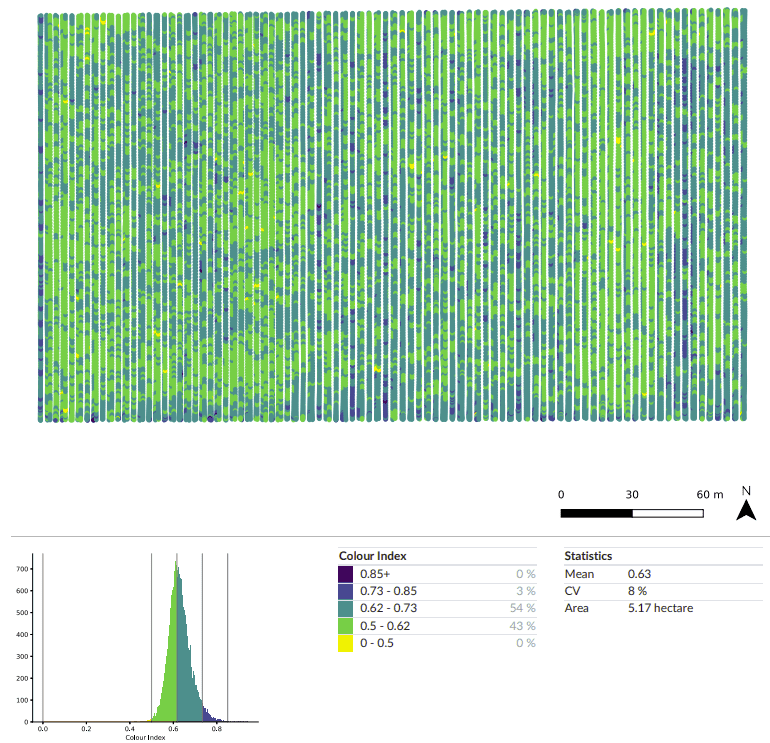
Figure 1: Average fruit colour index data acquired by Green Atlas Cartographer scanning in Site 1 (from low-colour index in yellow to high-colour index in blue) in April 2022 at one of the trial sites. Each square represents a tree; this data was averaged to 10m squares when completing correlation analysis against soil factors.
Crop load
The two trial sites have similar areas and similar numbers of fruit per hectare. In both orchards, uneven crop load distribution was observed from Green Atlas scanning data within the block. Use of the mapping system allowed for this variation to be mapped to zones, allowing direct comparison to soil chemical properties as per the grid-based soil maps produced.
Addressing soil variation for profit
Correlation analysis can provide useful information for orchard management, but how much does it cost and what do you do with the information afterwards?
Soil variability plays a considerable role in fruit quality and crop loading metrics, but addressing it with currently employed techniques is relatively difficult. In this case, the cost of the workflows to identify variability through both grid-based soil mapping and individual tree characteristics would be:
- soil sampling, data analysis and recommendations: $225/ha (4 samples per hectare)
- Green Atlas scanning as an alternative identification method: $150/ha
- variable rate spreader: $50,000+ capital outlay depending on model.
Typical savings identified from variable rate application are in the order of 10 to 30 per cent over traditional single/blended soil tests. With typical orchard expenditure of ~$1,100/ha on ground spread fertiliser (inclusive of ameliorants) per annum, an expected saving of $100–300/ha may be achieved on fertiliser cost, resulting in a likely break-even position (excluding amortisation of spreader upgrade) for implementing grid-based soil sampling.
Expected gains in fruit consistency, quality and yield would be expected due to greater consistency of soil nutrition and would likely lead to fruit return gains many times over the investment cost per hectare for application. For example, if packout were to increase by 3 per cent per hectare as a result, a likely net return of $20 per bin (say $2,000–4,000 per hectare per year) could be achieved relative to standard practice.
Further investigation of variable rate soil application on block profitability is warranted but, given the inherent variability of all orchard soils and relatively modest costs over standard practices, appear to be justifiable for implementation as growers undertake their next orchard spreader upgrade. Leasing of variable rate units by fertiliser sellers could also see rapid adoption of the technique.
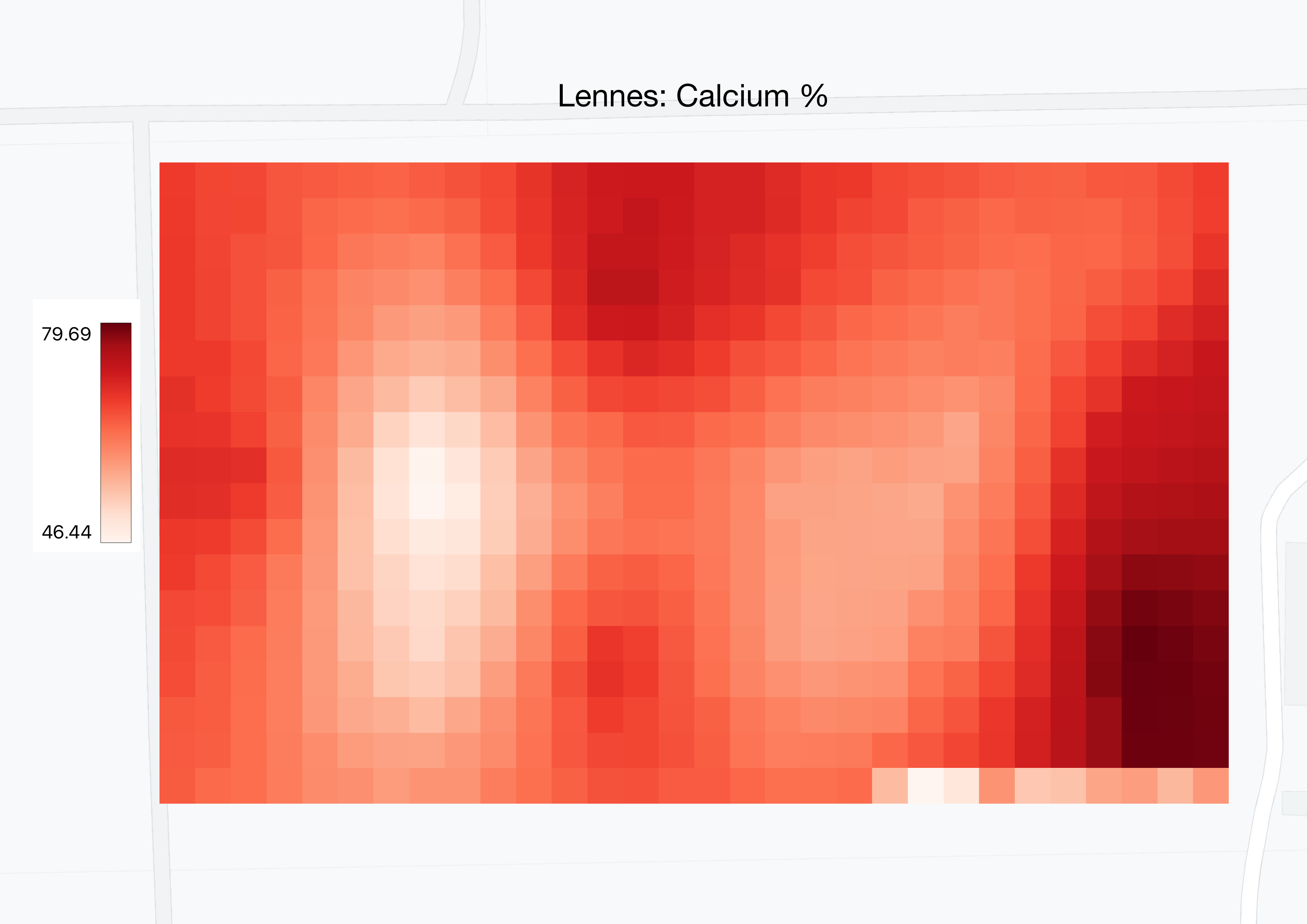
Soil grid mapping results for calcium as a percentage of cation exchange capacity (CEC).
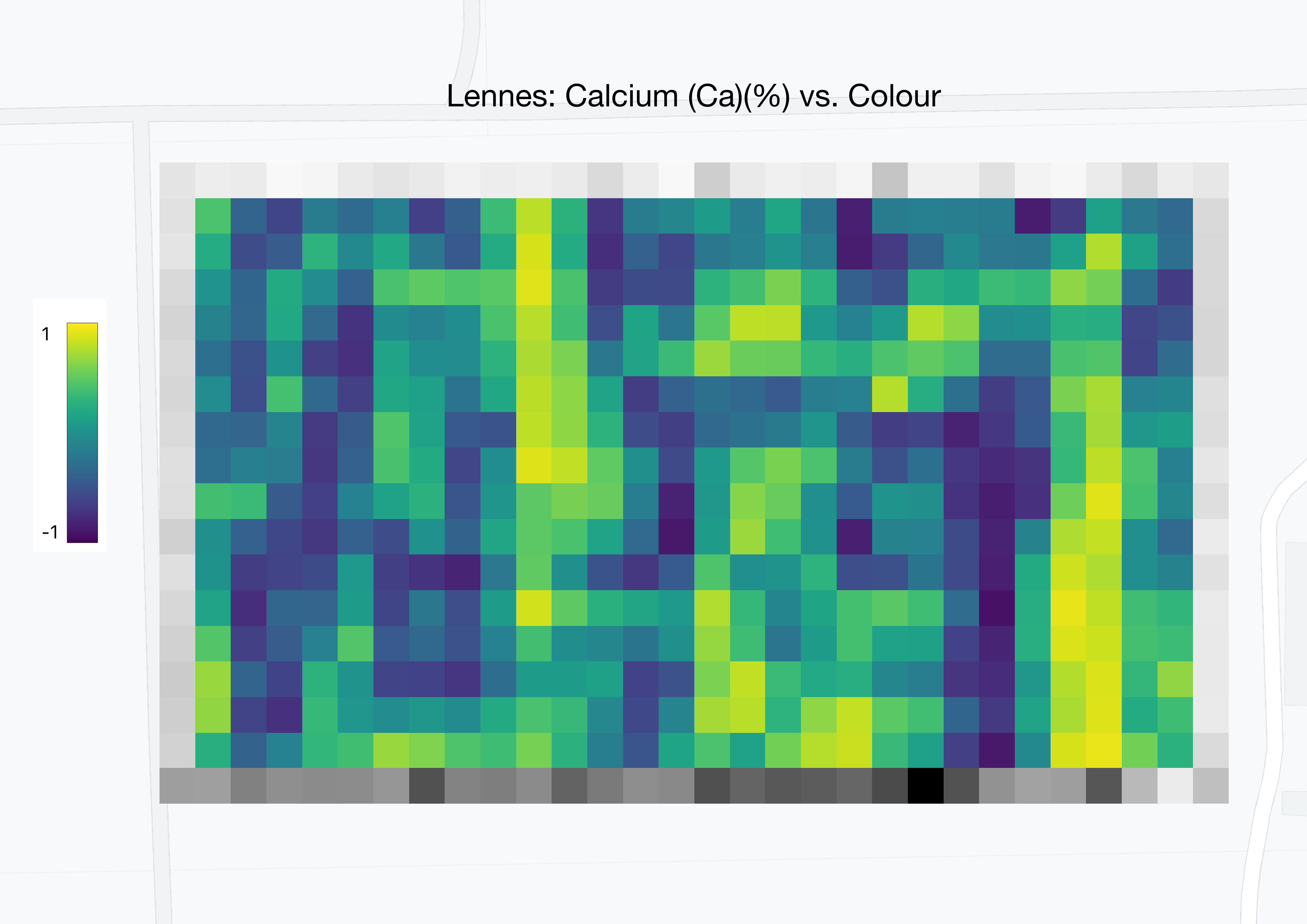
The result of correlating calcium as a percentage of CEC and fruit colour index at harvest on a 10m grid basis across the block. Yellow represents where a stronger positive correlation was detected between the two factors.
Conclusions
Green Atlas Cartographer scans can provide considerable amounts of data to be used in further analysis, such as identifying desirable soil chemistry properties, and for crop estimation. However, the performance for estimation is dependent on the ability to accurately predict final fruit size and bin weights, as well as the accuracy of calibration counts. A heavy emphasis towards accurate counts undertaken at elevated height rather than on the ground is critical for accuracy.
Soil chemical properties varied greatly across the field and correlated well with some tree and fruit quality characteristics. An emphasis on addressing zonal nutrition deficiencies appears to be justified in both blocks scanned, with the total corrective rate offsetting the additional cost of grid-sampling versus the total applied rate based on a typical blended soil test for the entirety of the block.
Soil CEC was positively correlated with organic matter and the total number of fruits per tree, fruit colour and fruit size.
Further investigation into the potential benefits of variable rate spreading on fruit quality is suggested, with savings in fertiliser cost offsetting the additional soil sampling costs relative to a single sample approach. Any gains in fruit quality are likely to increase profitability within the business and justify further investigation/implementation for growers.
Next steps
AgriFutures Australia has awarded APAL a grant for Phase 2 of the Producer Technology Uptake Program. This will occur during the 2023–24 season whereby a variable rate fertiliser spreader will be purchased, fertiliser applied variably and additional soil tests and Cartographer scans will be undertaken. It is hoped that this new project will demonstrate a clear benefit for usage of the technology, as well as highlight some of the key challenges with introducing the technology.
As part of this project, field days will be held in the Goulburn Valley at key timings (spring 2023 and autumn 2024) to communicate the outcomes of the trial and demonstrate the technology to growers. In addition to this, further updates will be communicated to growers via APAL’s print and digital publications.
Further information
This article is drawn from the AgriFutures trial report “Integrating soil and vision technologies for improving apple production” by Nic Finger and Eric Zhang, Fruit Help. For a copy of the full trial report, visit https://apal.org.au/wp-content/uploads/2023/06/Integrating-soil-and-vision-technologies-for-improving-apple-production.pdf.
Visit https://agrifutures.com.au/producer-technology-uptake-program/ to find out more about the AgriFutures Australia Producer Technology Uptake Program.
Acknowledgements
This project was made possible by funding from the Producer Technology Uptake Program facilitated by AgriFutures Australia. We thank AgriFutures Australia for their support of this project
A big thank you to Matt Lenne, Calimna Orchard, and to Andrew Plunkett and Jason Shields, Plunkett Orchards, for hosting the trial.
This article was first published in the Winter 2023 edition of AFG.