
Automated analytics tap into a world of under-used data
A Tasmanian trial points to the future of automated analytics – turning diverse pest monitoring data into powerful management insights for growers.
Key points
- Data explosion offers deeper insight opportunities
- Codling moth data used to trial analytics pathways
Ever had pest traps on or around your property and wondered what happens to the data, or whether you can get more value from it? You are not alone. Pest monitoring is undertaken by many players for a range of purposes, including for biosecurity and trade, for research, or to guide on-farm pest management.
A team from CSIRO is working with apple growers and the Tasmanian Government to show how diverse data sources can be harnessed to deliver near real-time insights back to growers, while protecting confidentiality and enabling data owners to retain full control of their data. The insights can help growers stay ahead of pest trends that could threaten access to sensitive markets.
Across Australia, significant volumes of data are generated each year by pest surveillance programs to detect plant biosecurity incursions or to meet domestic and international market access requirements. Typically, this data is simply stored as a record for regulatory compliance purposes and it is rarely communicated back to industry or used for further analysis.
Pest monitoring data is also collected by growers, crop consultants, researchers and others. This data is often collected for a specific purpose and rarely shared.
There is growing interest across industry and government to make better use of diverse data sources like these to inform management and decision-making. The challenge is to find solutions that enable data owners to maintain control of their data.
Research underway in the apple industry, as part of the Hort Innovation Safe Trade project, is providing an opportunity to explore how this can be done, using codling moth monitoring data as a test case.
The research trial tests an automated process to share, repurpose and analyse data sets collected by CSIRO, government and farm businesses. A key aspect of the automated analytics trial is to demonstrate how diverse data sets can be harnessed, while protecting confidentiality and enabling data owners to retain full control of their data.
“The automated analysis we are generating through the trial shows how growers can make use of data sources they otherwise could not tap into,” said CSIRO researcher, Dr Habacuc Flores-Moreno, who is leading the trial.
The Safe Trade project includes a specific focus on improving international market access for Tasmanian apples. This work, led by CSIRO researcher Dr Judith Stahl, involves field studies to assess and quantify how various practices on farm and in the packhouse contribute to producing consignments for export that are free from codling moth – a quarantine pest in many high-value international markets. The work will help the apple industry strengthen the scientific evidence needed to negotiate improved access to key Asian markets – with a particular aim to reduce the need for fumigation.
With permission from the participating growers, research data generated through the Safe Trade project is being repurposed for the automated analytics trial.

Research team member Bruce Davis checking traps in the Huon Valley. Photo: Judith Stahl
The trial demonstrates how pest monitoring and crop inspection data can be easily collected in the orchard in a digital format and made available for analysis. An automated analysis workflow has been designed and implemented, enabling research data collected from apple orchards to be rapidly collated and analysed. An automated insights report is emailed each week to participating businesses. For the 2024–25 apple harvest season, growers receive analysed data only from their own orchard (farm-back-to-farm insights).
Importantly, the analysis workflow is designed to incorporate multiple data sources, creating the potential for more powerful insights. The team has commenced integrating monitoring data collected by the Tasmanian Government to comply with export protocol requirements for a number of international trading partners. Historically, this data has not been provided to growers.
In future seasons, if supported by participating businesses, insights could be generated using both historic and current monitoring data from grower and government sources. Reports could provide analysis of the data from the orchard as well as insights for pest pressure trends in the local area.
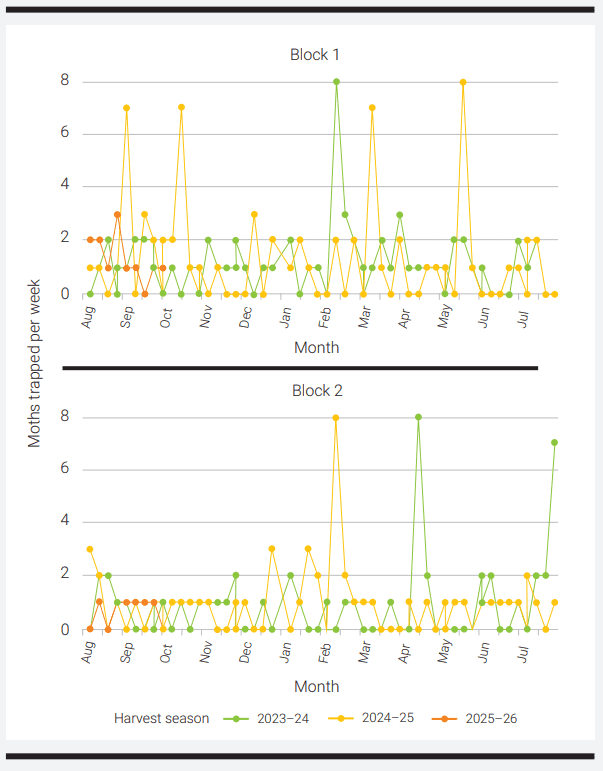
Insights, similar to this example, are sent to growers on a weekly basis. The Y-axis represents the number of moths trapped per week, while the X-axis represents time. Different seasons are distinguished by colour, and each panel corresponds to a different orchard block. As more data is collected, the system could generate increasingly valuable insights, such as predicting pest outbreaks.
A critical part of the trial is to demonstrate how the automated analysis process protects the ownership, privacy and confidentiality of growers’ data. Differential privacy preserving analytics techniques, developed by CSIRO, are being applied and tested to enable useful insights to be generated from the data, while preserving sensitive information.
“We hope the trial shows how the shift to digital pest monitoring combined with automated analytics workflows can deliver insights closer to ‘real time’ and help identify more timely and targeted management responses in the orchard,” Habacuc said.
APAL Head of Trade Jenny Van de Meeberg is keen to see how the trial can support the industry’s export goals.
“Making better use of available data sets to improve management of quarantine pests can help growers produce more fruit that meet the standards required for export markets – and also reduce the chance of biosecurity breaches,” Jenny said.
Interested in joining the trial?
The automated analytics trial can be expanded to include more apple farms. Any Tasmanian apple growers who are interested in participating in the trial can contact Habacuc for more information at [email protected].
Acknowledgement
Safe Trade (AM21002) is funded by the Hort Frontiers International Markets Fund, part of the Hort Frontiers strategic partnership initiative developed by Hort Innovation, with co-investment from the apple and pear levy fund, CSIRO, all state governments, the Northern Territory Government, Apple & Pear Australia Ltd (APAL), Fruit Growers Tasmania and contributions from the Australian Government, including a grant from ATMAC (Agricultural Trade and Market Access Cooperation).
This article was first published in the Autumn 2025 edition of AFG.



