
Improved calcium absorption for fruit quality
Gordon Brown reviews research investigating how foliar-applied potassium and calcium affects fruit quality.
In modern apple production the application of foliar calcium, often as soluble calcium chloride, to improve fruit quality is still regularly practised. Hence, any treatment to improve the efficacy of foliar-applied calcium needs to be studied in more detail. In this edition of AFG I will be reviewing Turkish research into the effect of foliar-applied potassium and calcium on fruit quality, to highlight the potential of adding potassium to calcium sprays to improve calcium uptake.
As part of the research I was involved in in the late 1980s, I conducted a survey of 54 different apricot trees in six orchards to identify associations between foliar nutrient levels and fruit quality. This survey revealed that, while foliar calcium levels were not related to higher fruit firmness, foliar copper levels were.
This was followed up in the 1990s with trials, dominantly on cherries, to investigate if foliar-applied calcium or foliar-applied copper caused an increase in fruit firmness. In two trials where rain did not occur it was found that calcium sprays did not lead to firmer fruit, while copper sprays did. These results were replicated in two trials conducted on apples, indicating that the results translated to a different crop. It should be pointed out that these trials used calcium hydroxide which is not very soluble.
Methods
This latest Turkish research by Onur Sürücü and Zeliha Küçükyumuk was conducted on 16-year-old trees of both Golden Delicious and Red Chief growing on M9 rootstocks at a density of close to 1,500 trees per hectare at a latitude of 37° north, similar to that of Shepparton at 36° south. For these trials, the treatments – using the soluble nitrate forms of potassium and calcium (Table 1) – were applied 20 days after full bloom, with a further three applications at 15-day intervals. Fertigation of the crop with N, P and K continued throughout the trial period. Leaves were sampled in midsummer and analysed for chlorophyll content as well as foliar nutrient levels. Fruit was sampled at commercial maturity and analysed for fruit quality.
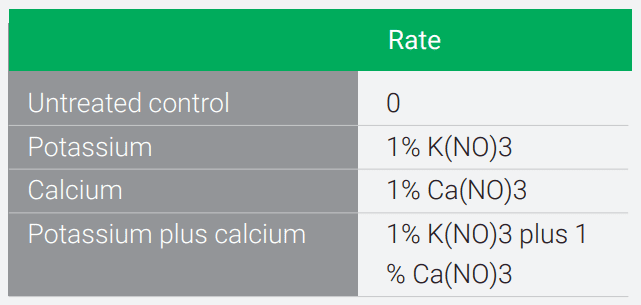
Table 1: The foliar treatments applied to apple trees at 20 days after full bloom then at 15 day intervals for a total of 4 applications.
Results
Midsummer leaves were harvested and washed to remove any surface residues prior to foliar nutrient analysis (Table 2). This revealed that the trees in all treatments had adequate foliar levels of both potassium and calcium. The treatments that contained potassium had foliar potassium levels higher than the other treatments for both cultivars. The level of foliar calcium in the calcium-only spray treatment was not significantly different to the untreated control trees. However, when potassium was added to the calcium spray, there was a 58 per cent increase in foliar calcium levels for both cultivars. This indicates that the addition of potassium to the calcium spray treatment synergistically improves the absorption of calcium into the leaf.
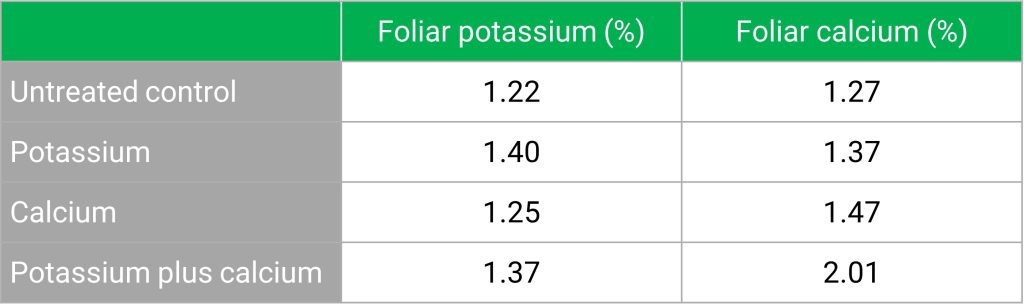
Table 2: Midsummer foliar levels of potassium and calcium average across the two cultivars.
There were no treatment effects on the quantity of chlorophyll in the leaves, or on fruit size or colour. There was, however, a significant effect of the spray treatments on fruit firmness (Figure 1). Here it was found that the fruit firmness levels reflected the level of foliar calcium with the potassium and calcium alone spray treatments causing a minor, but statistically unreliable, increase in the firmness of the fruit. However, the application of both potassium and calcium led to a 22 per cent increase in the firmness of the fruit. This dramatic increase in fruit firmness at harvest indicates that the potassium plus calcium treatment has potential to assist the marketing of apples from fields that have had a history of producing soft fruit. These results reflect and complement those of foliar nutrients as they indicate that the spray mixture of potassium plus calcium is superior to those of either nutrient alone.
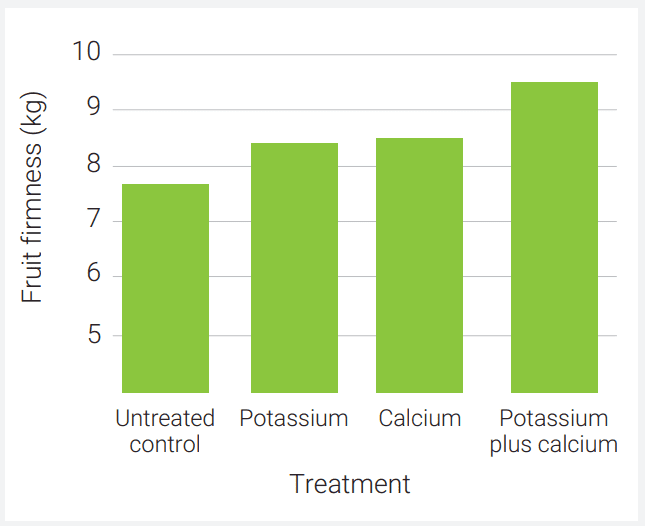
Figure 1: The impact of foliar application of potassium and calcium to apple tree during the growing season on fruit firmness at harvest.
This is not the first time we have seen a positive impact of foliar-applied potassium nitrate. The Autumn 2023 edition of AFG contained a review of a paper on pears where potassium nitrate was applied just after fruit set. The 1 per cent spray concentration led to an 18 per cent increase in fruit firmness as well as a slight reduction in the percentage of diseased fruit. These results suggest that a routine calcium spray application was applied to the trees at this trial site.
Conclusion
In this Turkish study, it was determined that a 1 per cent calcium nitrate plus 1 per cent potassium nitrate application together increase foliar calcium, while the application of calcium alone had minimal impact. Further, the spray mixture had a positive impact on fruit quality.
Take home messages
- Multiple sprays of 1 per cent potassium nitrate improved foliar potassium levels with minimal impact on fruit quality.
- Multiple sprays of 1 per cent calcium nitrate had minimal effect on foliar calcium levels and minimal impact on fruit quality.
- Multiple sprays of a mixture of 1 per cent potassium nitrate and calcium nitrate substantially increased foliar calcium levels as well as fruit firmness at harvest.
Further reading
Sürücü O and Küçükyumuk Z (2023) “Effect of foliar potassium and calcium applications on the nutrient status, fruit quality and yield of apple tree varieties”, Journal of Elementology, 28(1): 173187, https://yadda.icm.edu.pl/yadda/element/bwmeta1.element.agro-16b6a898-33c4-45b3-939a-9e6d161e6630/c/173-187.pdf
Brown G (2023) “What are the impacts of foliar fertiliser?”, Autumn 2023 AFG, 17(1): 43, https://apal.org.au/what-are-the-impacts-of-foliar-fertiliser/
This article was first published in the Autumn 2024 edition of AFG.



