
Varroa mite and pollination – what growers need to know
Regardless of whether growers use commercial pollination services or rely on wild honey bees for pollination, Varroa mite will impact both methods of pollination.
Key points
- Wild European honey bee hives are expected to be decimated by Varroa mite.
- Increased labour and costs associated with monitoring for and managing Varroa mite could see beekeepers exit the industry.
- Growers can take some simple but important steps to prepare for pollination services, including establishing a formal pollination agreement.
This season’s pollination is the first growers will face since the national Varroa mite emergency response shifted from a focus on eradication to a transition to management (T2M) plan. The T2M plan aims to increase resilience and minimise ongoing impacts of Varroa mite naturalisation across Australia’s bee and pollination-dependent industries.
The current phase focuses on increased training and specialist support to help beekeepers prepare for and manage the pest, including the use of an integrated pest management (IPM) toolkit. There are a variety of treatment options available to beekeepers, including synthetic and non-synthetic chemicals, mechanical methods such as drone trapping, and cultural methods such as selective breeding.
What and where is Varroa mite in Australia?
Varroa mite (Varroa destructor) is an external parasitic mite that attacks European honey bees (Apis mellifera) and the Asian honey bee (Apis cerana). They feed and live on both juvenile and adult honey bees. They reproduce on pupae in the developing brood, causing malformation and weakening of honey bees at high infestation levels, as well as transmitting numerous viruses.
Failure to manage Varroa mite numbers below a damaging threshold will make the colony more susceptible to pesticides, viruses and other stressors, and reduce production. Without timely and appropriate Varroa control, infested colonies will steadily weaken and eventually die.
Varroa mite was detected in New South Wales in sentinel hives in the Port of Newcastle in June 2022 and it has since been detected in a number of locations in NSW.
To date, there have been no detections of Varroa destructor species outside NSW in other states or territories; however, a single detection of Varroa jacobsoni species was made in a Port of Brisbane sentinel hive on 19 February 2024.
The NSW Department of Primary Industries (NSW DPI) maintains an interactive heat map showing the current spread of Varroa mite which can be found here: dpi.nsw.gov.au/emergencies/biosecurity/current-situation/varroa-mite-emergency-response.

Beekeepers use a drone uncapping fork to lift drone pupae out of the cells to check for Varroa destructor.
Impact on wild European honey bees
Wild European honey bee hives are expected to be decimated by Varroa mite; however, the speed at which this will happen will vary between locations.
NSW DPI Technical Specialist – Bees, Elizabeth Frost, said wild European honey bee hives are crashing from Varroa mite infestations in the Newcastle, Lower Hunter and Central Coast regions of NSW.
“Growers who rely on wild European honey bees for part or all of their pollination services need to know that this free resource could potentially disappear as a result of Varroa mite,” Elizabeth said.
“Australia is unique because it’s got a really high density of wild European honey bee hives – globally it’s one of the highest. But when Varroa mite becomes established in managed honey bee hives, it is expected that the wild European honey bee population in the environment will disappear.”
In New Zealand and North America, where management styles of beekeeping are similar to Australia, the impact of Varroa mite has been devastating.
Since the introduction of Varroa mite to the North Island of New Zealand in 2000, almost all wild European honey bee hives have disappeared.
In North America, Varroa mite killed 95 to 100 per cent of unmanaged or wild honey bees within three to four years of infestation. Elizabeth, who is originally from California where nearly three-quarters of the country’s fruit and nuts are grown, said growers there are now 100 per cent reliant on professional pollination services from beekeepers.
“They can’t rely on wild European honey bee hives, and that’s been the situation since the early 1990s where I’m from in California,” Elizabeth said. “It took less than 12 months for Varroa mite to spread from Florida in the southeastern region of the US, all the way across to California on the west coast and it quickly decimated wild European honey bees.”
Hive availability implications
The impact of Varroa mite on the beekeeping industry will directly impact growers who use managed pollination services. Beekeeper costs will inevitably increase due to increased labour required to monitor for Varroa mite and implement control measures.
Under the Australian Honey Bee Industry Biosecurity Code of Practice, developed in consultation with beekeepers and governments, all beekeepers in NSW are required to complete hive testing for Varroa at least two times a year and report positive results to NSW DPI on the day of testing.
During the Varroa Mite Emergency Response eradication effort, beekeepers were required to undertake hive assessments for Varroa four times a year. It is strongly recommended that beekeepers continue to monitor for Varroa at least four times a year.
Elizabeth said the flow-on effects of Varroa have prompted some beekeepers to look to sell their businesses.
“They have assessed that being a beekeeper and managing Varroa is not something they want to do, so they are using this challenge as a stop–go point,” Elizabeth said. “They’re going to sell their business or they’re going to scale back because they either can’t get or afford more labour that’s required to monitor and manage Varroa. It can be a challenge finding labour in this unique but critical industry.
“NSW beekeepers with Varroa in their hives are confined to NSW due to the current interstate border restrictions in place. It means growers within NSW are quite well placed to get contracted pollination even if they have never used it before.”
What can growers do to prepare for pollination?
There is a range of simple but important steps growers can take to prepare for pollination services. Apiary site selection, hive placement and the provision of water can all help reduce the risk of pollination problems.
“Beekeepers want to ensure their hives aren’t coming out of a crop worse than when they went in,” Elizabeth said.
“Orchardists need to plan for beehive placement that maximises pollination activity. In some cases, set-down sites for beehives can be an afterthought, but growers will get better pollination services if it’s an early spring flowering crop and if there is a nice open sunny spot for those hives to be placed because they’ll get more pollinating hours in the day.
“With honey bees, very little pollinating activity occurs below 13°C, and that’s where the sunlight really helps.
“Protection from wind is important as well. Wind speed of 16km/hour or above can impact pollination.
“For growers in a dryland location, providing clean water sources that aren’t contaminated with pesticide is important.
“If growers know where wild European honey bee hives are on their farm or neighbouring properties, the beekeeper would appreciate knowing wild European honey bees are still around, as they may be a source of Varroa re-infestation.
“It’s important the crop is monitored for pollinator activity – this is best done on a calm, sunny day with a temperature between 15°C and 20°C.
“Beekeepers also need to know if the crop is under netting or unprotected, as that will have an impact on hive stocking rate and what strength of hive is appropriate.
“Then of course the beekeeper wants to know their hive isn’t going to come into contact with a pesticide that the grower may need to use, including on nearby crops on neighbouring properties. There’s a set period of notification that the beekeeper needs, so they can take their bees out before any spraying occurs.”
Formal pollination agreements
Establishing a formal pollination agreement is considered best practice. It is a legally binding contract between a grower and their pollination provider. Written pollination agreements protect all parties and eliminate misunderstandings between beekeepers and growers.
When establishing a pollination agreement, growers should always seek legal advice. Although pollination agreements can vary, some of the key aspects of a pollination agreement should specify:
- names and addresses of the parties concerned and the date of the agreement
- location of the crop
- number of colonies hired
- timing of delivery of the hives
- strength of the colonies hired (number of frames covered by bees)
- distribution of hives throughout the crop
- length of notice required before shifting hives in and out of the crop (for example if pesticide application is required or the crop has been sufficiently pollinated)
- rental fees and terms of payment
- an arbitrator in the event of a dispute
- permission and protocol for an independent audit of hive quality if required
- action to be taken if an audit is failed
- protection of hives from pesticide damage while in the crop
- witness to the agreement.
Plant Health Australia’s (PHA) BeeAware website has a good review of pollination agreements: beeaware.org.au/pollination/pollination-agreements/
If growers have never contracted a beekeeper before but want to start, the state peak apiary bodies, such as the NSW Apiarists’ Association (nswaa.com.au), are a good place to start.
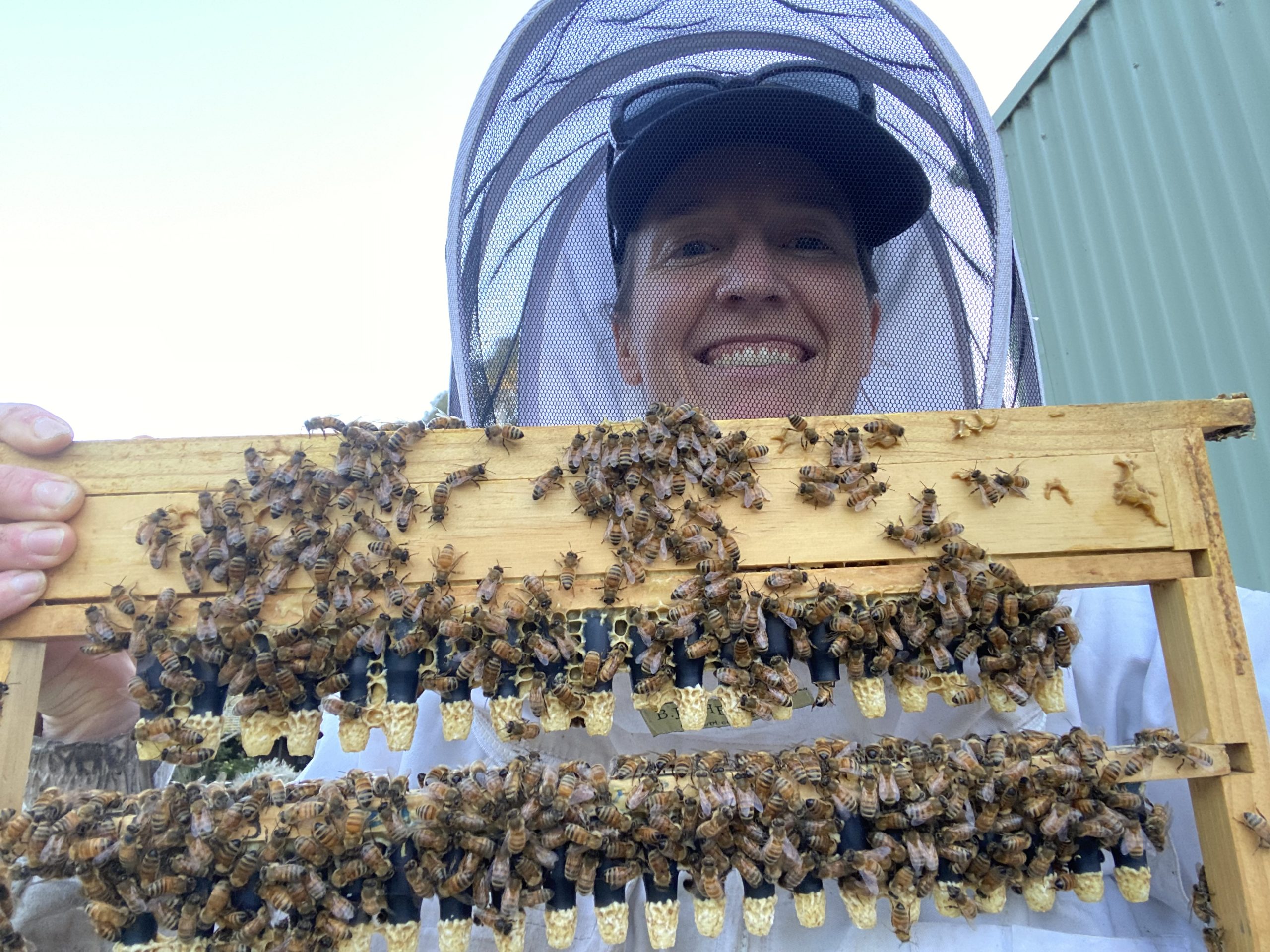
Elizabeth Frost, NSW DPI Technical Specialist – Bees, said that when Varroa mite becomes established in managed honey bee hives, it is expected that the wild European honey bee population in the environment will disappear.
This article was first published in the Winter 2024 edition of AFG.



