Variable rate fertiliser applications in orchards: costs, benefits and return on investment
Significant potential gains possible through the use of variable rate spreading technology to improve overall profitability of tree crops.
APAL has been evaluating variable rate spreading technology in the Goulburn Valley in two apple blocks. This project was carried out in partnership with GV Crop Protection, Fruit Help, Lenne’s Orchard and Plunkett Orchards, and was funded by the Agrifutures Australia Producer Technology Uptake Program (PTUP).
Fertiliser spreading
Using datasets generated in the first phase of the PTUP in 2022 on the same demonstration sites, a variable rate spreader – the Red Ant Auger Spreader – was successfully used to spread four products across each field during the 2023–24 growing season. The four different granular products were:
- potassium sulphate
- manganese sulphate
- ferrous (iron) sulphate
- boron.
These products were chosen due to the relatively high level of variation present in the soil – identified during the 2022 project – and the ability to source them quickly following delays in the importation of the spreader. Fertiliser was spread twice as a band to the tree, across the herbicide strip zone under the tree canopy, approximately three weeks apart. It became apparent early in the project that a high-quality flowable granule was necessary to maintain free flow of the unit, which uses an auger that ejects fertiliser into an airstream before being directed to the base of the tree through a piece of PVC pipe.
This spreader was chosen due to its unique design, with dual hoppers allowing for two products to be spread independently of each other (front and back) and to both the left and right of the unit. Two separate control boxes allow for the GPS position to be fixed and control of fertiliser flow to be controlled independently, based on prescription maps generated through (in this case) soil maps. Other variability identifying technologies can also be easily uploaded into the map – for example, NDVI data from satellite or drone, soil maps, vigour maps or hand-drawn maps based on the grower’s goals.
After loading the desired map, calibrating the machine’s flow for each product type and adjusting the desired speed and row and tree spacing data, each job was able to be pushed to the handheld controller (smartphone) that was mounted to the tractor and connected to the spreader via Bluetooth. The operator was then able to enter the mapped block to commence spreading based on the downloaded prescription map that automatically adjusted the flow of fertiliser based on tractor speed and GPS coordinates.

Cost–benefit analysis of variable rate spreading
While it was clear that the variable rate spreader did in fact work, that was only part of the assessment that was undertaken in this project. Variable rate spreading revealed fertiliser savings to vary based on product and innate field variability (saving ranged from 0–50 per cent relative to an estimated average requirement), but in these demonstration trials averaged ~16 per cent of the products used.
Results of the cost–benefit analysis suggested that a purchase based purely on fertiliser savings (at 20 per cent overall) was unlikely to see a direct benefit over the course of five years, with a gain in packout (due to improved fruit quality) a clear factor to ensure viability when assessing at a 50ha farm scale. Viability for the minimum area in hectares to justify purchase under a purely fertiliser savings model suggested that this would be justified on farm sizes >235ha.
If any gains in fruit quality were achieved, substantial financial gains were modelled justifying the capital cost and variability identification method of choice to be completed on an annual basis. Given poor performing trees often are cash negative (for example, highly vigorous trees with poor colour), the potential to address soil as a means to help manage them – among a suite of other changes – presents an opportunity to improve block-level profitability.
While the independent effects of soil-based changes were not able to be assessed in regards to fruit quality in this single season evaluation, it is clear that proper nutrition can enhance the quality of fruit and, thus, completing this to match the needs of different zones within a single block is likely to lead to improved outcomes as modelled.
Additional intangible benefits – such as reduced potential for overapplication and associated leaching, and reduced need for certain management tasks associated with excess fertiliser (for example, summer pruning) – and other environmental benefits were identified and should also be considered when evaluating this type of technology.
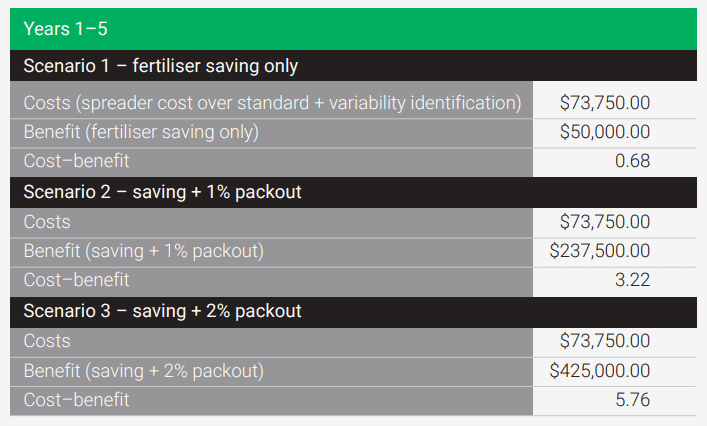
Table 1: Result of five-year cost–benefit analysis for use of the spreader based on a series of assumptions under three potential scenarios.
Note for Table 1: Assumptions used in the financial analysis were:
- Farm with 50 planted hectares of apples
- 20 per cent fertiliser saving
- 2 per cent packout gain, average yield of 50t/ha
- Variability identification cost $175/ha
- $21/12kg carton average orchard gate return
- Variable rate equipped spreader comes at a premium of $30,000 over a basic fertiliser spreader.
Recommendations
- Based on data sourced through this project and assumed for the purposes of analysis, growers should consider the adoption of variable rate fertiliser spreading where they believe improvements in fruit quality through modified fertiliser programs is likely in their blocks.
- Careful consideration to the types of fertiliser used with variable rate spreading should be undertaken, with a high-flowing granular fertiliser required for an air-based auger unit such as that used in the trial, which may differ to the grower’s current choices.
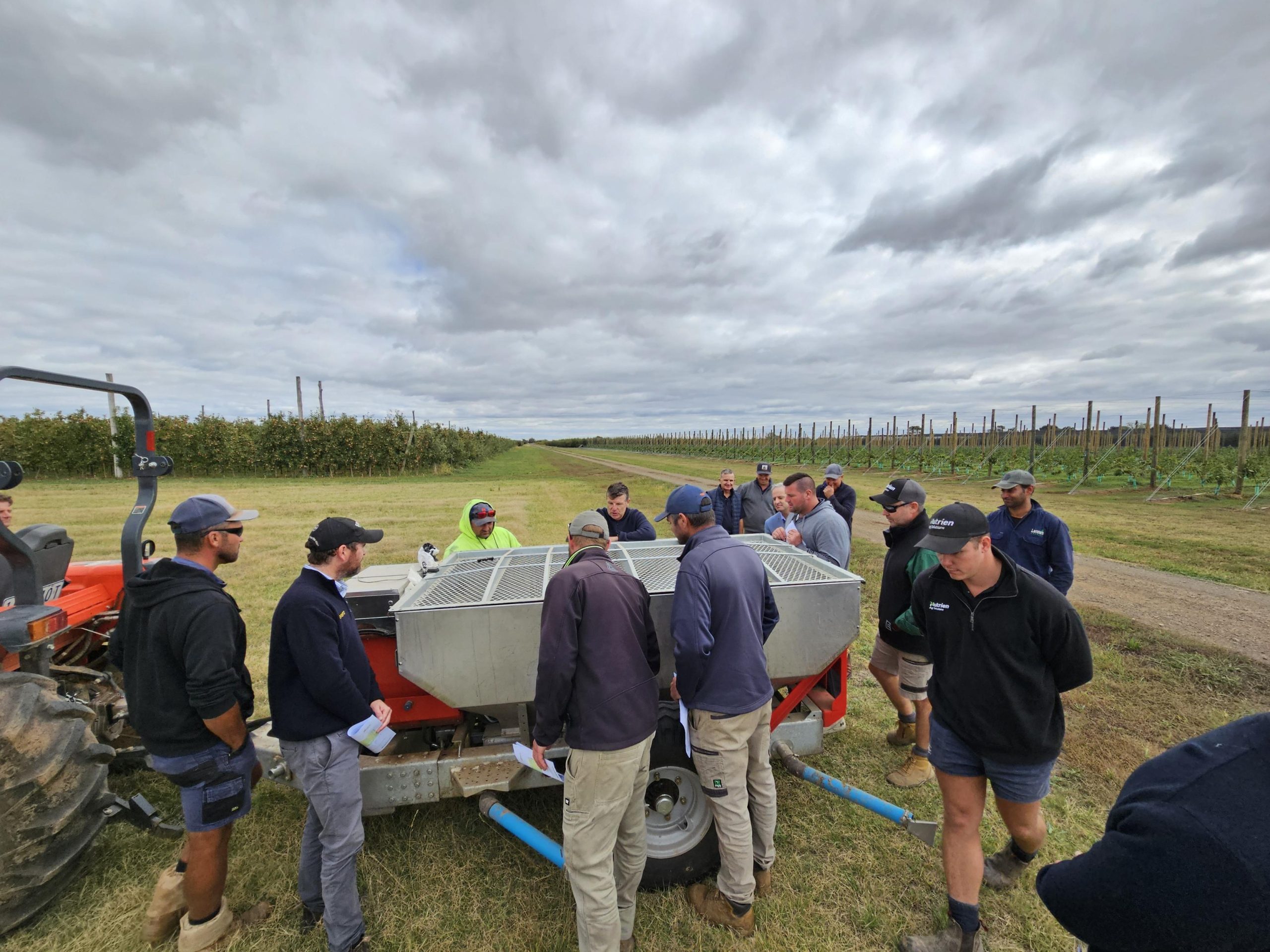
Growers at the preharvest field walk discussing the variable rate spreader and results to date.
Conclusions
Use of variable rate spreading technology in orchard environments has significant potential gains toward improving overall profitability in tree crops.
The Red Ant Auger Spreader used in this project is fit for purpose and allows a range of variability identification methods (satellite, aerial, ground-based or even hand-drawn) to be used to spread fertiliser variably to an orchard manager’s preference.
Barriers to adoption include:
- capital cost
- Economic analysis suggests a favourable cost–benefit ratio for adoption where minor improvements in fruit quality (1 per cent in packout) or improvements in fruit size are achieved.
- size of orchard
- Should no gains in packout be achieved, the minimum size to justify the purchase of a similar unit would be ~235ha based purely on fertiliser savings.
- technology and data skills
- A computer and smartphone were required to operate the spreader and use of these may present a challenge to some growers.
- However, the capability to have a central person (such as an agronomist) prepare maps and ‘push’ to a user’s smartphone may enable a wider pool to use this technology.
- A number of modern tools are now controlled through similar touchscreen interfaces whereby setup can be done by an advanced user with an operator effectively hitting start/stop buttons and accepting tasks.
Next steps
Growers can trial the technology on their own farm thanks to project partner GV Crop Protection. Those interested in trialling the spreader on their own farm are encouraged to contact Nic Finger at [email protected].
Further information
- “Precision orcharding through variable rate spreading”, AFG Summer 2023: apal.org.au/precision-orcharding-through-variable-rate-spreading/.
- “Potential to improve crop quality and yield supports case for variable rate spreader”, AFG Winter 2023: apal.org.au/potential-to-improve-crop-quality-and-yield-supports-case-for-variable-rate-spreader/.
- The AgriFutures Australia Producer Technology Uptake Program is a national program, aimed at helping producers overcome barriers to technology adoption, including digital literacy, lack of understanding on the potential return on investment, and overall appetite for technology. Visit agrifutures.com.au/producer-technology-uptake-program/ to find out more.
Acknowledgement
This project was supported by funding from the Producer Technology Uptake Program facilitated by AgriFutures Australia. APAL thanks Agrifutures Australia for its support of this project, as well as GV Crop Protection for its co-funding arrangements and purchase of the spreader used in the project.
This article was first published in the Spring 2024 edition of AFG.