
Trip report: Interpoma 2024
In this first of two articles, Nic Finger reports on his observations about new planting systems and emerging technologies from the recent Interpoma apple trade show.
In November, apple experts from all over the world came together at Interpoma in Bolzano, Italy for three days of speaker presentations, guided tours, exhibits and workshops. I attended Interpoma as part of the Developing orchardists of the future (LP23001) pilot program, which is funded through Hort Innovation Frontiers.
New planting systems
Multi-leader systems continue to see slow adoption in many areas of Europe and across the world. In addition, a shift to narrower row systems is likely to require a relatively large step change in growing style, equipment and other management activities. Key drivers for growers adopting these systems were quoted as follows:
- Reduced tree costs per hectare; however, the operating costs for the first 1–2 years was consistently elevated with an additional 200–300 hours of tree training required.
- High Class 1 yields per hectare.
- Simpler management of tree vigour.
- Further potential light capture with row to height ratios pushing out to 140 per cent of row width in some cases, for example, 2.8m rows at 4m height and 2.4m rows at 3.6m height in commercial settings.
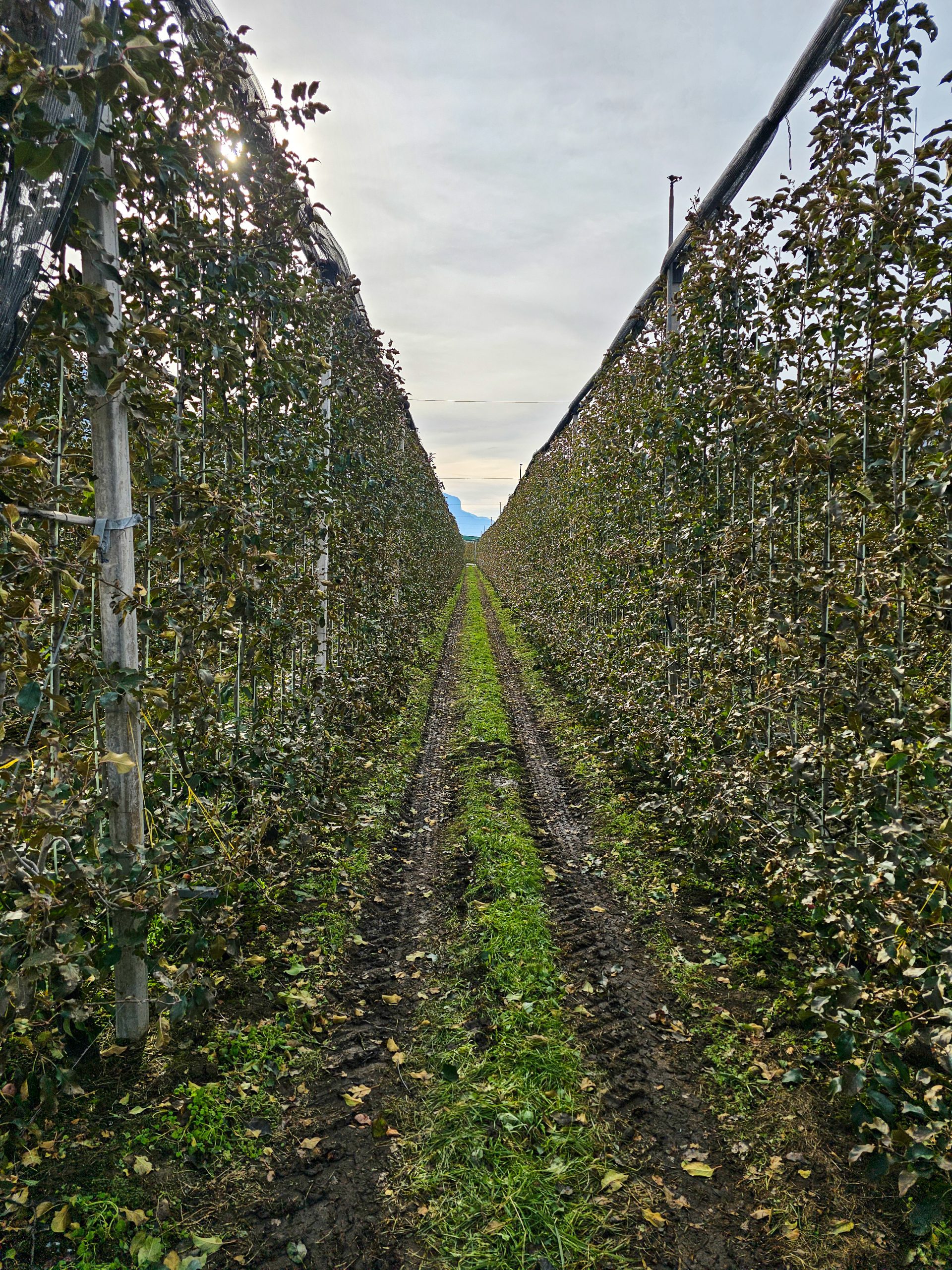
A 6-leader Lady in Red planted at 3m x 2m with six uprights per cordon (33.3cm between uprights). To compensate for the wider row, a 60cm wide yoke system (30cm per side) is employed at the lowest wire to provide a ‘tabletop’ of waist-height fruit to increase bearing surface.
Existing harvesting systems are not necessarily suitable for these systems and lighter weight systems are seemingly the preferred way forward. For example, rather than a single large platform with four to six people on it, narrow row multi-leader systems seem to be positioning towards smaller teams operating lighter weight systems as a combination of the restricted drive row (there is realistically only one driving position in the <2.5m rows).
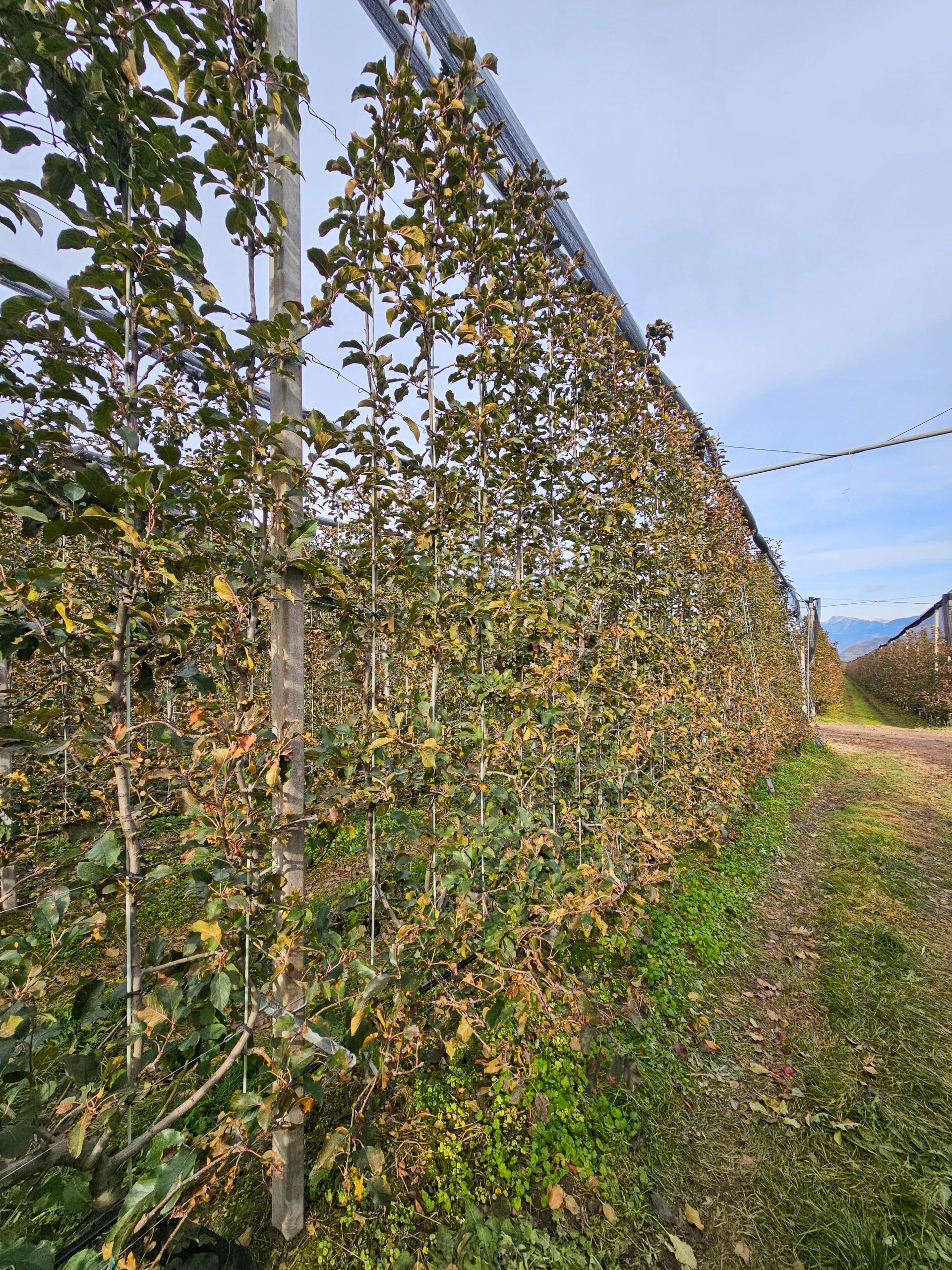
A 5-leader Rosy Glow block on M9 rootstock planted at 2.8m x 1.5m with five uprights per cordon (30cm between uprights). It had just achieved 92t/ha in the 5th leaf.
This lighter weight format machinery seems to be relatively cost effective. Platforms in this style (see Frucotec Landlady platform image) are typically quoted at €6,000–12,500 dependent on make and options, so investment would largely be expected to be similar or slightly lower than pre-existing harvest-assist options
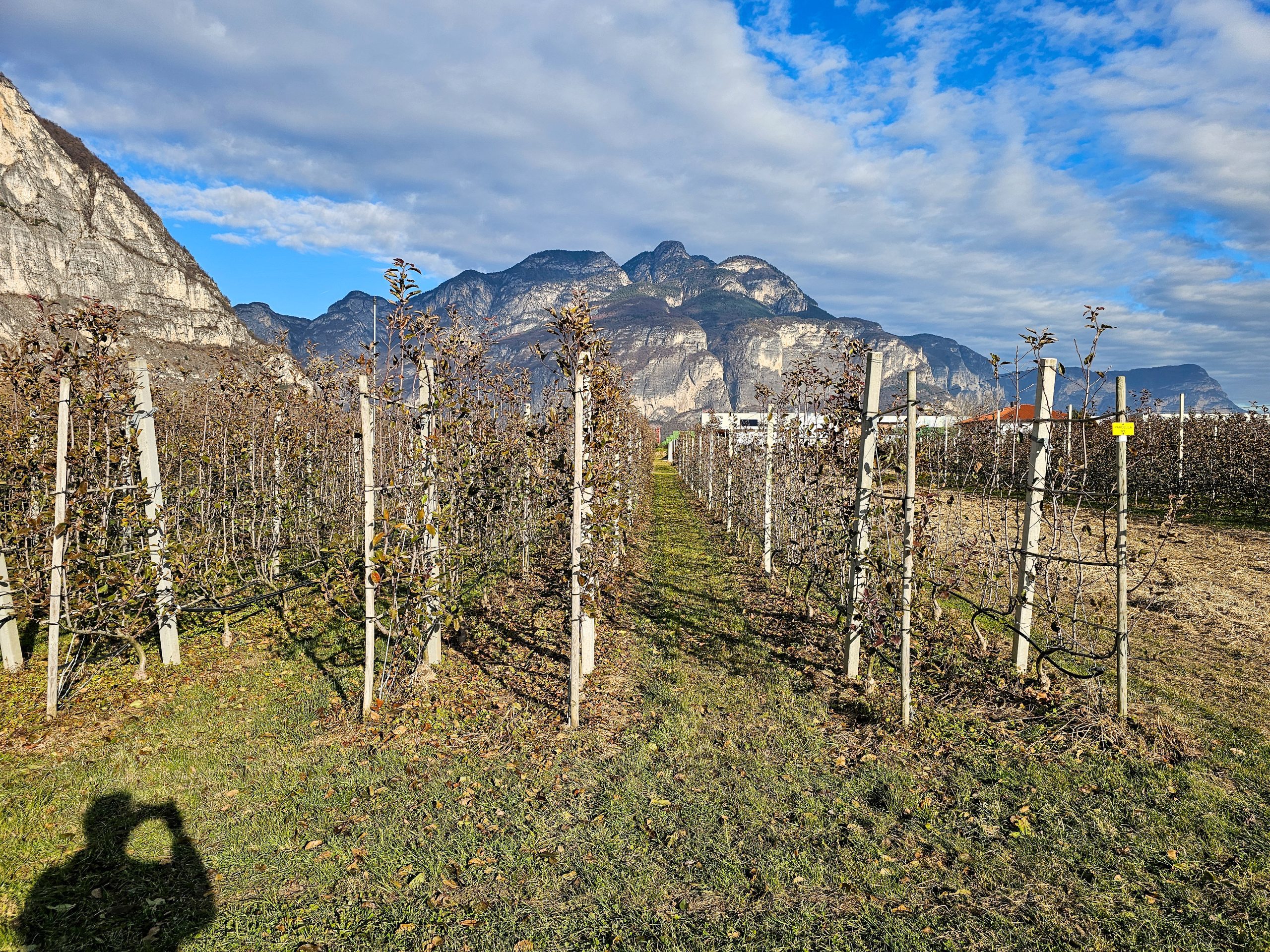
An example of a multi-width narrow row trial system with alternating 2.2m and 1.4m row widths, with the wider row being used by machinery.
Emerging technologies
Continued growth in variability management/identification tools was clear at the trade show, with various data capture points highlighted by each manufacturer. They broadly fit the following categories:
- On-tree imaging, for example, Aurea Imaging, Green Atlas Cartographer, Vivid Machines and Naturamon.
- During harvest scanning, for example, Munckhof and Revo harvest platform data capture/scanning.
- In-bin imaging, for example, Hectre and Optiflux.
To match the above, a number of sprayer manufacturers now have GPS equipped sprayers with automated valve control based on output maps (i.e. their own sensing systems) to allow variable rate application in the orchard for spray tasks. In addition to GPS capability, many manufacturers’ ‘flagship’ sprayers were equipped with newer drift reduction features and several manufacturers were showcasing canopy sensing equipped sprayers with sector control to match missing areas of the canopy or missed trees.
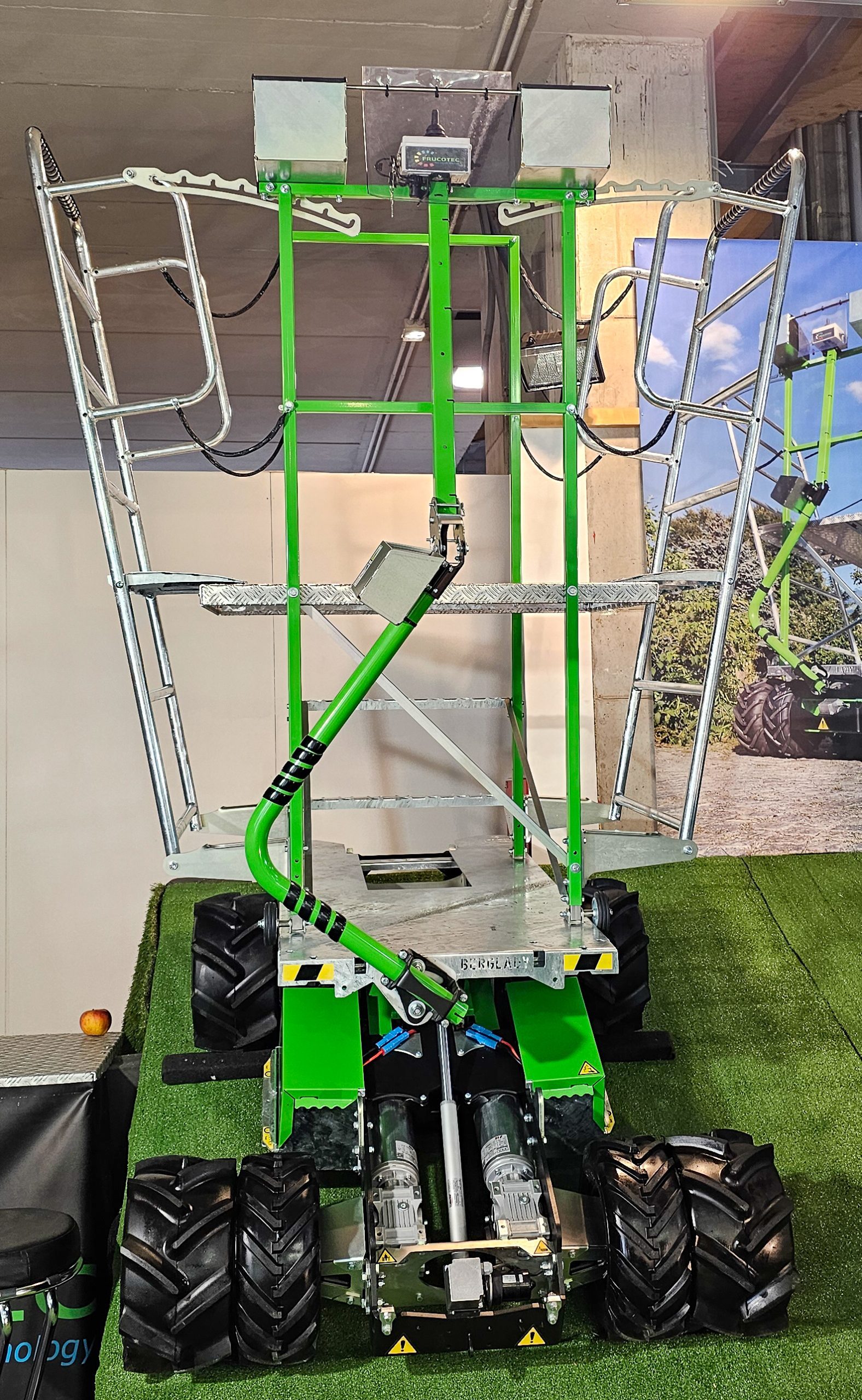
A lightweight Frucotec Landlady platform (300kg) that is being positioned as a lighter-weight labour assist solution, particularly in narrower row systems.
Movement away from traditional herbicide strips to cultivation or line trimming implements was apparent, with the line trimming option being the dominant style on show, typically integrated with a mower for a single pass weed management option. Reduced herbicide use was a trend in orchards, with narrow strips and a shrinking pool of herbicides resulting in growers exploring these options moving forward.

The BMV Newton fruit thinning machine is designed to mechanically remove larger sized fruit off the tree.
Small robotic sprayers and mowers designed for ultra narrow rows were on show at the exhibition, but they have relatively limited battery life at present. Demonstrations of the SlopeHelper robotic platform showed some of its interchangeable components to allow year-round usage.
Overall, a range of new platform technologies, sprayers, variability identification and other options were on show, with newer features being added to these emerging technologies.

The Rinieri multi-arm Florix flower thinning machine with independent string thinners at various heights along a tower.
In the Autumn 2025 edition of AFG I will report on my key findings from Interpoma and visits to orchards in Italy, Switzerland and Germany, emerging themes in Europe and opportunities that growers may be able to seize, particularly in the technology space.
Take home messages
Narrow row multi-leader canopies continue to be explored, and a suite of more appropriate machinery options continues to emerge.
- Any development should consider the costs of this machinery and appropriate scale to optimise the additional capital expenditure on new machinery.
There are a range of new technologies available and emerging within the market:
- Sprayer drift reduction.
- Robotics.
- Variability identification/management.
- Weed strip management.
Acknowledgement
 Nic Finger’s attendance at Interpoma was part of the Developing orchardists of the future (LP23001) pilot program, which is funded through Hort Innovation Frontiers with co-investment from APAL and Pink Lady® and contributions from the Australian Government.
This article was first published in the Summer 2024 edition of AFG.



