Train your way to a more productive, efficient and easier to manage orchard
Italian pomology researcher Alberto Dorigoni joined the Future Orchards® winter orchard walks and APAL Technical Symposium to share his experience of using multi-leader systems to lift orchard productivity and efficiency, while reducing input costs.
Key points
Multi-leader systems deliver:
- greater intensification for less tree outlay
- improved crop quality and uniformity
- simpler management and labour efficiencies
- reduced chemical use
- readiness for mechanisation.
Narrow multi-leader systems can deliver higher packouts and labour efficiency from a lower outlay on trees than comparable central leader systems.
Visiting Italian pomology researcher and grower Alberto Dorigoni told attendees at the APAL Technical Symposium and Future Orchards® winter walks that, while there were several competitive modern training systems, multi-leader systems were easier to thin, prune and spray effectively and better suited to mechanisation, more than offsetting higher establishment costs.
“Double leader, multi-leader and Guyot training systems are effective alternatives to central leader and other modern tree shapes,” he said.
More light, simpler to manage
Drawing on his three decades of experience as a researcher with the Fondazione Edmund Mach and, more recently, experimentation in his own orchard at Friuli in northern Italy, Alberto outlined the evolution of multi-leader systems and the physiological argument for dividing trees into leaders and moving away from long, horizontal branches.
Dividing the canopy to create two ‘treetops’ increased the canopy surface area, he said, and therefore vital light interception.
Alberto said early production trials of twin leader – patented as a Bibaum® by Italian Mazzoni Nursery around 20 years ago – versus spindle Fuji found that doubling the treetops increased the fruit numbers without impacting fruit weight, and improved colour coverage right down through the tree.
“Fruit quality is higher on the treetops,” Alberto said. “We have almost doubled the number of fruits, and the number of kilos, in the upper part of the tree and therefore we increased the percentage of better quality apples.”
Shortening laterals to create a more two-dimensional system had been found to provide more uniform fruit exposure throughout the canopy; making fruit easier to see and reach, driving higher efficiency and enabling narrower rows for greater production per hectare.
“It makes all the operations that are done by hand very, very efficient; harvest in particular,” Alberto said. “Also, the fruits are held in the same position, so they don’t tend to move like they do with a long branch.
“We can shrink the canopy and reduce the alleyways (row width) and more easily apply mechanisation. For example, Darwin mechanical thinning, or hedging, or leaf removal, is much more effective.”
Alberto said narrow canopies, where fruit could be easily seen and assessed, also made it easier to do precise bud counts, crop load estimates and adjustments.
“You can make easy bud counts and calculations of what your crop is going to be and adjust it pretty simply, because you can see everything,” he said.
“So, we march towards higher efficiency and precision horticulture.”
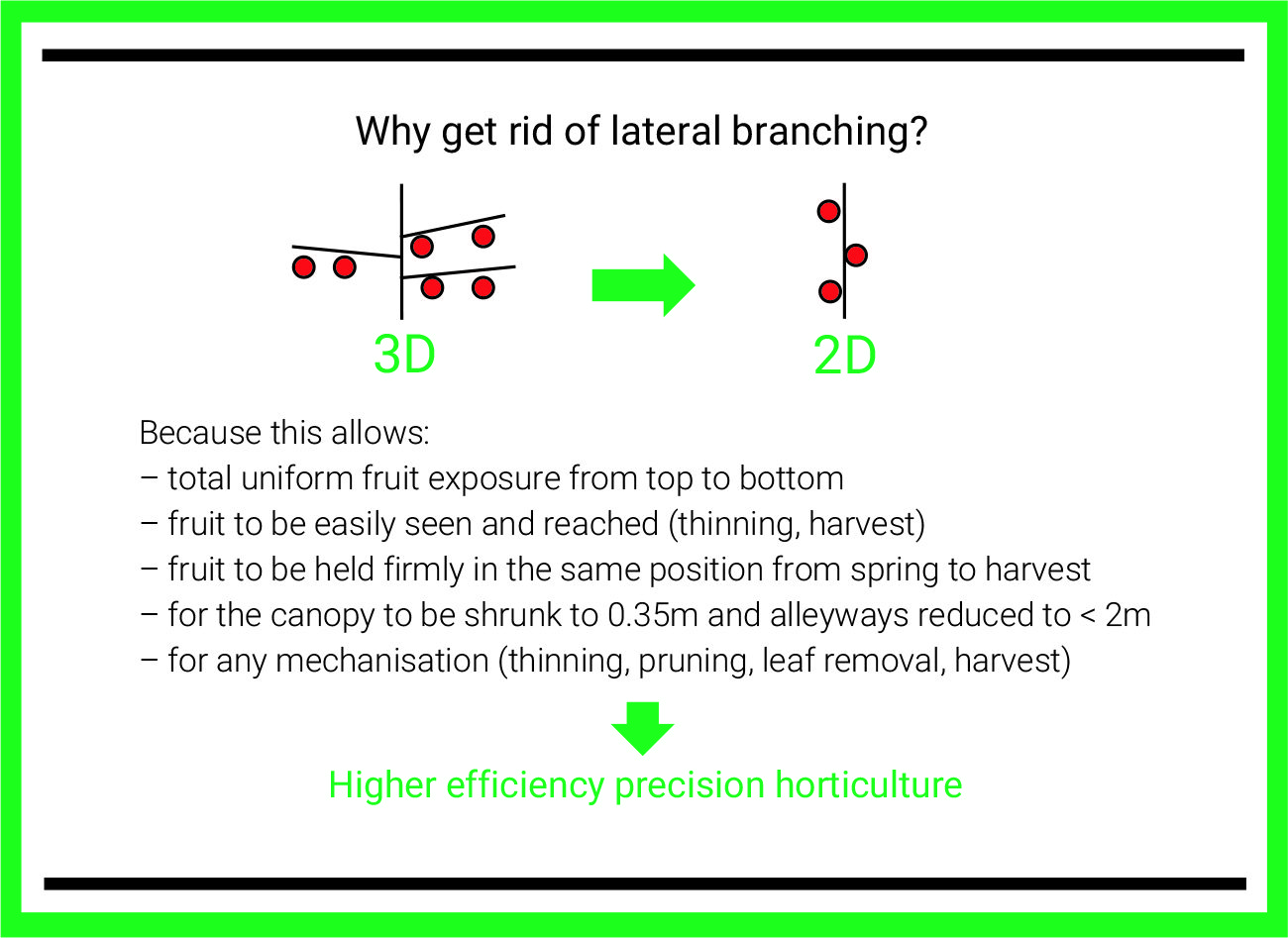
Figure 1: Narrow canopies drive efficiencies and enable precision horticulture. Source: Alberto Dorigoni
Exploiting vigour
Alberto said a further benefit of multi-leader systems identified by researchers was that vigour was spread across the increased number of leaders, which had practical implications for managing vigour in the orchard.
“When we split the tree into 2, 3, 4, 6 or whatever number of leaders, in terms of vigour, it’s very similar to changing from a medium vigour rootstock to low vigour, or from a high vigour to a medium vigour. It has a dwarfing effect.
“A multi-leader can exploit vigour very well, so this is another variable, alongside variety, rootstock and soil fertility, to give you the right planting.”
As the tree’s tendency is to pull nutrients and grow more strongly at the centre, Alberto said he favoured a 4-leader over a 3-leader system – where the central leader could dominate – for a more homogenous tree.
“We tend to build the outside of the tree at least one year before the inside, to compensate for the centrality that trees have,” he said. “We try to build the outside of the tree and then the inside will come and catch up.”
Guyot
Taking the multi-leader system a step further, Alberto said the Guyot system rotated the geometry of the tree 90 degrees to create a highly productive planar system with no fixed number of leaders, and the flexibility to continually replace older wood with new.
First developed for vines, the Guyot involves tying down one (or two) leaders to form a single (or double) horizontal cordon, from which the shoots grow vertically to form replaceable uprights.
For the entire life of the orchard the renewal wood starts at the same height, 0.5 metres from the ground level.
“The only permanent structure is the cordon or cordons, and the vertical ‘suckers’ transform into treetops, and are not permanent,” Alberto said. “They are used and exploited, as long as they don’t become too big, when they are replaced accordingly.
“What I like about the multi-leader system in general is that you can rejuvenate it. In a 4-leader, you can remove one of the biggest leaders in the middle after 10 years and replace it. This is even more true in a Guyot system where this is not the exception, it is the rule. After 4, 5, 6 years, depending on the vigour, you start renewing with new ones.”
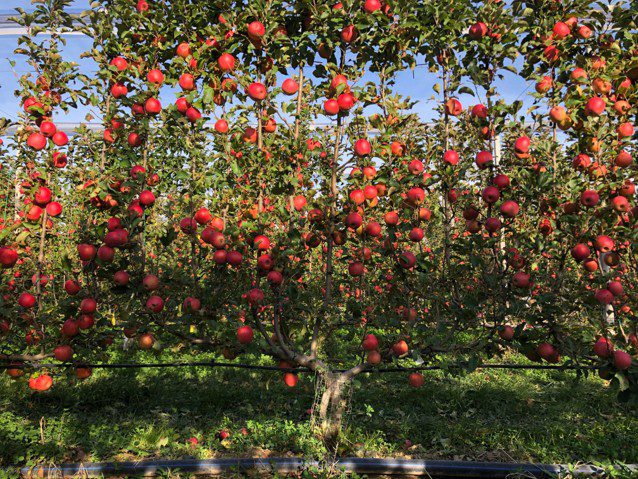
Figure 2: A double Guyot of Rosy Glow in 3rd leaf, yielding 20kg/tree in the Mazzoni orchard (Ferrara).
To establish the system, the Guyot cordons are first laid down to establish the outer leaders, before establishing the inner uprights 15–20cm apart. Tree spacings were approximately 1.8–2.4m for a double Guyot or 1.2–1.8m for a single Guyot system, and in his own orchard he used a row spacing of around 2.3–2.5m as any narrower made it too challenging to work.
Although requiring additional training in the first few years Alberto said upfront costs for the Guyot were more than compensated for by the greater uniformity and quality of the fruit, the higher yields and vigour control, and the labour efficiencies of working a more intensive and simpler system.
Trials with the Guyot system had comparable or lower total costs to central leaders by the third year of establishment (Figure 5). Savings from lower tree numbers – even allowing for a higher number of rows made possible by the narrower canopies – more than offset the high outlay in the first two to three years on training leaders to the wires.
“In the first three years, you are almost even, especially if you choose a lower number of trees with a double Guyot,” Alberto said.
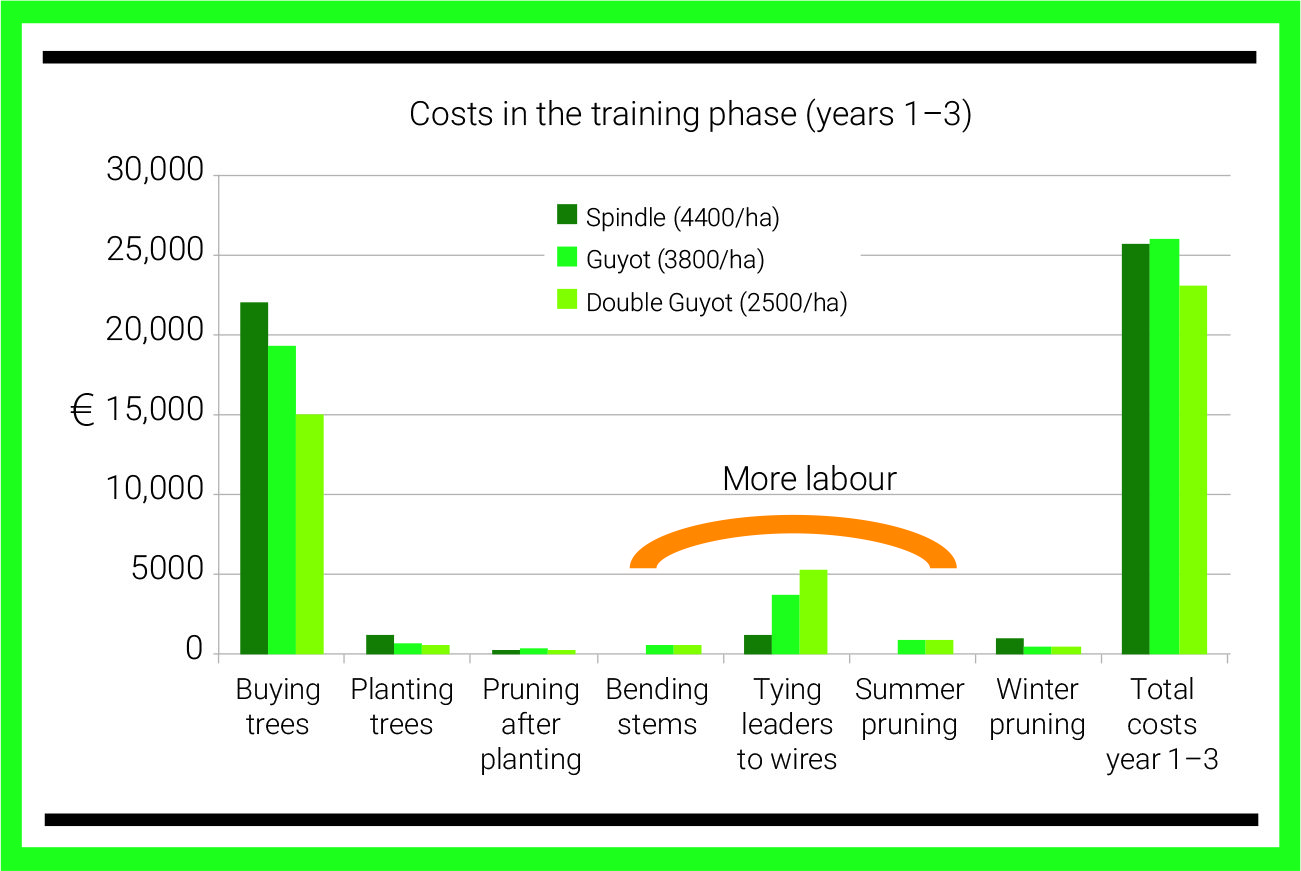
Figure 5: Although training costs are high for Guyot and double Guyot in the first few years, or training phase, they are offset by lower tree purchase, planting and winter pruning costs. Source: Alberto Dorigoni.
Asked if a single or double cordon was better, Alberto said it depended on the cultivar, rootstock and soil fertility.
“If I have poor soil or a low vigour cultivar, I use a single Guyot and train five leaders, no more,” he said. “If I have very good rootstock, good fertility, good variety, I would go for a double.”
Good trees a must
In Italy, growers have access to high-quality Bibaum trees, with two balanced leaders already established, rather than heading back a whip and developing leaders in the orchard as is more common for Australian growers.
“Tall, feathered trees will save a lot of time and money,” Alberto said.
“We start bending the cordon to the horizontal (90 degree) when trees reach about 1.8m. Having feathers (short limbs) is also important in getting early crops. In fact, some feathers – the ones in the right position – become the first vertical leaders.”
Alberto is experimenting with pedestrian orchards, potentially reducing the need for platforms, as high productivity means the same tonnage can be achieved from shorter 3.2m trees.
His vision for apple orchards of the future is of a 2D-like fruit wall system that reduces input of both chemicals and labour and is suited to mechanisation.

Figure 4: Alberto Dorigoni (right) viewing a single Guyot of a high-coloured Cripps Pink strain at Jassi (centre) and Hardeep Bhangu’s Ardmona orchard during the Technical Symposium field day in August – “… a very nice example of what you can do on a single Guyot. It is flat, has good treetop and balance of the vertical leaders.”
Further information
Advanced tree training for orchard efficiency (video with Alberto Dorigoni): https://youtu.be/tEbbdxXa7QM
Planar canopy systems (video with Ken Breen): https://youtu.be/7ELiPhoSKtM
The PIPS 4 Profit Optimising apple production systems project is evaluating renovating orchards to multi-leader systems as a transition to 2D fruiting wall systems. Look out for an update in the summer 2025 edition of AFG and read more about the project at apal.org.au/projects/AP22004/.
“Italian orchards growing into the multiverse” (January 2023) Good Fruit Grower: https://goodfruit.com/italian-orchards-growing-into-the-multiverse/
This article was first published in the spring 2025 edition of AFG.