
Tips for Qfly control as we head into spring
Written by Bronwyn Koll, Regional QFF co-ordinator, Yarra Valley QFF Awareness & Management Project.
Experts indicate we can expect carried over Qfly pressure this spring and into the 2022–23 fruit season.
We are in for another high-pressure fruit fly season (2022–23) given several factors:
- Queensland fruit fly (Qfly) populations were still present last autumn.
- The likely La Niña and negative Indian Ocean Dipole (IOD) influence over rainfall and humidity this season.
- Favourable Qfly weather days, temperature-wise, already occurring this August.
- Some Qfly detections already recorded in August 2022.
These factors mean that Qfly can’t be ignored or addressed later, and we will all need to use all the tools in the toolbox this season.
Qfly pressure in late autumn 2022
Qfly pressure remained high at the end of the last fruit season. Janren Consulting’s report for the Goulburn Murray Valley (GMV) fruit fly program, Queensland Fruit Fly Goulburn Murray Valley Grower Outlook May–June 2022, suggests “weather conditions for April and May 2022 were not significantly damaging to fruit fly survival and activity, indicating the fruit fly season will extend further into late autumn and early winter than usual”.
The Yarra Valley also experienced Qfly activity in May 2022. The report on a single Qfly found in the Yarra Valley last season (May 2022) states: “Qfly, Female, Ovaries developed with few well-formed eggs, … most likely not mated yet … with a larger number (of sample flies to test) we could (potentially) argue for an overwintering population of adults that will mate when the new favourable season starts”.
Unless there were concerted efforts to treat potential Qfly-damaged fruit fallen to the ground and unless effective baiting and chemical controls were still being applied late in the 2022 fruit season, experts have indicated we can expect carried over Qfly pressure for this spring and into the 2022–23 fruit season.

Rainfall and humidity
On the back of two La Niña-influenced fruit growing seasons where Qfly populations were aided in survival by higher-than-average rainfall and humidity, we are possibly in for another wetter-than-average season ahead that will most likely promote Qfly survival and increase Qfly populations, and therefore pose an increased Qfly risk to fruit production. According to an ABC News article on 3 August, “BOM declares negative Indian Ocean Dipole, likely to add to unrelenting rain in Australia’s east”, the Bureau of Meteorology is giving indications of the formation of another La Niña and suggesting the likelihood of rainfall and humidity will also be increased due to the influence of the negative IOD climate driver.
Warm August days and Qfly activity
Spring weather has already graced most of Victoria, albeit for a brief period. Janren Consulting shared some recent temperature observations with our team of QFF Area Wide Management co-ordinators about a significant warming trend of day and overnight temperatures in all Victorian regions for the first week in August. During this same week, early reports are suggesting a small number of Qfly detections in monitored Qfly traps in the Goulburn Valley.
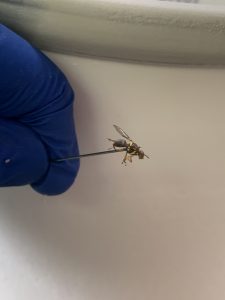
Interpreting the scenario and using clues from the landscape to promote improved Qfly control
It is important to remember the role of the Qfly monitoring traps in this seasonal outlook work, and how the information can support early action in any region (high or low Qfly pressure).
Qfly monitoring traps attract male fruit flies – only those mature enough to mate
The information about Qfly population detections is based on findings in the network of Qfly male attracting traps. The lures attract males that are reaching maturity and a ready to mate. We know that this means the male Qfly have been feeding and maturing for a period of time leading up to the point that they are lured to the trap. The opportunity to use a food-based bait to control these very flies existed over the prior fortnight period leading up to his capture (where the male Qfly was spending his time feeding). We also know that the presence of male flies is a strong indicator of female flies in the area.
Qfly baiting needs to start now
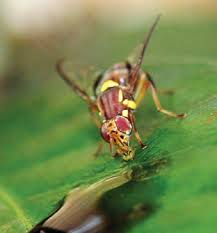
Qfly don’t travel far unaided and this is where we can get the early jump on controlling the Qfly population. If baiting activities started now (in selected areas), Qfly populations would potentially never increase exponentially like they have the capacity to do uncontrolled. Best to try and be ahead of the Qfly population curve!
Qfly control is best utilised at targeted sites in early spring:
- HISTORICAL RISK: Where Qfly was known to be present at the end of last autumn, including habitat near apple blocks.
- EVIDENCE RISK: Where Qfly are being detected in traps now – see your own property trapping data.
- HIGH RISK PRACTICES: Where high-risk practices are currently occurring (i.e. fruit production such as citrus hanging on trees, or other unprotected and unharvested fruit hosts) – look around your farm and help your neighbour or roadside area deal with overwintering produce that could be hosting
- HIGH RISK HABITAT: Where Qfly habitat has hosted flies over winter such as warm, protected areas (bush areas, stored timber, shrubs around dams and creeks, sheds, chook houses and evergreen trees, especially in home gardens).
Advantages of early baiting
Bait can be applied in high-risk locations, on the warmer days, at times when Qfly are most likely going to be out feeding (before mating). This need not be regularly each week until the weather or trapping data indicates regular Qfly activity. A stitch in time saves nine! Chemical volume could be kept to a minimum and target areas could be exploited with effective baiting to prevent the need to cover a wider area with Qfly controls later. If channel water supply for bait application is an issue, consider how to apply a concentrate bait formula** that uses less water, and apply it in key areas. (**See your agronomist for best rates for your use and your equipment – it may need to be calibrated, altered or new equipment made.)



