
Testing narrow row 2D multi-leader apple systems in Western Australia
Can modern orchard production systems enhance climate resilience, productivity, profitability and sustainability?
Why narrow orchard systems?
Narrow orchard systems (NOS) take advantage of a two-dimensional multi-leader canopy to squeeze rows closer (2–2.5m) and extend tree spacing (2–3m). This increases total light interception and the evenness of light as it passes through the foliage to maximise fruit quality and yield while keeping the initial cost of trees equivalent to current high-density planting systems.
Constraining the canopy height and vigour by grafting to the best available dwarfing rootstocks make an orchard:
- safer and more accessible to field workers
- amenable to robotics, automation, sensing and crop protection
- more efficient in resource use (labour, space, energy, etc.), thereby enhancing profitability.
The new five-year national Narrow orchard systems for future climates project is designing and testing NOS in various crops (apple, pear, cherry, apricot, plum, nectarine) to maximise yield, fruit quality, climate resilience and the efficient use of labour and resources.
Industry-oriented research and innovations in past decades have significantly helped fruit crop industries worldwide to overcome the many challenges they face. These innovations include new cultivars adapted to hotter climates, new planting systems that optimise light interception and penetration through the canopy,1 sensor technologies auto-monitoring real-time plant functions, and experiment-model-integration towards digital decision-making tools to support growers.2
As the industry faces decreasing chill accumulation (Figure 1) and more frequent and intense heatwaves that cause substantial stress on the performance of multiple fruit crops and affect the harvest time window, the current trend is to move towards modern orchard production systems with enhanced climate resilience, productivity, profitability and sustainability.
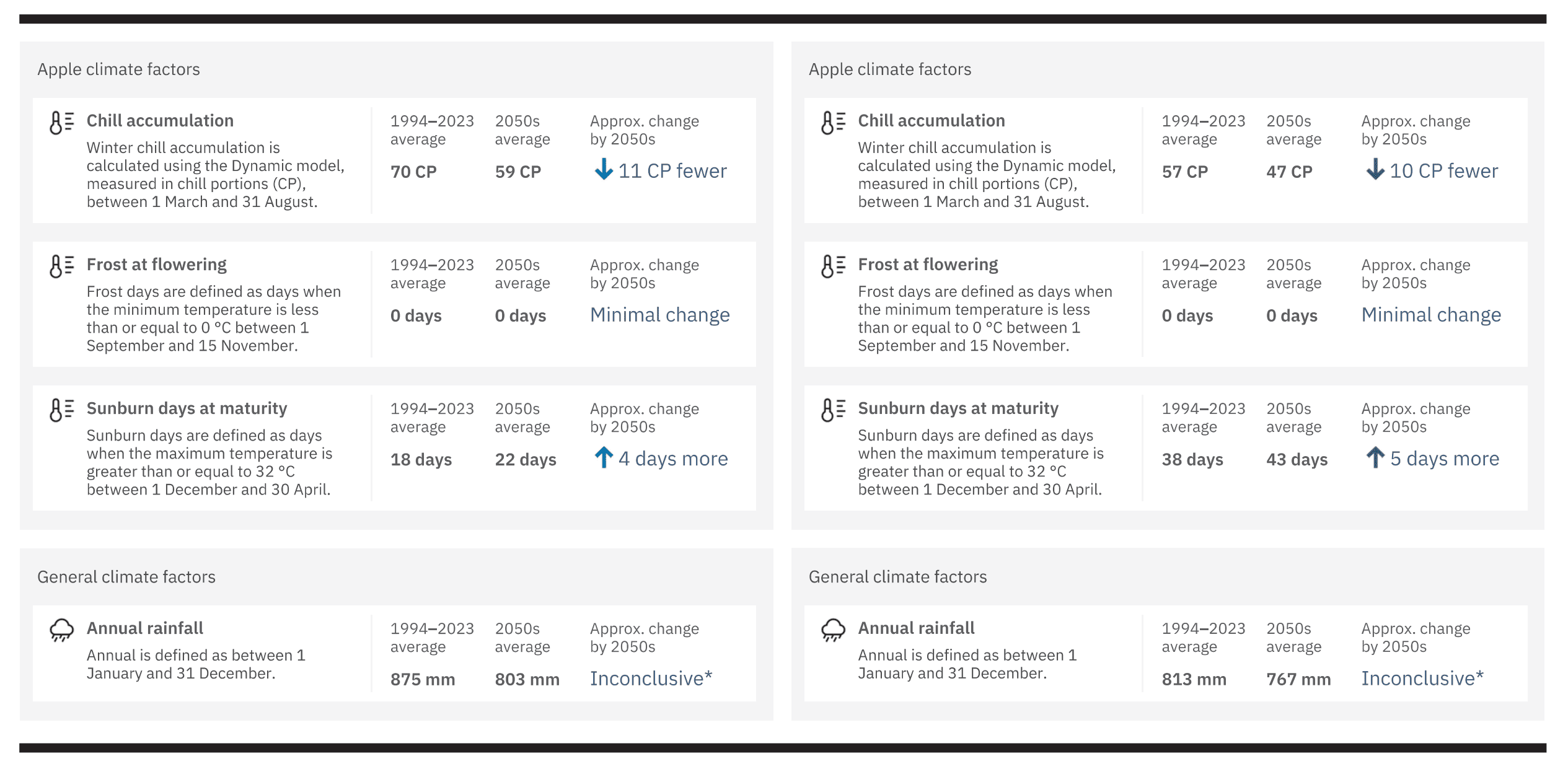
Fiigure 1: The projections on change of apple climate factors in Manjimup WA and Donnybrook WA by the 2050s. Source: myclimateview.com.au
As part of the Narrow orchard systems for future climates project, researchers based at the Department of Primary Industries and Regional Development’s (DPIRD) Manjimup Horticultural Research Institute in WA are testing the interactions between three Australian-bred apple varieties, three commercially available rootstocks and three cordon-based planting systems. These tests, integrated with an economic analysis, aim to validate the best combination(s) of cultivar, rootstock and planting systems for Australian apple growers.
The varieties being used in the project are ANABP 01 (sold domestically as Bravo® and internationally as Soluna™) and two uncommercialised varieties, ANABP 09 and ANABP 14 (Figure 2). The two uncommercialised varieties show great opportunity following the success of Bravo/Soluna in response to both domestic and international market demands.
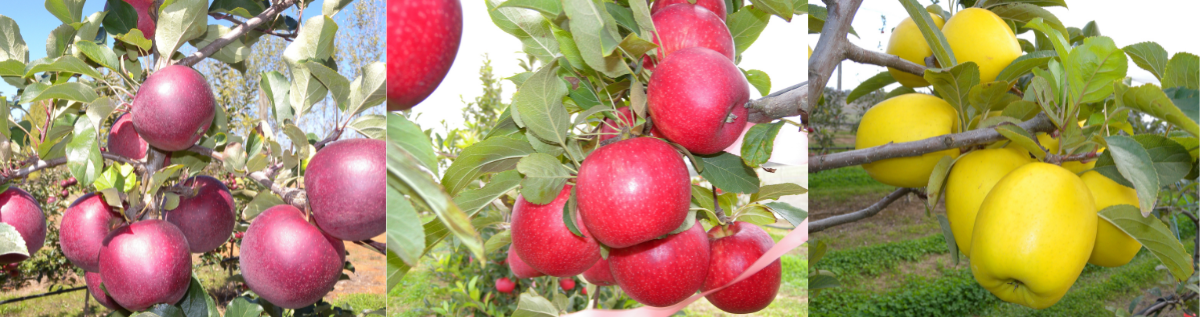
Figure 2: Three apple cultivars with distinct market-oriented characteristics bred by the Australian National Apple Breeding Program are being used in the project: ANABP 01 (left), ANABP 09 (middle) and ANABP 14 (right).
The comparison of the three cordon-based canopy systems delivering pedestrian fruit walls – single cordon, double crossover cordon and standard double cordon (Figure 3) – aims to investigate the time it takes to fill the canopy space, precocity of fruiting, investment into canopy training and/or return on investment. For example, compared to the double-cordon systems, the single cordon system does not require cutting of the trunk to trigger the standard cordon shoots in the first year, supposedly saving time and energy for the trees to reach full canopy and production. In the double crossover cordon, the bending and crossing of the two major stems (cordons) is supposed to also stimulate canopy development and overall consistent production, according to the experiment in Italy reported by Dorigoni¹.

Figure 3: Conceptual figure of the three canopy training systems to be tested by DPIRD in Manjimup: single cordon (left), double crossover cordon (middle) and standard double cordon (right).
The same apples trained as standard double cordon will also be compared on three different rootstocks – two dwarfing (M26 and M9 Nic® 29) and one semi-dwarfing Geneva® (CG) 202 – with the aim of identifying the most consistent, resilient and profitable combination.
The experiment will collect data on light interception and within-canopy light distribution, tree growth, fruit yield and fruit quality. In addition, the project will test appropriate technology in the form of various types of plant-based sensors, autonomous vehicles and auto field grading technology suitable for NOS. Economic analysis of the different cultivars, rootstocks and training systems will be performed.
The project outcomes will be insightful for growers, stakeholders and industry researchers interested in new Australian-bred cultivars with export prospects, 2D production systems and emerging robots, with a view to enhancing yield, quality, production efficiency and climate resilience.
Acknowledgement
The Narrow orchard systems for future climates (AS22002) project is funded through Frontiers developed by Hort Innovation, with co-investment from Agriculture Victoria, NSW Department of Primary Industries and Regional Development, South Australian Research and Development Institute, Department of Primary Industries and Regional Development WA, University of Queensland, Plant and Food Research New Zealand, Pomewest, Tobias Industries and contributions from the Australian Government.
References
1 Dorigoni and F Micheli “Guyot training: A new system for producing apples and pears”, European Fruit Magazine, 2018, 2:18–23.
2 Zhou, Z Ye and D Stefanelli “Experiment-modelling-integration of fundamental physiological processes towards digital twin: light-response of photosynthesis as an example”, Acta Horticulturae, 2024, 1395:133–140.
This article was first published in the Summer 2024 edition of AFG.



