
Real time quality
This article originally appeared in the Spring 2021 edition of AFG magazine, available online here.
“We had expected this project would need at least a few seasons to build data, but that was before Covid-19 and our industry’s urgent need to better understand the impact of new harvest practices on fruit quality,” says Justin Smith, APAL’s Head of Industry Services speaking about APAL’s Quality Testing project that commenced earlier this year.
APAL has engaged Quality Associates to conduct quality testing (Brix and firmness) at key points in the supply chain – firstly as the fruit arrives at major retailers’ distribution centres, and secondly once the product is in store and on the shelf.
The program draws on Quality Associates’ relationships with the major retailers and their role in the successful quality improvement program for the Australian Table Grape Association (ATGA).
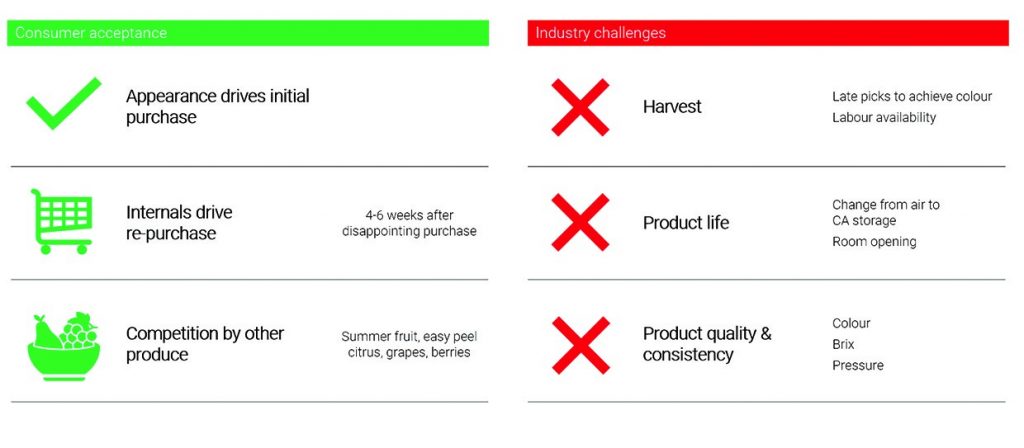
The project rationale
“The ATGA project was key to addressing negative eating experiences that result in delayed repurchasing and have an enormous impact on Table Grape demand, sales and price,” said Andreas
Klieber of Quality Associates.
On the back of its program, ATGA introduced national minimum maturity standards for domestic and export markets to ensure growers harvest their fruit at the optimum maturity and so provide a consistent high-quality experience for consumers from the start of season to the end.
“Getting quality right and consistent underpins domestic and potential export market growth,” said Justin. “Consumer confidence is also key to ensuring we don’t lose apple and pear consumers
to categories that consumers consider more reliable.”
Changing tack in response to Covid-19
With Covid-19 preventing all but essential access into distribution centres, APAL and Quality Associates changed tack and have agreements with the major retailers to share with Quality
Associates their national in-bound quality testing data (Brix and firmness) that is generated through regular random sampling.
“This gives the project access to more data than we could have hoped for and the DCs are using the same equipment and testing regime, so the data is directly comparable,” said Justin.
The on-shelf quality testing involves Quality Associates randomly sampling product, several times each week, in at least three major retail outlets in Victoria and NSW.
“This allows us to identify anomalies and outliers and to remove their distortion from the underlying results,” said Andreas.
While the project and partnership with Quality Associates is ongoing, the project is broken up into campaigns targeting specific varieties and points in the season.
“In the first 12 months we have four campaigns that will target early season Pink Lady apples, Galas and late season Williams pears into Packham pear changeover. A further campaign is
scheduled for later in the year –around November – when we will test the quality of Pink Lady apples coming out of storage.
“We opted for these, firstly because the varieties dominate the apple and pear categories, and secondly because most variety managers are investing in similar programs for their specific
varieties,” explained Justin.
Fast tracking data sharing
The ATGA project provided the full supply chain with access to a weekly report and to an online portal with real-time de-identified data that could be filtered and interrogated at a more detailed level including by variety and date.
“We had planned to share the apple and pear campaign data on a semi-regular basis at this early stage in the project… but that was before the pandemic forced the Australian apple and pear
industry to expand its use of products to extend the harvest window in response to severe labour shortages,” said Justin.
“This was the first time we have seen these products used so widely and to extend the period by weeks – not just days,” said Justin.
“We had a great season last year with great colour, and then we were forced to prioritise our limited labour to picking the best – these factors combined should see consumers enjoying some
of our best apples and pears. We also understand at least some fruit required extensive ‘scrubbing’ to reduce the high CO2 levels and protect the quality of the fruit in long term storage.
“The test will be later this year when this fruit comes out of storage and is on shelves for Australian consumers,” said Justin.
“By fast tracking the data coming out of our November campaign we hope to help growers better understand the impact of stretching the picking window and factor this into their 2022 harvest planning,” said Justin.
Long term conversations about our shared goal
Over the longer term, the project’s data base will continue to grow and will enable more informed consideration of how practices through the supply chain impact on quality, and in turn how they impact on consumers’ confidence to buy and keep buying.
“The current labour shortages mean there is considerable pressure to maximise the crop by picking earlier or later than is ideal. There’s also the established understanding that fruit is more often
rejected for visual defects like softness and bruising, than for lower sugar levels which drive taste,” said Justin.
“This project is the first step in tackling these challenges by looking at the data and what it means for our shared goal of maximising consumer purchases of Australian apples and pears,” said
Justin.



