
Agtech holds key to hort crop advances, says R&E Provider of the Year Dr Ian Goodwin
This year Dr Ian Goodwin celebrates 40 years as an agricultural scientist – thirty of them in apple and pear research – so it’s not surprising that he was chosen as APAL’s 2022 Research and Extension Provider of the Year.
“I was quite chuffed!” said Ian, research leader of crop physiology at Agriculture Victoria’s Tatura SmartFarm in the Goulburn Valley. “It’s an honour and a privilege because it’s recognition not only of me but of a pretty good group of scientists here in Tatura and down in Melbourne.”
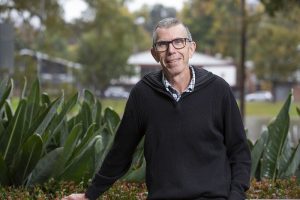
Dr Ian Goodwin
Photo: Nigel Welch – Pulse Photography
Ian is currently project leader for two projects in the PIPS3 research program. One of those is the smarter and sustainable pear orchards project, looking at management systems and techniques – including ag tech – to maximise productivity and fruit quality in new blush pears as well as traditional cultivars.
He began his career as a technical officer working on irrigation management, mainly in pears, at Tatura in October 1982, at a time when all agricultural research was funded by state governments.
“In those days we were looking at irrigation, high-density orchards, pedestrian orchards – which were quite revolutionary – before I moved away to focus on viticulture. In the last 15 years I started working again with the apple and pear industries,” he said.
During his time away, funding from governments dried up and researchers had to rely on industry funding.
“It was a huge change. Scientists had to have an in-depth understanding of what the industry wanted but also make sure they were focused on a discipline, whether that was tree training systems or physiology,” Ian recalled.
“The apple industry leads all fruit tree species by a mile in terms of intensive production systems and consistent quality fruit. When I came back to pears they were still grown in very traditional systems, lots of flood irrigation, widely spaced trees, traditional cultivars, but in the last 15 years pear production has changed.”
Ian’s research encompasses many aspects of the orchard system to increase the profitability outcomes for growers along the supply chain: planting systems, rootstocks and root pruning, irrigation, cultivars, climate adaption, biennial bearing, vigour management, crop load management, nutrient management and advanced sensor technologies such as Green Atlas Cartographer validation for the industry.
His biggest research breakthrough was developing RDI (regulated deficit irrigation).
“RDI was a quantum leap in terms of irrigation management where we applied less water than the tree’s total requirements but maintained yield, so at certain times you can stress a pear tree but get the same yield as if you’d irrigated all year,” Ian explained.
“The focus now is on trying to understand how we can get good quality pears. We’re probably only just starting to fully understand the mechanisms behind colour development, and how you get maximum colour in some of the blush or fully red cultivars.”
It’s ag tech, Ian said, that holds the key to really advancing horticultural crops. His input was pivotal to the development of the innovative Sundial Orchard, planted in 2018 at the Tatura SmartFarm. The orchard has been central to the second PIPS3 project he leads on technology-driven apple orchard systems, where research is being undertaken on cultivars, rootstocks, irrigation, sensor technologies and climate change adaption.
“There’s so much potential for such a complex crop, and ag tech has so much to contribute. Data is what we scientists live on but it can be a burden for the grower. They want to know how the data can be applied to find solutions in production systems.
“The other day I was thinking about the disconnect that sometimes emerges between grower and packer. If a grower is relying on a packer to pack and sell their fruit, the grower isn’t getting the complete feedback on what’s wrong with his fruit.
“If we had systems measuring the quality of fruit as it’s picked, maybe by putting instrumentation into platform harvesters that can measure each piece, then that’s the grower’s data. It should match the data that comes back from the packer when grading the fruit, and then you have traceability.
“People have commented that I don’t seem to be lacking in enthusiasm after 40 years of research, but there’s still plenty to get right!”
This article was written by Judy Kennedy and was first published in the Winter 2022 edition of AFG.



