PIPS 4 Profit program regional highlight: Western Australia
Extensive work is underway in WA across three of the national PIPS 4 Profit program projects.
In its fourth iteration, the PIPS 4 Profit program is delivering R&D activities in growing regions, conducted by regional partners, to address local challenges with local solutions. These are underpinned by aligned research for apples and pears being overseen nationally by Agriculture Victoria and the Tasmanian Institute of Agriculture.
Each quarter, AFG will highlight a region to exemplify the local PIPS 4 Profit program work underway and the way in which program-wide research and development knowledge is being applied to specific growing conditions and orchard systems to tailor regionally relevant outcomes.
Pomewest and the Department of Primary Industries and Regional Development (DPIRD) are establishing experimental and demonstration sites in WA under three projects of the national PIPS 4 Profit program. This is in addition to contributing data and analysis to economic evaluation case studies being prepared by project partners Nic Finger from APAL and Kerry Stott from Agriculture Victoria, and case studies demonstrating the potential of eco-credential options for industry.
AP22001 – Pest and disease management
Delivered by: Susie Murphy White and Jen Riseley, Pomewest, and Alison Mathews, DPIRD
The project will assess the safe introduction of parasitoid wasp species to WA and evaluate orchard management practices that are designed to support habitat and food source availability, balanced parasitoid/predator populations and soil health.
The augmentative biocontrol options in WA being investigated are the native parasitoid wasp Trichogramma pretiosum and T. carverae for light brown apple moth and the classical biocontrol option for Mediterranean fruit fly using native parasitoid wasps from eastern Australia, such as Diachasmimorpha krausii.
These biocontrol options have shown very promising results domestically and internationally for establishing in temperate environments and attacking multiple pest species.
This project partners with the Building sustainable soils (AP22003) project to provide ground cover and habitat for beneficial insects. The project aims for producers to replicate positive results on-farm in a commercially viable way. Baselining sites have been established in Donnybrook, Manjimup and Pemberton to establish estimates of pest population before biological controls can be introduced and assessed.
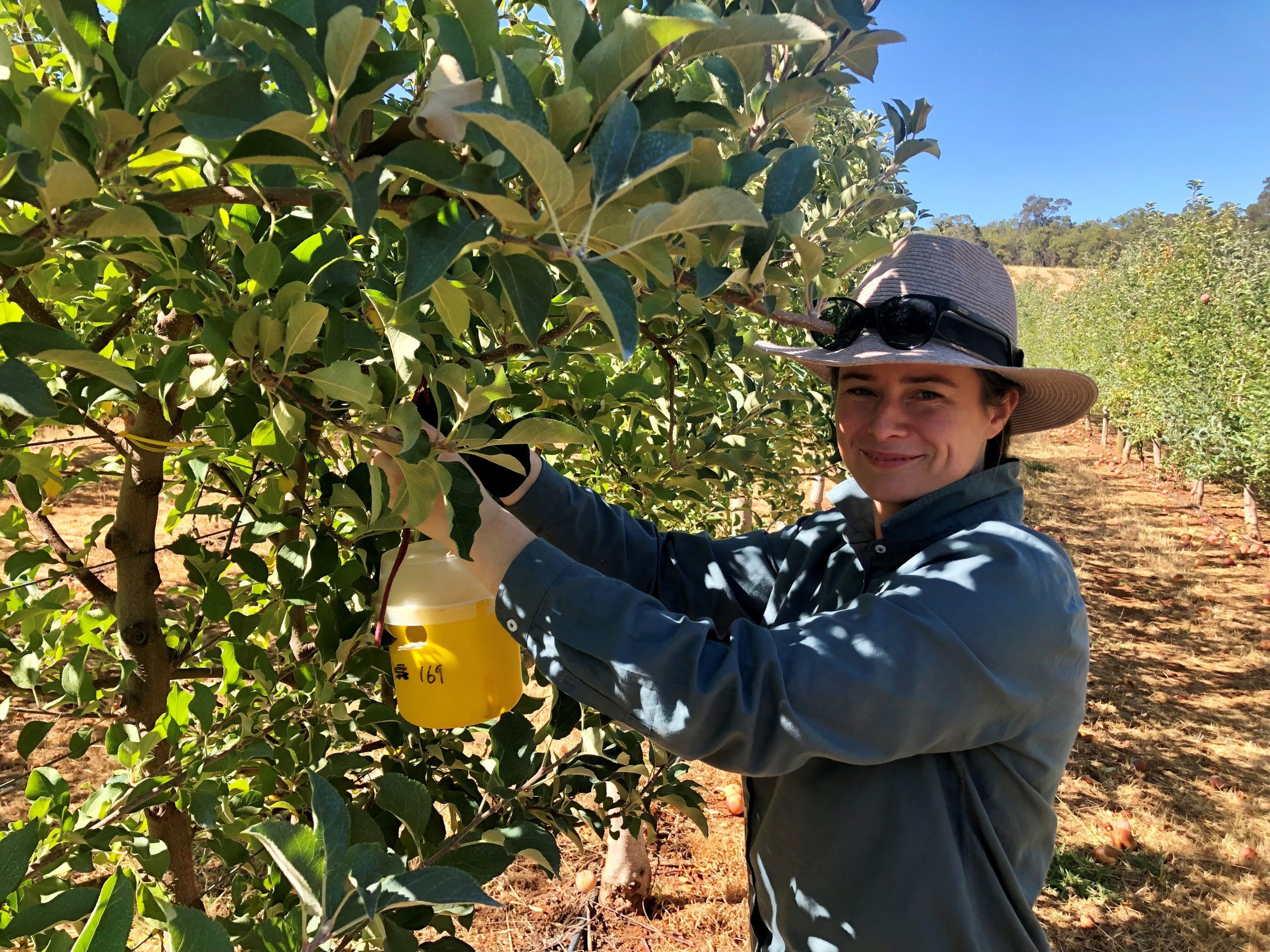
Pomewest Project Officer, Jen Risely, setting up traps that use pheromone lures to establish baseline pest population numbers.
AP22003 – Building sustainable soils
Delivered by: Susie Murphy White and Jen Riseley, Pomewest
The WA element of the project aims to answer the questions: How do we feed the carbon cycle by improving the under-tree strip? What are the benefits of moving away from having bare earth under the tree line? Can under-tree treatments have a positive effect on fruit quality and yield by improving the soil health?
To answer these questions, this project will trial different under-tree options:
- Control: current grower practice of bare herbicide strip
- Living legume mulch (cover crop), comprising peas, faba beans and oats
- Mushroom compost
- Living legume mulch (cover crop), cut in spring and covered by compost
- Native Australian flowering varieties Kennedia prostrata and Myoporium
- ‘Mow and throw’ local hay applied as mulch in spring, also a common grower practice.
Plant species have been chosen to avoid harbouring pests over winter or interfering with irrigation and orchard management. Legume species will be mowed to return nitrogen to the soil before the crop terminates and nodulation will be monitored over the growing season to assess if nitrogen is being fixed from the atmosphere or from applied fertiliser. In treatment 4, compost will be applied in spring to a terminated legume crop to apply carbon in balance with the degrading nitrogen to test if this preserves existing soil carbon levels in the under-tree strip.
Native species Kennedia prostrata and Myoporium have been selected as sturdy ground covers with a low habit to withstand orchard traffic. The previous AP19006 project found native species were challenged by weed pressure and many varieties could not persist in high-traffic areas. It is hoped these hardier varieties will better withstand the orchard environment.
This trial is once again taking place at Ladycroft Orchard in Manjimup and there will be opportunities for growers to visit the trial site to view the orchard floor treatments. Together with measurements of soil health, data on pest and disease pressure, tree growth and fruit yield will be analysed to examine for multi-layered benefits across the conditions. The five-year trial will establish a more robust link between the under-tree conditions and tree performance to give producers confidence in the trial findings.
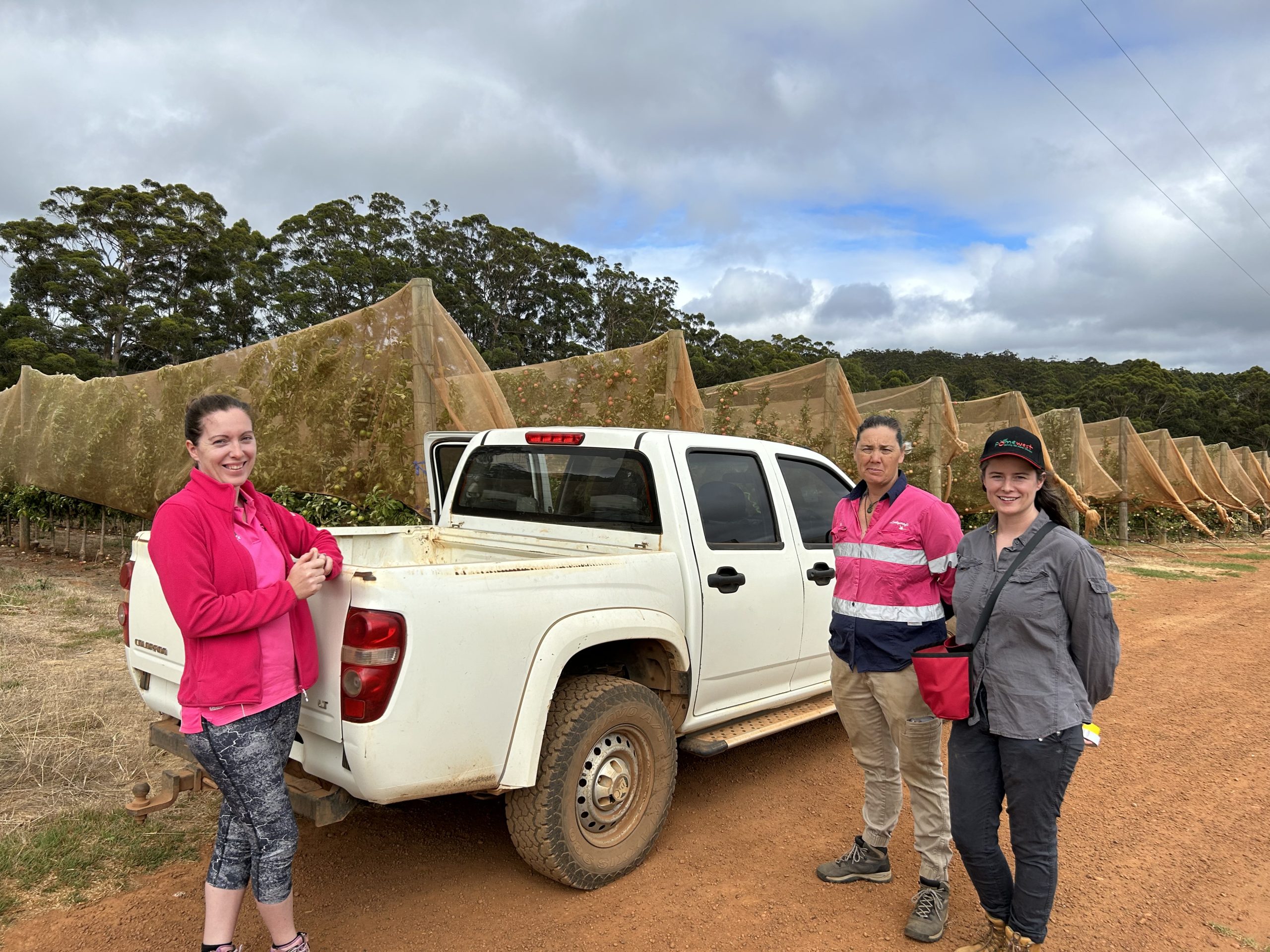
Ladycroft Orchard visit with Dee Fagan, Bec Whittaker and Jen Riseley
AP22004 – Optimising apple production systems
Delivered by: Dr Dario Stefanelli, DPIRD, and Jen Riseley, Pomewest
This project analyses orchard renovation systems to identify effective and profitable methods of rejuvenating orchards without replanting. The change in producer resources required for thinning, pruning, crop load management and the costs of retraining trees will all be considered. Variations in crop load, flowering and canopy vigour will be measured both manually and using digital imaging, including LiDAR. One trial site at RK & J Fox & Son Orchards in Pemberton has already been selected, reworking a Fuji block into Granny Smith via in-field grafting under hail netting.
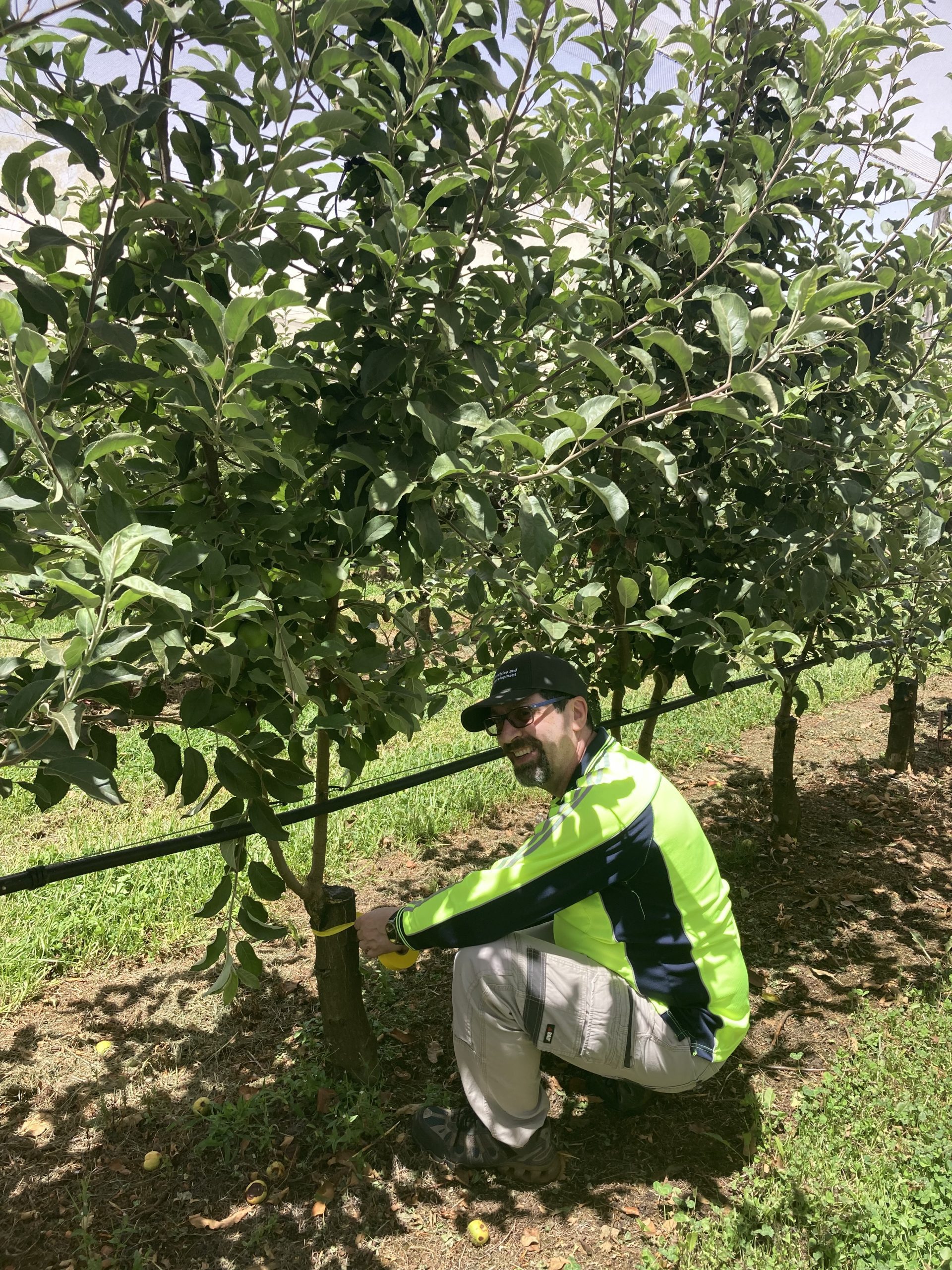
DPIRD researcher, Dario Stefanelli, marking trees undergoing different thinning techniques in a grafted Granny Smith block.
Further information
Visit apal.org.au/pips-4-profit to visit the PIPS 4 Profit program website interactive map and click on the WA sites for further insight. Alternatively, contact Jen Riseley at Pomewest at [email protected] or (08) 9777 0185 for more information.
Acknowledgements
 The PIPS 4 Profit program has been funded by Hort Innovation, using the apple and pear research and development levy, contributions from the Australian Government and co-investment from Agriculture Victoria and the Tasmanian Institute of Agriculture. It is co-funded in Western Australia by the WA Department of Primary Industries and Regional Development and supported by Pomewest. Hort Innovation is the grower-owned, not-for-profit research and development corporation for Australian horticulture.
This article was first published in the Winter 2024 edition of AFG.