
PIPS 4 Profit program: Informing more profitable and sustainable apple and pear orchards
The latest iteration of the program aims to respond to industry efforts to address current operating challenges and meet consumer expectations.
What’s the background of PIPS?
The apple and pear industry’s Productivity, Irrigation, Pests and Soils (PIPS) research and development program commenced in 2009 to improve production, quality and profitability outcomes through advanced new knowledge and management strategies in best water and nutrient use, crop load practices, tree physiology and architecture, climate change adaptation and integrated pest and disease prevention and control. PIPS1 (2009–14), PIPS2 (2015–20) and PIPS3 (2020–23) established a cooperative program foundation for the fourth iteration, PIPS 4 Profit, to continue its delivery for industry.
Identifying the orchard systems, management practices and technologies with the greatest potential to deliver economic and sustainable benefit to the apple and pear industry is the focus of the latest round of the flagship Productivity, Irrigation, Pests and Soils (PIPS) research and development program.
Reflecting its sharp commercial focus, the new program of projects will be known as PIPS 4 Profit. It was approved in late 2023 and runs until mid-2028.
In alignment with the goals of the current Apple and Pear Strategic Investment Plan (SIP) 2022–26, the PIPS 4 Profit program objectives are to improve profitability and sustainability through:
- the development of new and innovative management strategies and technologies that optimise soil and plant health, use of inputs such as water and labour, and crop protection and environmental factors
- enhancing sustainable orchard system design and management to deliver input efficiencies and quality improvements.
In a first for the program, a particular feature of PIPS 4 Profit will be the assessment of potentially adoptable practices through a ‘profitability and sustainability lens’. This will include economic analysis, eco-credential performance studies and comparisons of pros and cons to determine which techniques and approaches have the greatest potential for economic and sustainability benefits to growers. A suite of business and sustainability performance case studies will be prepared to communicate the outcomes succinctly for growers.
Six key program priority areas were identified by the Apple and Pear Strategic Investment Advisory Panel (SIAP) for PIPS 4 Profit to respond to industry efforts to address current operating challenges and meet consumer expectations. These are:
- environmental credentials
- labour efficiency
- commercial implementation
- fruit quality
- regional relevance
- climate variability.
Four research and development projects, led by the Tasmanian Institute of Agriculture–University of Tasmania (TIA) and Agriculture Victoria and supported by regional partners, have already commenced a network of collaborative activity across growing regions of Victoria, Tasmania, New South Wales (NSW), Western Australia (WA) and South Australia (SA) in both research facilities and commercial orchards.
Collectively, the R&D activities of the PIPS 4 Profit program aim to:
- optimise production systems by developing orchard renovation, crop load management, spatial (i.e. in-block) and precision timing management, and climate readiness strategies that maximise quality and increase input efficiencies, particularly of labour and water
- expand the availability of effective integrated pest and disease management (IPDM) strategies by combining knowledge on entomology, plant pathology, genetics, ecology, new technologies, and risk management, underpinned by a formal support and technical development model for service providers so they can extend information more rapidly to growers and build their confidence in IPDM
- build sustainable soils that require less synthetic intervention by developing new knowledge, linking orchard floor management systems with soil health, and evaluating the economic impact of potential changed management systems to overall orchard profitability
- prepare evidence-based case studies that demonstrate how indicators of environmental sustainability and economic benefit can be informed by research-, industry- and orchard-generated data. These will evidence how orchard businesses undertake, or have potential to improve, practices that deliver increased resilience to climate extremes and weather events, efficiency, profitability and a stewardship approach to managing natural assets and people.
At the commencement of the program, there are thirty-eight team members contributing to the program, most in a part-time capacity, providing the industry with a wealth of expertise across disciplines. Preparing for the future of the industry, PIPS 4 Profit also provides six PhD opportunities through the University of Tasmania, University of Melbourne and Charles Sturt University.
Keeping up to date with PIPS 4 Profit
Expect to engage frequently with the PIPS 4 Profit program! The program’s webpage is live – use the interactive map to locate what is happening and who is involved in your region, and where the opportunities are to get involved. Watch out for ongoing articles, videos and podcasts in national and regional e-newsletters, social media and magazines, especially APAL’S quarterly AFG magazine and Industry Juice weekly e-newsletter. Watch out for regular opportunities to hear directly from the researchers and host orchardists in your region and have ample input into next steps along the way.
The PIPS 4 Profit website will regularly be updated with research and demonstration activities. Visit www.apal.org.au/pips-4-profit.
The PIPS3 website also has an extensive library of resources developed between 2020 and 2023, ready for growers to access and use. Visit https://apal.org.au/programs/more-industry-programs/pips3program/pips3resources/.
AP22001 Pest and disease management – Agriculture Victoria
Project leader: Greg Lefoe
Project research partners: Pomewest, NSW Department of Primary Industries (NSW DPI) and Tasmanian Institute of Agriculture
Project objectives:
To optimise the Australian apple and pear industry’s profitability and use of sustainable IPDM by:
- developing effective and efficient monitoring tools for key pests and beneficials
- developing evidence-based economic thresholds to inform pesticide application decisions
- establishing tolerance levels for key pests beyond which attacks cause significant economic loss
- developing effective orchard management practices that support habitat and food source availability, balanced parasitoid/predatory populations and reduce soil compaction and soil loss
- demonstrating the efficacy of biological control practices (classical, augmentative and conservation) of major pests and diseases such as codling moth, light brown apple moth, apple scab and root rot
- developing a risk matrix for the key pests in each growing region indicating the efficacy of the available control options and the need for adoption of a suite of integrated management tools.
The activities:
The development of biological control agents (i.e. parasitoids) is underway at Agriculture Victoria’s Tatura SmartFarm and AgriBio Centre in Bundoora, with orchard experiments and releases on commercial properties throughout growing regions. These include:
- remote sensing technology testing for effective and efficient monitoring of black spot as a proof of concept for other major pests, diseases and beneficials
- evidence-based economic injury levels, and pest tolerance and action thresholds assessed to better inform IPDM decisions
- evaluation of orchard management practices designed to support habitat and food source availability, balanced parasitoid/predator populations and soil health, in partnership with AP22003
- demonstration of the efficacy of biological controls for codling moth, LBAM, apple scab and root rot
- a key pest risk matrix for each growing region showing the efficacy of available IPDM control options.
More information:
Visit the AP22001 project website, https://apal.org.au/projects/ap22001/.

Scott Price, Orchard Manager at R&R Smith, Dr Stephen Quarrell, Entomologist at TIA, Kara Devlin, Agricultural Science student at the University of Tasmania, Greg Lefoe, PIPS IPDM Project Leader, Agriculture Victoria, at the Huon Valley Mastrus ridens release and researcher roadshow orchard walk for PIPS in 2023.

Ashley Green, owner of Hillview Fruits, Lenswood, releases the codling moth parasitoid, Mastrus ridens, as part of the PIPS researcher roadshow in 2023. A new Mastrus population was imported from Chile, quarantined and reared by Agriculture Victoria at its AgriBio and Tatura SmartFarm facilities from 2020–23.
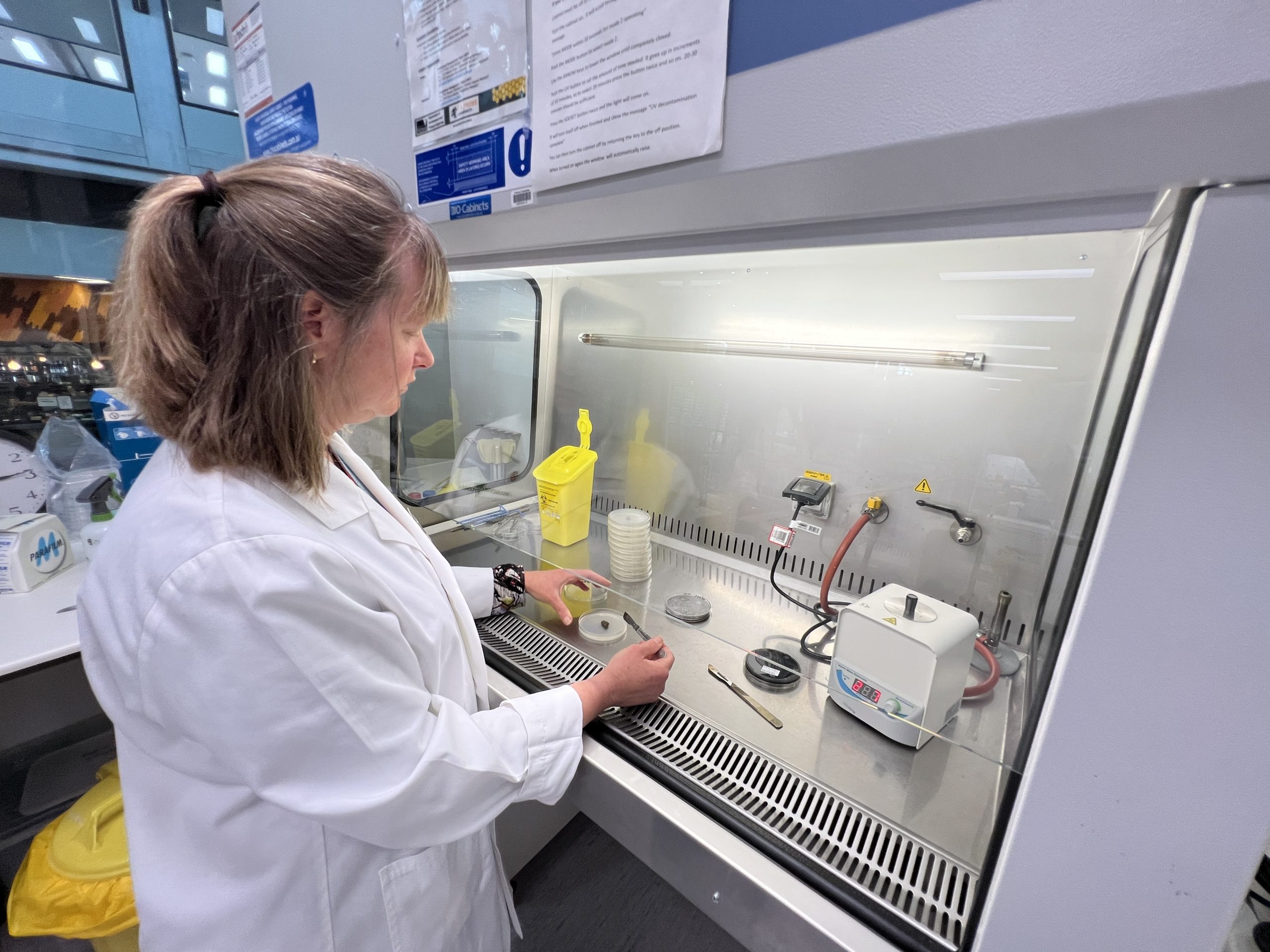
Dr Tonya Wiechel, Plant Pathologist at Agriculture Victoria’s AgriBio laboratories, undertaking plant disease research as part of the new PIPS 4 Profit IPDM project.
AP22002 Pear production systems for future climates – Agriculture Victoria
Project leader: Dr Ian Goodwin
Research leader: Dr Lexie McClymont
Project objectives:
- Develop and test profitable spatial (i.e. in-block) and precision timing management strategies to optimise size and colour for improved packout and grower profit.
- Investigate profitable crop load management strategies and technologies.
- Demonstrate the potential of evidence-based indicators of environmental sustainability and economic benefit, particularly focusing on irrigation efficiency.
- Increase labour use efficiency in orchards.
The activities:
Experiments are being conducted at Agriculture Victoria’s Tatura SmartFarm and in commercial orchards of Victoria’s Goulburn Valley, encompassing:
- Fruit colour and sun damage: reflective mulch timing, leaf blowing and evaporative cooling (and disease risk); netting design and type (spectral transmission, effects on insects including pollinators); spray-on products and effects on fruit surface temperature; effects of intermittent fruit shading during the daytime.
- Crop load management: hand, mechanical and chemical thinning and comparison of financial benefits and costs; floral initiation, polliniser synchronicity and fruit set studies.
- Use of sensing technologies to map orchard fruit number and colour to inform zonal management and evaluate the associated profitability benefit.
- Monitoring and benchmarking irrigation water use across orchards using advanced technologies.
- Testing and evaluating the potential economic feasibility of prototype robotic harvesters in increasing labour use efficiency in Australian pear orchards.
- PhD on genetic sequencing and phenotypic expression of new pear selections from the Australian breeding program as well as established cultivars.
More information
Visit the AP22002 project website, https://apal.org.au/projects/ap22002/.
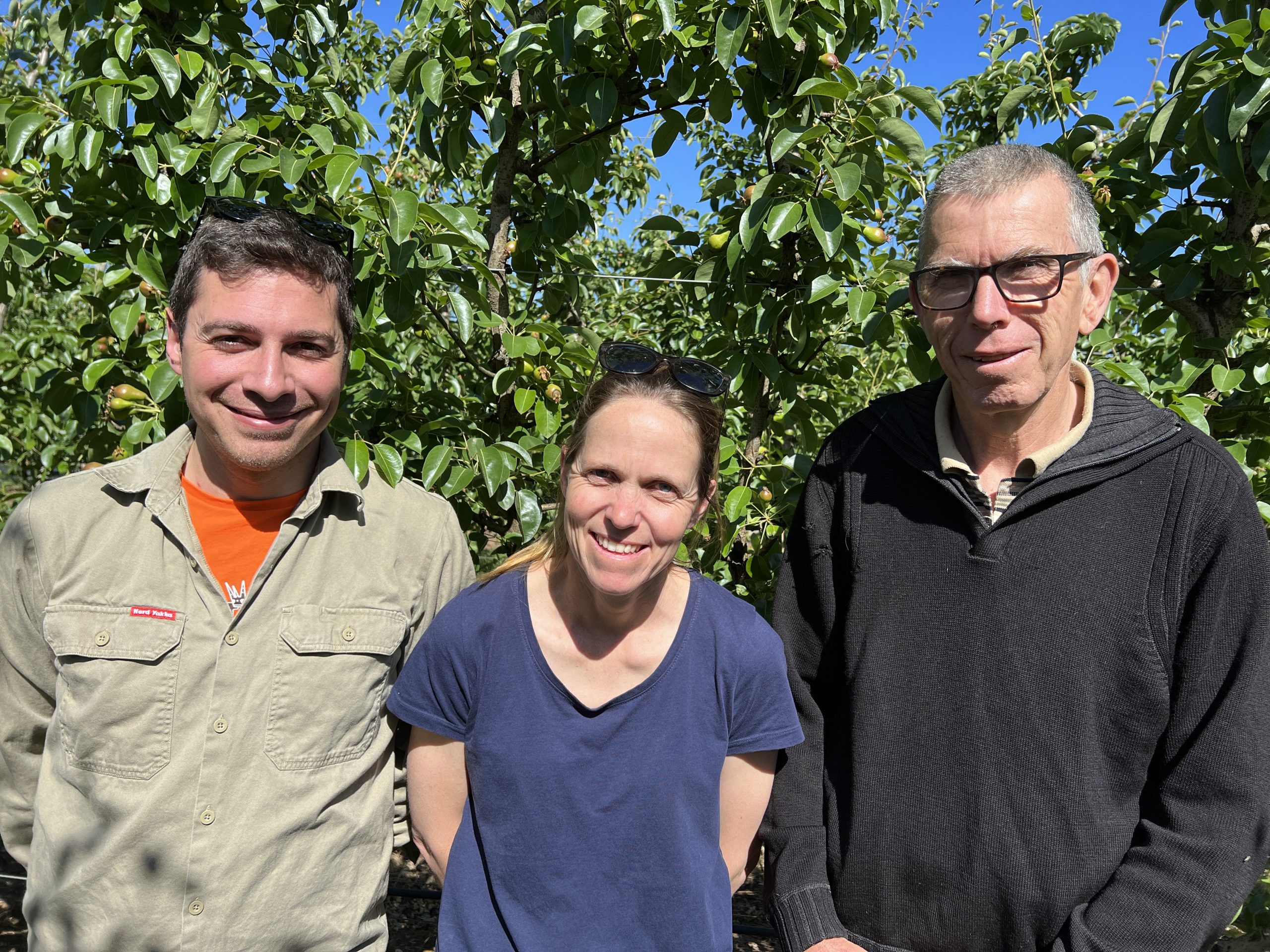
The Pear production systems for future climates project team: Alessio Scalisi, Lexie McClymont and Ian Goodwin.
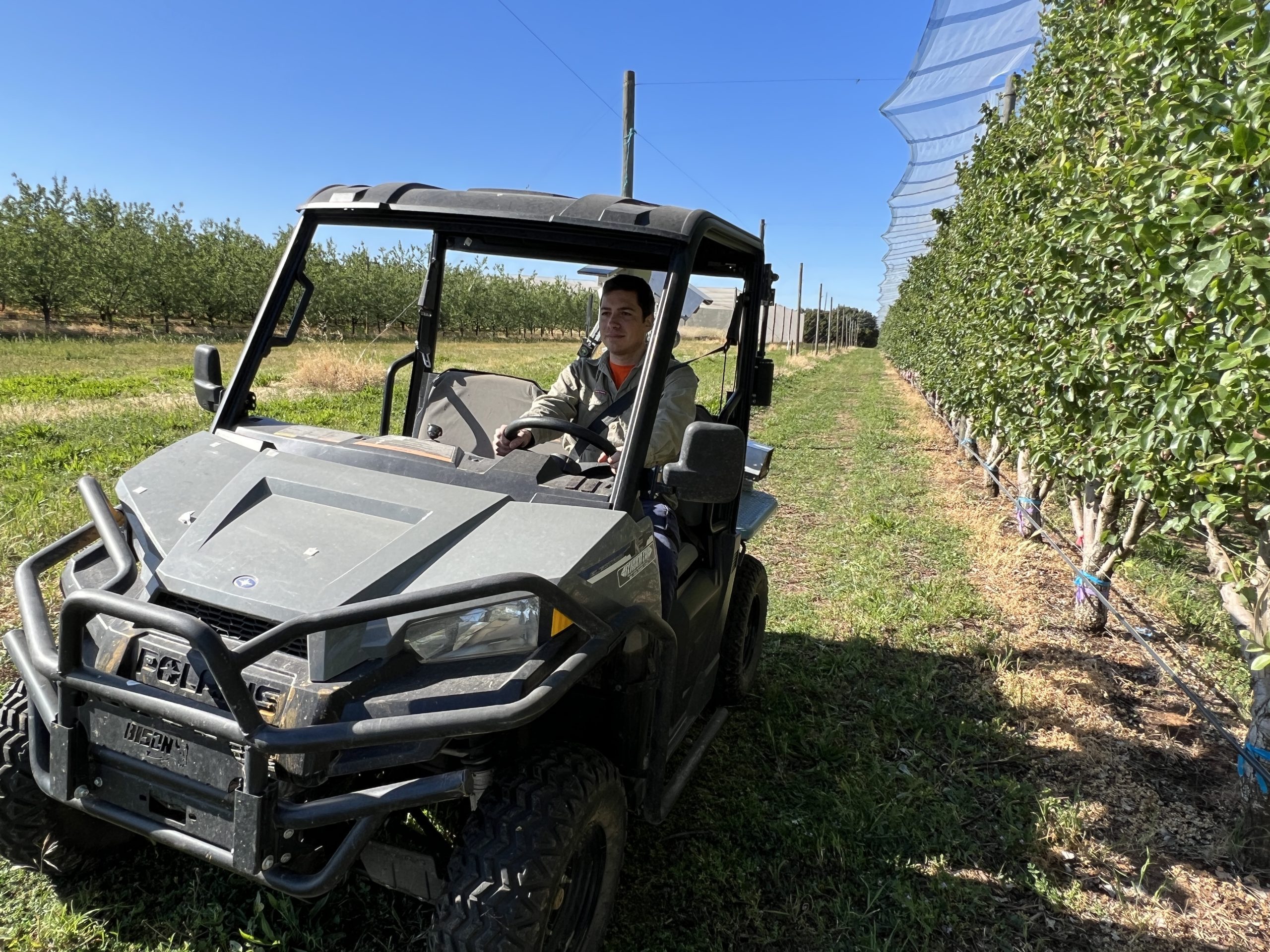
The Green Atlas Cartographer is used to map orchard fruit number and colour to inform zonal management.
AP22003 Building sustainable soils – Tasmanian Institute for Agriculture (TIA)
Project leader: Dr Nigel Swarts
Research leader: Dr Sally Bound
Project research partners: Pomewest, NSW DPI, Lenswood Apples and APAL (Nic Finger).
Project objectives:
This project aims to improve the adoption of profitable and sustainable soil, nutrient and water management practices in apple and pear orchards by:
- developing and evaluating strategies and technologies for efficient and reliable orchard soil, nutrient and water management
- enhancing understanding of the ways in which orchard management practices influence soil health outcomes and, therefore, longer-term environmental and business sustainability
- evaluating the cumulative economic impact of changes to orchard soil management and IPDM on overall orchard profitability
- demonstrating the potential of evidence-based indicators of environmental sustainability and economic benefit, particularly longer-term soil carbon capture and storage, and water, nutrient and labour use efficiency.
The activities:
Experiment and demonstration sites are based in commercial orchards in Victoria, Tasmania, Western Australia, NSW and South Australia. The activities will measure how orchard floor management strategies impact:
- soil health indicators: biological, chemical and physical
- tree health, fruit yield and fruit quality
- local IPDM relationships with orchard floor management strategies, particularly habitat and food creation for pollination and predatory services.
Long-term studies and regionally specific trials:
- In Tasmania existing tree-line treatments of living mulches and composts are being continued and new inter-row management strategies are being applied. This is building six seasons of data to show long-term impact of orchard floor management on indicators of environmental sustainability and economic value.
- In other regions, orchard floor tree-line and inter-row cover cropping management sites are evaluating the impact of different orchard floor management strategies using locally relevant treatments.
- Regional grower-based trials of the irrigation and nutrient forecasting and decision-making platform, SWAN Systems, that integrated irrigation capabilities from the industry’s SINATA tool in PIPS3 (strategic irrigation and nitrogen assessment), and in PIPS 4 Profit will undergo further nitrogen budgeting capability development.
More information:
Visit the AP22003 project website, https://apal.org.au/projects/ap22003/.
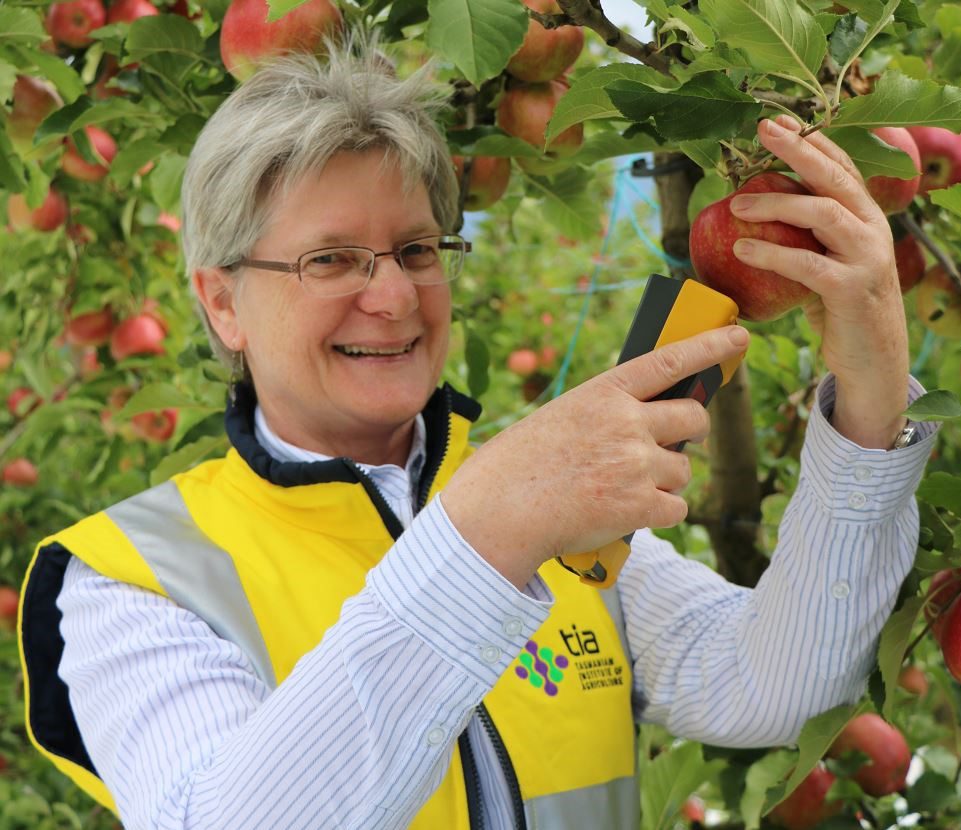
Dr Sally Bound, Research Scientist at TIA, is working across three of the PIPS 4 Profit Program projects in soil health and crop load management, particularly chemical thinning.
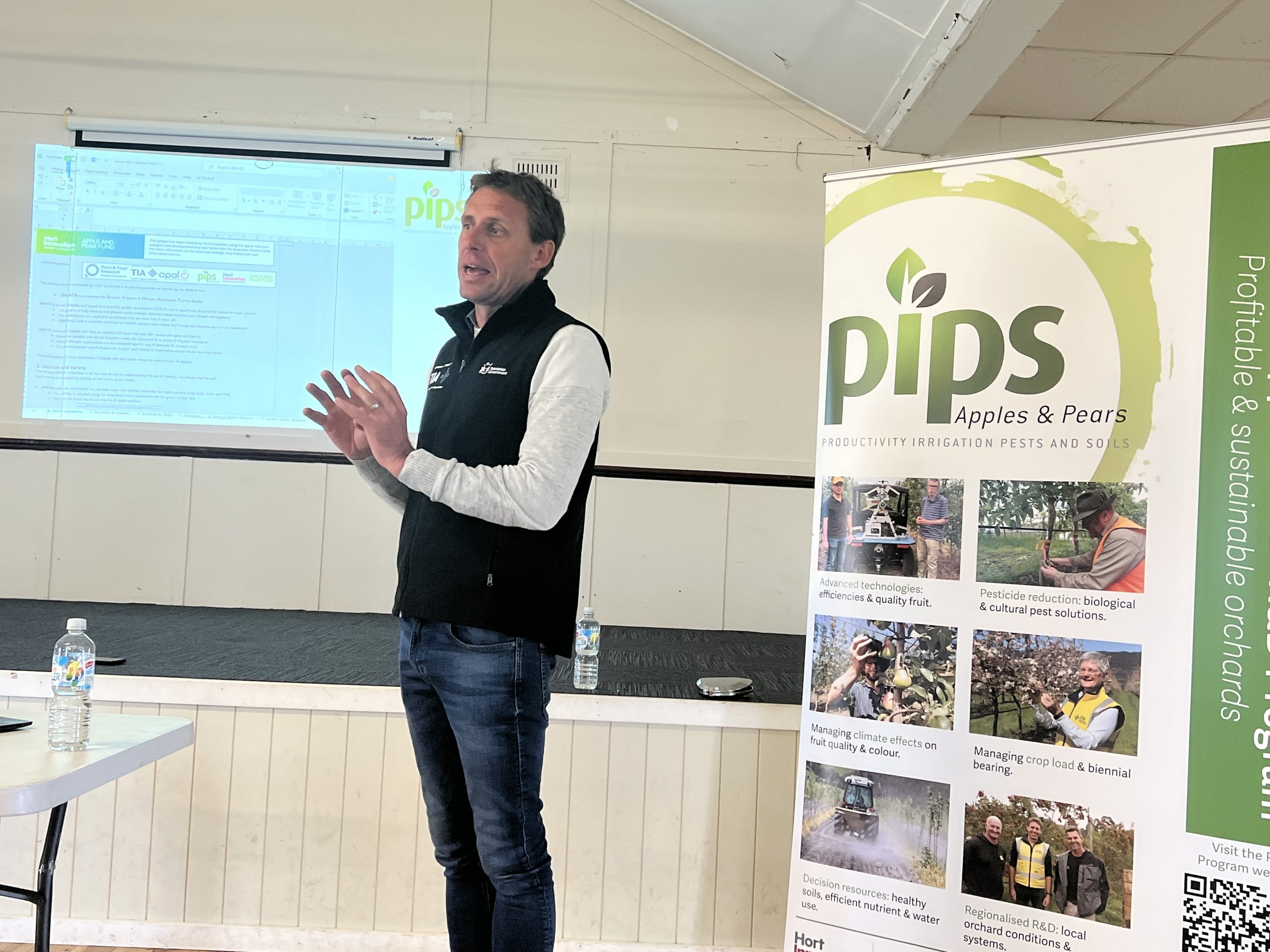
Dr Nigel Swarts, Project Leader AP22003 and AP22004, TIA, presents the results of the SWAN Systems platform grower trials at the NSW PIPS Researcher Roadshow near Orange in 2023. The platform assists growers to make decisions on irrigation using forecast weather information and keeps track of water usage. In PIPS 4 Profit, new nitrogen budgeting capabilities will be developed and trialled by growers across regions.
AP22004 Optimising apple production systems – TIA
Project leader: Dr Nigel Swarts
Project research partners: Western Australian Department of Primary Industries and Regional Development (DPIRD), Agriculture Victoria, NSW DPI, Lenswood Apples and APAL (Nic Finger).
Project objectives:
This project aims to improve the profitability of apple production by:
- developing and testing profitable spatial (i.e. in-block) and precision timing management strategies to optimise size, colour and mitigate sunburn/hail damage
- investigating profitable crop load management strategies and technologies
- investigating orchard renovation and restructuring, and more reliable pruning/thinning strategies for management of crop load to deliver labour efficiencies
- demonstrating the potential of evidenced-based indicators of environmental sustainability and economic benefit, particularly labour use efficiency.
The activities:
Experiments and demonstration sites are being conducted in both research facility and commercial orchards in Victoria, Tasmania, Western Australia, NSW and South Australia, encompassing:
- crop load management: pruning, chemical and mechanical thinning strategies with evaluation of return bloom, fruit set, yield, quality and economic benefit
- orchard renovation: canopy development, crop load, fruit yield/quality and economic and labour benefit of changed genetics and/or growing systems
- climate impacts and biennial bearing: netting colour and time-of-use treatments to determine the combined effects of different light environments and crop load determinants (bud development, metabolic profile, non-structural carbohydrates) and management strategies on the eco-physiology and productive performance
- use of sensing technologies to map orchard fruit diameter (size), skin colour and effects of netting treatments to inform zonal management and evaluate the associated profitability benefit.
More information:
Visit the AP22004 project website, https://apal.org.au/projects/ap22004/.
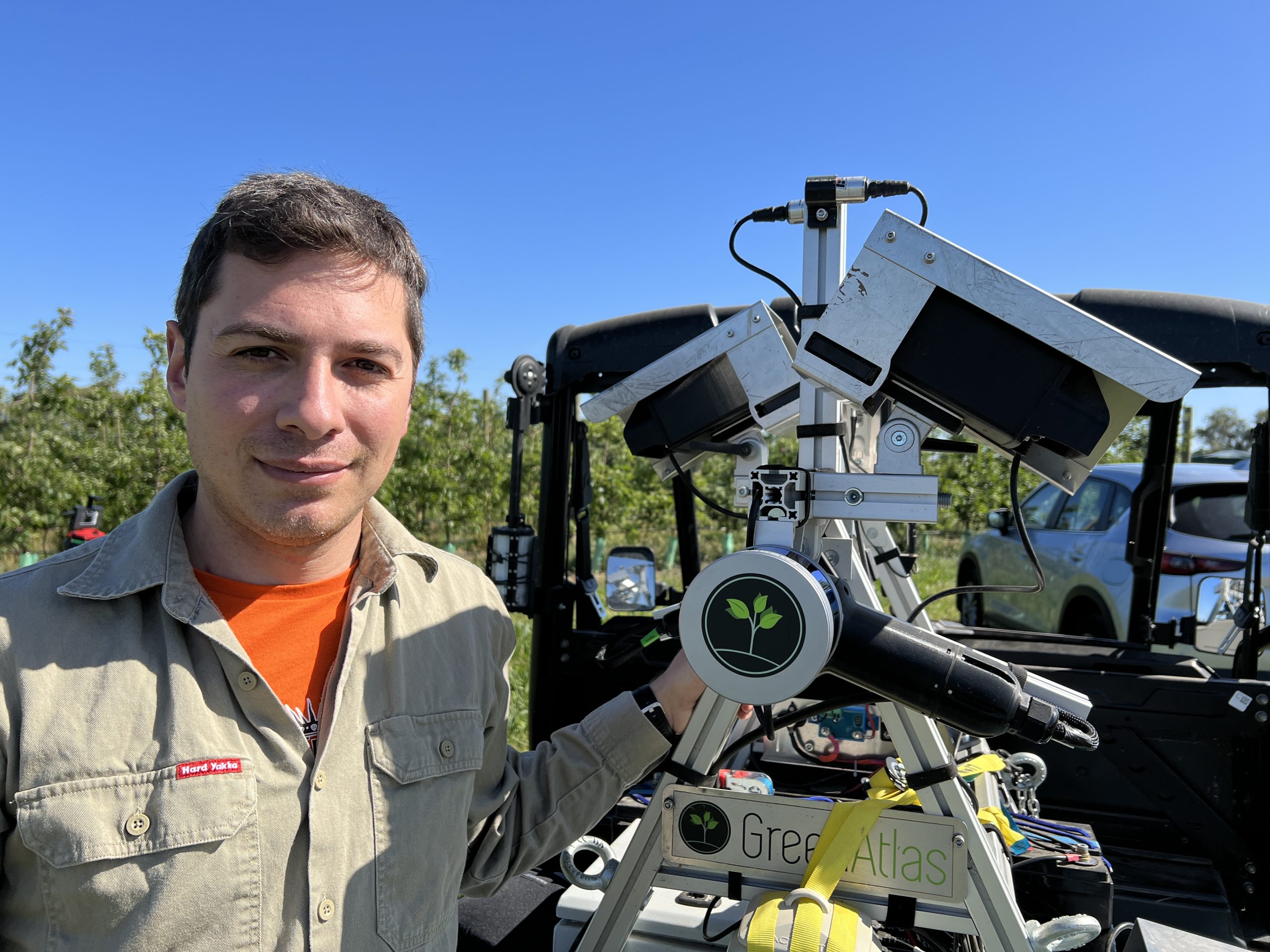
Agriculture Victoria researcher, Alessio Scalisi, will use the Green Atlas Cartographer to map orchard fruit diameter, skin colour and effects of netting treatments to inform zonal management.
AP22005 PIPS 4 Profit Coordinator, ICD Project Services, Marguerite White
This overarching role will importantly:
- support and coordinate integration of R&D, communication and engagement activities to elevate efficiency, effectiveness and confidence in the science
- coordinate program governance, planning, monitoring and evaluation, and integration
- lead program communications and engagement activities across all regions and organisations involved.
Acknowledgement

PIPS 4 Profit Program
The PIPS 4 Profit program has been funded by Hort Innovation, using the apple and pear research and development levies, contributions from the Australian Government and co-investment from Agriculture Victoria and the Tasmanian Institute of Agriculture. Hort Innovation is the grower-owned, not-for-profit research and development corporation for Australian Horticulture.
This article was first published in the Autumn 2024 edition of AFG.



