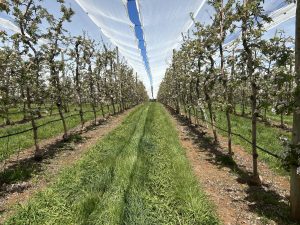
Optimise pruning and fruit quality in pear orchards — Part 2
June 2018 | Presented by Stefano Musacchi, Washington State University | Future Orchards® winter Orchard Walks
This is Part 2 of Stefano Musacchi’s Future Orchards® pear-pruning series, prepared for the June 2018 Orchard Walks. The presentation treats pruning as part of a whole-tree management system rather than an isolated winter operation, linking tree balance, crop load, light distribution and fruit quality.
The material focuses on the productive and economic consequences of different pear orchard systems, including fruit size, yield, value and planting density. Across the series, Musacchi emphasises that pruning changes the balance between vegetative and reproductive growth and should therefore be designed around the cultivar, rootstock, planting density and intended training system.
A recurring theme is the value of narrow, well-lit canopies and simple, repeatable tree structures. Higher and more uniform light interception supports productivity and more consistent fruit quality, while excessive vigour and complex canopies increase management costs and make crop regulation more difficult.
The presentation is most useful when read as part of the complete three-part sequence, because the sections build from pear physiology and orchard structure into practical management choices for modern high-density systems.