
Non-invasive maturity testing a step closer
Researchers are fine-tuning a new non-invasive maturity testing and storage disorder prediction tool to assist growers to improve quality and packouts.
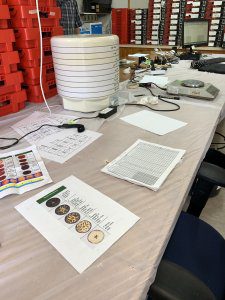
Starch models are developed in reference to existing colour and starch plate parameters.
Bravo™ apples were put through a gamut of tests at the Agriculture Victoria’s Tatura SmartFarm in late March as researchers work to refine a non-invasive maturity-testing tool which could be in use as early as next harvest.
The 360 apples were measured with a colourimeter, DA-meter (which measures chlorophyll as an indication of ripeness) and visually assessed, before being scanned with the new device, developed by Rubens Technologies, which measures three different light spectra.
Dr Daniel Pelliccia of Rubens Technologies said the apples were then maturity tested using conventional destructive testing methods for sugar (soluble solids concentration), firmness, dry matter and starch (iodine test).
“The aim of this work is to develop calibration models to predict all of these parameters (including colour and DA-value) via a single non-destructive Rubens scan,” Daniel said.
The device has a cap-like shape that sits around the fruit, ideal for outdoor, pre-harvest operations. Data is then transferred via Bluetooth® from the hand-held device to a smartphone app incorporating the calibration model and an algorithm enabling display of a final figure that corresponds to existing measurement charts and specifications.
“The idea was to build everything into the app so that the number you would get from the smartphone would be the same as you would get from a chart, but obviously without cutting the apples,” Daniel said.
Recognising that connectivity can be an issue in rural areas, Daniel said the goal was to have the models in the app so it could be used offline. A separate calibration model needs to be developed for each variety, which can then be selected within the app. In addition to Bravo, data has been collected on Granny Smith, varieties marketed as Pink Lady and some Gala.
In addition to its use for maturity testing, enabling growers to make data-driven assessments of optimum harvest timing and storage potential, Daniel said the aim is to also use the Rubens device to predict storage disorders.
“We expect to have the prediction model developed by June, to be able to be deployed next season,” Daniel said. “At this stage, all work was done on post-harvest apples. We look forward to working together with interested producers to be able to do pre-storage scans of apples, to develop models for storage disorders, in a similar vein to what is being done with stone fruit and the Food Agility CRC.
“Ideally we can scan before they go into storage and predict what is the likelihood of them developing a disorder in storage, and how long can they be stored.”
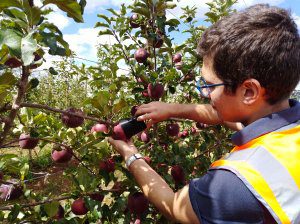
Dr Alessio Scalisi, Agriculture Victoria, tests the Bravo™ apples on the tree using the Rubens spectrometer.
The apple testing is being carried out in parallel to a two-and-a-half year $1.1 million Food Agility Cooperative Research Centre (CRC) Deploying real-time sensors to meet Summerfruit export requirements project led by Agriculture Victoria atTatura in collaboration with RMIT University, Summerfruit Australia Limited and Australian technology companies Green Atlas and Rubens Technologies.
The stone fruit project was launched by the Food Agility CRC in October 2020 to test the accuracy and utility of a number of sensors and platforms to help growers and exporters improve fruit quality.
The sensors that are being studied as part of the project include: Rubens fluorescence/reflectance spectrometer, Rubens colourimeter, Green Atlas Cartographer and a bistatic LiDAR. The sensors are being calibrated on Agriculture Victoria’s Tatura SmartFarm in Goulburn Valley, and then road-tested in commercial orchards and packhouses in Goulburn Valley, Swan Hill, Cobram, and Sunraysia.
Dr Alessio Scalisi has been working on the project with Agriculture Victoria and says the Rubens spectrometer is being used to predict storage disorders in two stone fruit cultivars.
“We are trying to predict in advance when storage disorders will develop, such as mealiness, leathery/rubbery texture and internal browning.”
The project team is also calibrating and validating the Rubens colourimeter for food colour measurement, and Alessio said the data is tested against a reference spectrophotometer. Testing is also taking place using the Green Atlas Cartographer® to assess the spatial distribution of yield, fruit size and fruit colour.



