
Manipulating the storage environment to extend postharvest storage of apples
The most flexibility for storability can be achieved when fruit is harvested at the optimal maturity. Postharvest, the way to maintain that quality is through careful management of the fruit temperature.
Determining the ideal storage environment for apples starts with harvesting the fruit at the ideal maturity. The physiological maturity of the fruit at the point of harvest will establish how long the fruit can be stored, under what conditions the fruit can be stored and which markets the fruit will be suitable for.
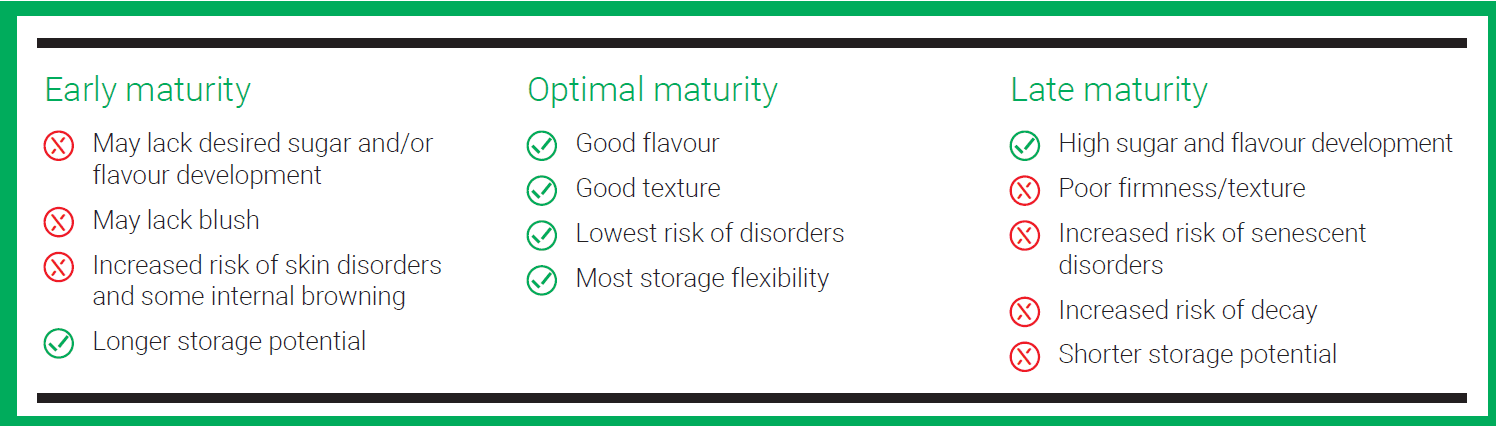
While fruit maturity progresses along a spectrum, it can be divided into three general stages: early, optimal and late. Harvest at each of these stages will have different pros and cons. For example, fruit that is harvested early may lack blush and sugar development while having the longest storage potential. Fruit harvested at the optimal maturity gives the highest flexibility over how and for how long the fruit can be stored.
Matching the maturity of the fruit at harvest to the optimal storage conditions involves a balancing act of different postharvest technologies. By managing the risks associated with storage temperature and storage atmosphere, optimal fruit quality can be maintained.
Cool storage of pome fruit
Following harvest at the ideal maturity, the temperature at which apples are stored will have the biggest influence on how long quality can be maintained. The primary physiological function through which refrigeration acts is on the respiration rate of the fruit. By reducing temperature, cool storage maintains quality characteristics such as firmness as well as reducing moisture loss and limiting the development of decay.
Both the rate of cooling as well as the final storage temperature are critical determinants for extending the postharvest period. Removing the field heat and bringing the core temperature of apples down to 5oC as quickly as possible after harvest will extend storability. The rate of cooling from 5oC to the final storage temperature (typically between 0.5 and 2oC) will depend on the cultivar. Some cultivars, such as Gala, can be rapidly cooled down to the final temperature as quickly as possible without compromising any quality characteristics. However, some cultivars, such as Cripps Pink and Fuji (among others) are chilling sensitive. These cultivars need to be slow or stepwise cooled from 5oC to the final temperature over a period of several weeks. Slowing the rate of cooling in sensitive varieties will minimise the risk of disorders developing during later storage.
The role of carbon dioxide in pome fruit storage
When the goal is to extend the storage of apples for as long as possible, changing the mixture of oxygen (O2) and carbon dioxide (CO2) in the storage atmosphere is a key tool for achieving that outcome. The purpose of changing the atmosphere is to reduce the fruit’s respiration rate beyond what can be accomplished through cool storage alone.
Even after being harvested, apples are still living tissues that require energy to maintain their cells. Through the process of respiration, apples convert stored sugar into energy using O2 and releasing CO2 and water. In long-term storage, respiration can be reduced by four primary controls: reducing the temperature, reducing the availability of O2, increasing the availability of CO2, and reducing the availability and action of ethylene.
Ethylene is an important consideration in apple storage as its presence, even in small amounts, can accelerate ripening. Ethylene is a naturally occurring plant hormone, produced by apples, that can accelerate ripening by speeding up processes such as softening, colour change and starch breakdown.
Ethylene production and perception of ethylene by apples can be controlled by the application of a postharvest ethylene inhibitor such as SmartFresh™. The SmartFresh molecule binds to the fruit’s ethylene receptors, inhibiting their ability to sense or react to ethylene. The result is a delay in ethylene-related ripening changes.
Changes to the levels of O2 and CO2 in the storage environment fall into three main categories:
- Regular air (RA): no active changes are made to the O2/CO2 (it may still be important to manage CO2 levels to prevent disorders)
- Controlled atmosphere (CA): O2 is reduced and CO2 is increased to fixed levels
- Dynamic CA: O2 is reduced and CO2 is increased, with levels optimised based on feedback from the fruit in storage.
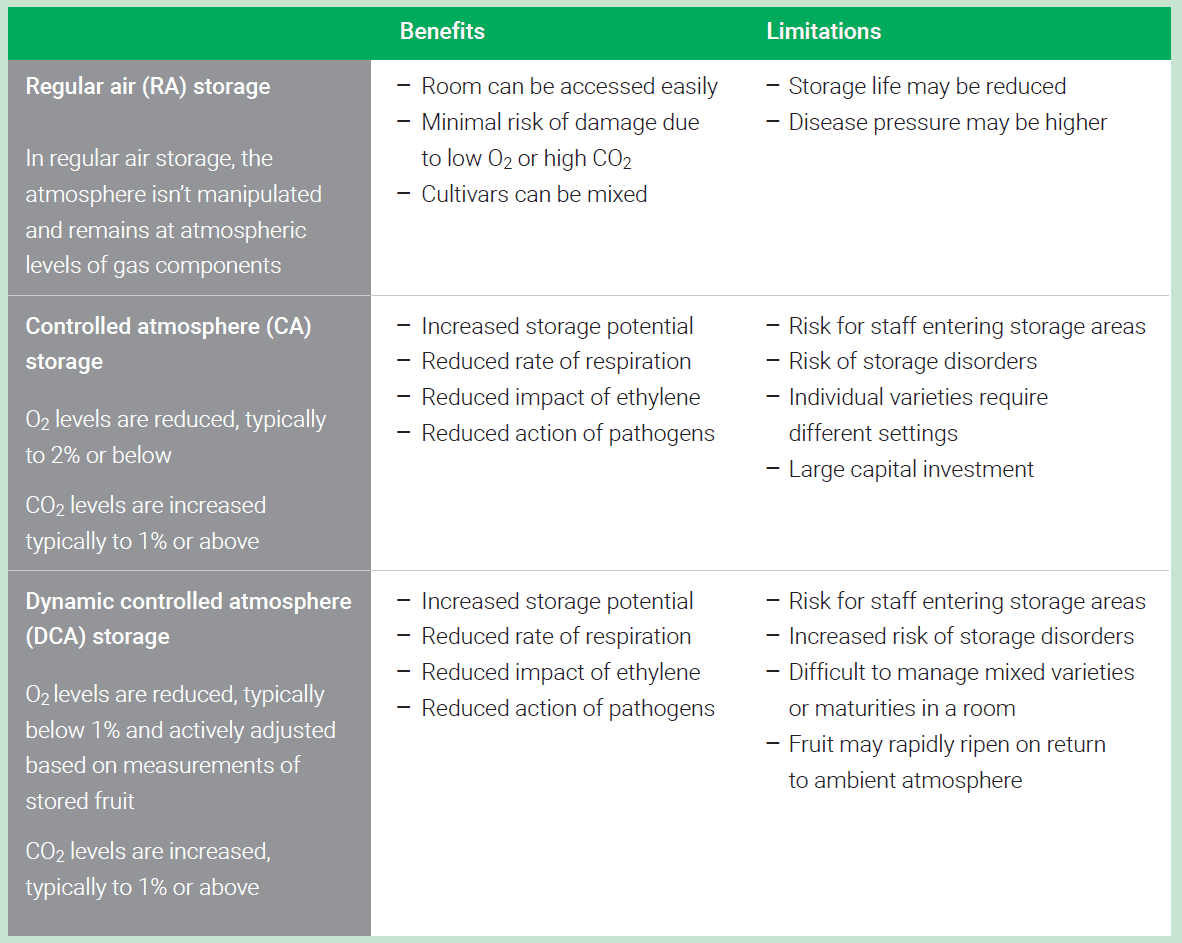
Table 1: Comparing regular air, controlled atmosphere and dynamic controlled atmosphere storage.
Similarly to variety sensitivity to cooling, some apple varieties, such as Cripps Pink and Fuji (among others), are also sensitive to levels of CO2 in the storage atmosphere. The increase in CO2 above ambient levels in the storage atmosphere is a result of fruit respiration. The rate of CO2 production by apples is directly influenced by fruit temperature. By reducing the temperature of apples to 5oC rapidly after harvest, the production of CO2 can be minimised.
For any apple variety, storage in an atmosphere containing higher than ambient levels of CO2 can induce injury. The level of CO2 at which injury may occur will vary depending on the variety and the maturity of the fruit at harvest. Injury resulting from exposure to CO2 is typically not a ‘24-hour’ injury. Rather, it occurs following the cumulative exposure to elevated levels of CO2 during storage. Apples are the most sensitive to elevated levels of CO2 during the first 6–8 weeks after harvest. As the fruit adapt to the storage environment, the sensitivity to CO2 reduces. Due to the high sensitivity directly after harvest, it is important to ensure that exposure to CO2 is kept to a minimum by venting rooms or scrubbing the CO2 out of the atmosphere. While the damage may be initiated early in storage, symptoms may not develop for several months.
There can be a need to balance the increased storage potential of CA storage with an increased risk of disorders. This can be seen in the charts showing firmness and rates of internal browning in Braeburn apples – a highly CO2-sensitive variety (Figure 1). With rapid CA establishment, the highest firmness is achieved. However this rapid CA also has a high incidence of browning. Delaying CA for 6 weeks greatly reduced the incidence of browning, with only a small sacrifice in firmness. For other sensitive varieties, it may be recommended to delay the establishment of CA storage for several weeks to minimise the development of internal browning.
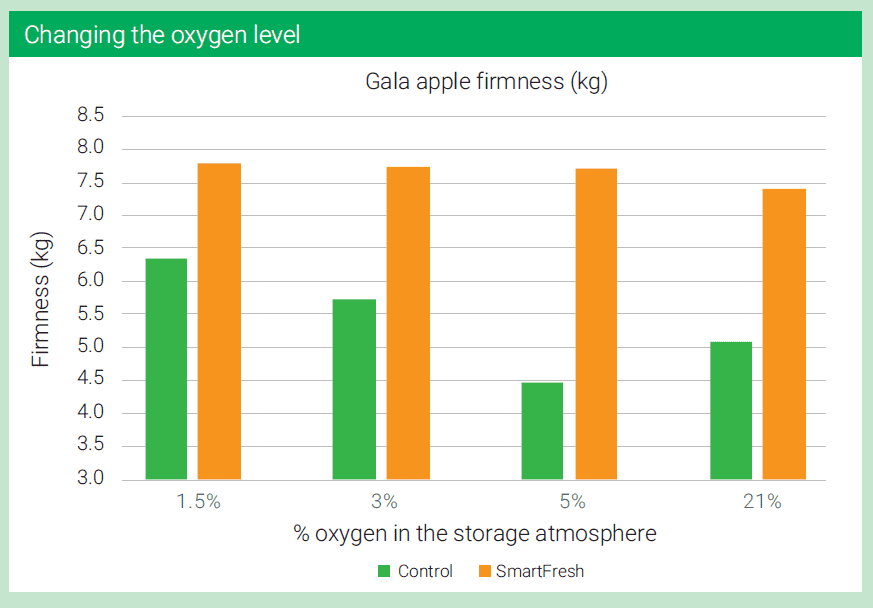
Figure 1: Changing the oxygen level: For untreated apples, as the level of oxygen in the storage atmosphere increases, the firmness of the apples decreases. For Gala apples treated with SmartFresh™, the firmness is maintained regardless of the level of oxygen in the storage atmosphere. Additional information: Fruit were stored under different levels of oxygen for 6 months. Assessments were completed after 7 days at room temperature. Fruit stored at 1.5, 3 and 5% O2 were in CA storage with 1% CO2. Fruit stored at 21% O2 were stored in RA with no additional CO2. Source: internal AgroFresh data, 2012
Maximising quality by minimising oxygen
Similarly to CO2, manipulation of the level of O2 in the storage atmosphere is another tool for prolonging storability. As can be seen in the chart of Gala apple firmness (Figure 2), the lower the oxygen level is during storage, the firmer the apples remain. As oxygen is required for respiration, reducing the availability of O2 will slow down respiration – to a point. The low oxygen limit (LOL) is the level of O2 that is required for aerobic respiration. If the level of oxygen is reduced below the LOL, the fruit’s respiration will instead convert to fermentation in order to continue to produce energy. When in a fermentative state, apples will lose quality as well as develop alcoholic off-flavours.
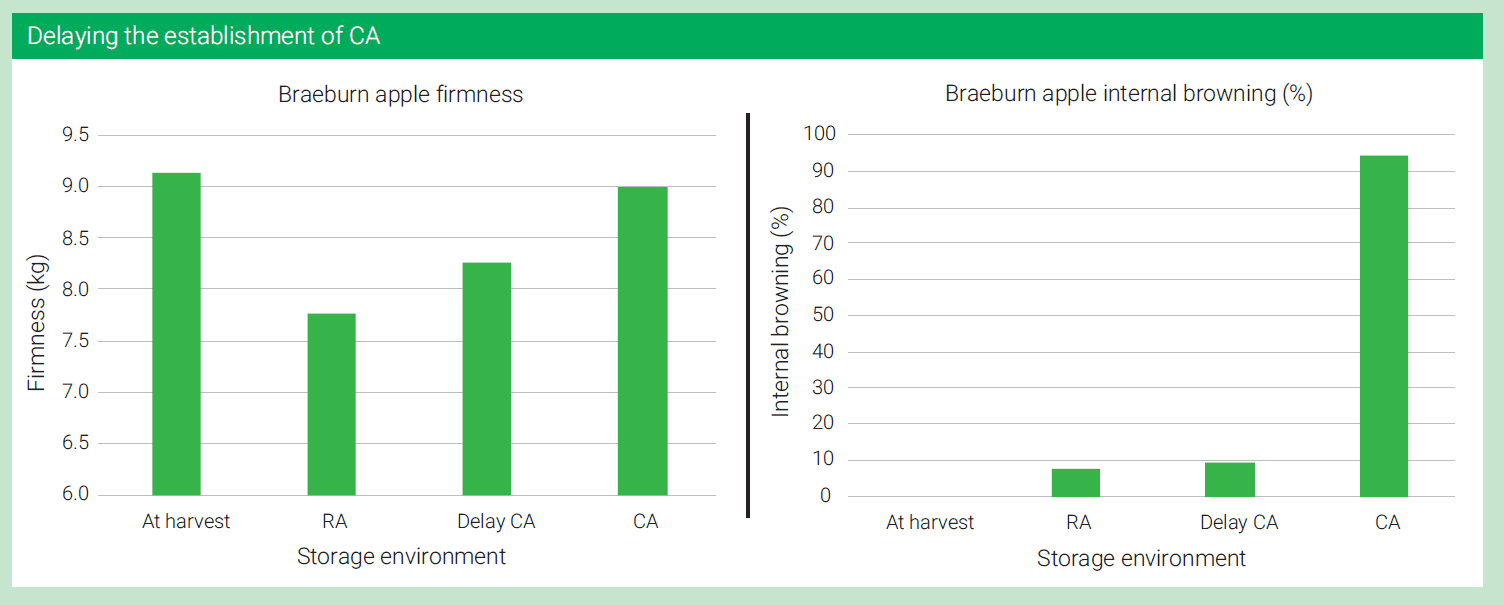
Figure 2: Delaying the establishment of CA: Deciding how fast to establish CA can be a balance between managing firmness and IB. Braeburn apples softened more rapidly when stored in RA compared to storage in CA. Delaying establishment of CA resulted in a 0.8kg reduction in firmness compared to fruit stored in CA. Apples stored in CA showed a 95% incidence of IB after 6 months of storage. Apples stored in RA entirely or for 6 weeks prior to CA showed 8 or 10% incidence of IB respectively. Additional information: RA: regular air storage. Delay CA: 6 weeks in RA, then moved to 2% O2/1% CO2 CA storage for remainder. CA: 2% O2/1% CO2 established within 1 week of harvest. Fruit were stored for 6 months, assessments completed after 7 days at room temperature. Source: internal AgroFresh Data, 2011
Types of O2 manipulation
- Standard CA storage
- O2 ~1–2%
- Above the LOL
- Low risk of fermentation
- Some sacrifice of potential storage quality
Ultra low oxygen (ULO) storage
- O2 <1.5%
- Closer to the LOL
- Higher risk of fermentation
- Less sacrifice of potential quality
Dynamically controlled atmosphere (DCA) storage
- O2 <1.0%
- Very near the LOL
- Higher risk of fermentation
- Less sacrifice of potential quality
When harvest maturity is optimal, postharvest cooling is tailored to the specific cultivar, and ethylene levels are effectively managed, the final step in maximising apple storage potential is dynamic control of the storage atmosphere. In a standard CA storage environment, the levels of O2 and CO2 are typically set at fixed levels. Recommended levels of O2 and CO2 in standard CA are established based on research that identifies the optimal balance between extended storage and minimal risk of inducing any disorders for a given apple variety. These recommendations are made to cover a wide variability of growing conditions. To find the specific O2 balance point for a specific room of apples, more sophisticated sensors and controls are required.
By taking this approach, O2 levels will be lower than a standard CA room and will be dynamically adjusted to the minimum level that induces a stress response by the apples. Such storage technology has been commercially available for over twenty years.
There are two primary commercially available techniques for determining the LOL for a room of apples. In the first, a subsample of fruit are placed under a fluorescence sensor. When the O2 level drops below the LOL, the apples will produce a measurable stress signal. When this response is observed, the O2 level can then be slightly increased such that the fruit have just enough oxygen to respire, and storage length is optimised. In the second system, fruit respiration itself is measured by assessing the whole room or a subsample of fruit. The O2 level can then be manipulated until the respiration rate indicates that the fruit is at the optimal level for storage extension. In both cases advanced and automated systems manage the environment to optimal levels.
Storing apples under DCA provides a number of benefits beyond increased storage potential. The low O2 environment may reduce the growth of spoilage pathogens and the system is also compatible with organic production. While an extension of storage can be gained in DCA, there are also some risks. The maturity of fruit in the room needs to have minimal variability such that the sub sample of apples is representative of the rest of the room. With high variability in maturity, the O2 level may not be set accurately and, as a result, there is a risk that some fruit may develop internal browning disorders. The variability in fruit response can also result in it being more difficult to store multiple varieties or harvests of apples in the same room under DCA. Additionally, apples can rapidly ripen once they are returned to ambient air as part of packing and entering the supply chain.
Technologies that support the extension of storability in apples do so through slowing the respiration rate of fruit. By harvesting fruit at the optimal maturity, the most flexibility for storability can be achieved as this will establish the baseline rate of respiration. After harvest, careful management of the fruit temperature is the next most effective way to maintain quality. Reducing the effect of ethylene and adjusting levels of O2 and CO2 in the storage atmosphere are additional strategies to further slow respiration and extend the storability of apples. The specificity of maturity, cooling and storage atmosphere will vary depending on the apple variety, as well as orchard management and seasonal conditions. Together, these approaches can maximise storage life while maintaining fruit quality.
This article was first published in the Autumn 2026 edition of AFG.



