IPDM in focus: San José scale
Adapted from the IPDM Manual for Australian Apples and Pears (2021).
Once one of the most devastating pests of the apple and pear industry, San José scale is making a comeback.
What is San José scale and why does it matter?
San José scale is a tiny insect that attacks many types of trees and shrubs, especially fruit trees such as apple, pear and stone fruit. These insects stick to the bark and form thick clusters, slowly weakening the tree over time. If left untreated, branches can die, and the tree becomes harder to manage and train. This leads to lower fruit production and poor fruit quality.
San José scale used to be one of the worst pests in apple and pear orchards. In the past, insecticides in use at the time helped control it, but as growers move toward softer, more targeted sprays and reduce winter treatments, the pest is starting to return in some orchards.

Figure 1: San José scale symptoms on apples. Photo: NSW DPIRD
What damage does it cause?
- Fruit damage: While feeding, San José scale injects a toxin that causes red spots or halos on fruit and young shoots (Figure 1). In severe cases, apples and pears can become lumpy, misshapen, or stunted. Pears used for canning may be rejected because the damaged areas can’t be peeled off.
- Tree damage: If not controlled, the pest can weaken trees, especially young ones, which may die within 1–3 years. Affected trees often look water-stressed, with cracked bark and sticky gum leaking out. Damage to branches also makes it harder to shape and train trees, which can affect future fruit production.
- Confusing symptoms: The red spots caused by San José scale are quite distinctive, but they can sometimes be mistaken for other problems like boron deficiency or damage from other bugs. Careful inspection is needed to tell them apart.
San José Scale life cycle
San José scale insects are active most of the year, even in the colder winter months (Figure 2.1), but start developing faster in spring when it gets warmer, usually around blossom time.
Females stay hidden under a round, grey shell and never move (Figure 2.2). They give birth to live young (they don’t lay eggs).
Males grow under a smaller, oval shell and eventually emerge as tiny flying insects with two wings (Figure 2.3).
The young insects or nymphs (Figure 2.4), also called crawlers, are bright yellow and move around to find a place to feed, usually on bark, fruit, or leaves. Within a day, they settle down, lose their legs and antennae, and start sucking sap. As they grow, they form a protective waxy shell.
San José scale usually take six to eight weeks to grow into adults, and there can be two to four generations each year, depending on the weather.
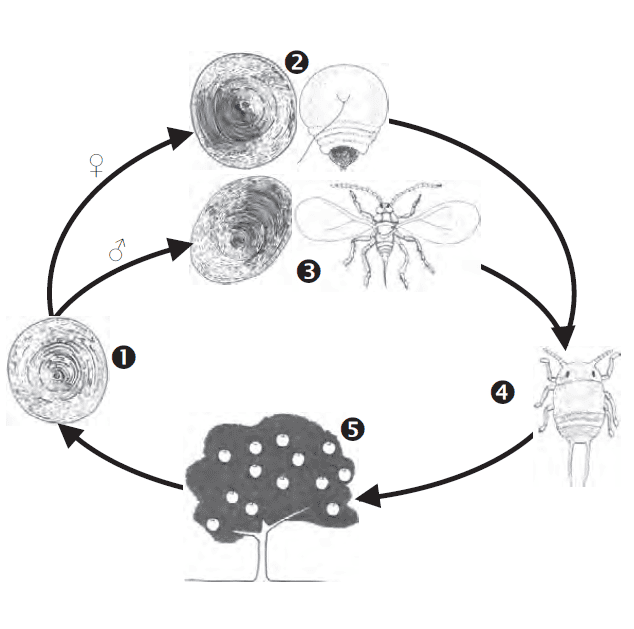
Figure 2: San José scale life cycle showing (1) immature scale, (2) female and round scale, (3) winged male and oval scale, (4) nymph (also called a crawler), and (5) dispersal throughout tree. Source: IPDM Manual for Australian Apples and Pears (2021)
Managing San José scale in your orchard
Pruning
If San José scale is found in your orchard, it’s unlikely to go away on its own. In areas where it has previously been a problem, check trees carefully during winter pruning. Cut out and remove any infested wood and make sure to burn it to prevent the pest from spreading.
Monitoring
The best time to target San José scale is during the crawler stage, when young insects are moving and not yet protected by their waxy shell. This is the stage when sprays work best. However, crawlers are only active for a short time.
To predict when crawlers will appear, growers can use average daily temperatures to calculate heat units called degree days and estimate pest development. Degree days are calculated from the date when male scale are first caught in pheromone traps or from a set winter date (1 July in Australia). A description of how to calculate degree days is provided in the IPDM Manual for Australian Apples and Pears (2017, p. 275). These calculations may need adjusting for different growing regions in Australia.
During pruning, look closely in sheltered spots like branch forks and bark cracks, and near buds. Older scale colonies can be hard to see because they blend in with the bark.
Using pesticides responsibly
If oil sprays and other methods don’t control the scale, insecticides may be needed. Most sprays used during the growing season can harm beneficial insects, so they should be a last resort (refer to chapter 6 of the IPDM Manual). Certain options can help control San José scale while targeting other pests like codling moth and may be gentler on helpful predators.
Natural and low-impact management
Oil sprays
If San José scale keeps showing up in your orchard, spraying horticultural mineral oil during winter (dormant season) should be part of your regular routine, even if you haven’t seen scale recently. These pests can build up from small, hidden populations.
Dormant oil sprays are registered for use when the scale insects are young and more vulnerable. If you also have problems with European red mite, you might delay spraying until just before bud swell. This may better target both pests due to increased mite activity at this time.
To avoid damaging trees, leave at least four weeks between two oil sprays. Use winter checks and past records to decide which pest is more of a threat and plan your spray timing accordingly.
Lime sulphur
Spraying lime sulphur with oil during dormancy can also help control San José scale; however, it may harm helpful insects like predatory mites. Lime sulphur is only approved for some varieties of apples, so always read the label carefully and check if the specific product you plan to use is compatible with your varieties. If used incorrectly, it can damage trees. Lime sulphur is not approved for use on any pear varieties.
Biological control
Nature also helps! Several beneficial insects feed on San José scale. One of the most important is the native ladybird beetle, Rhyzobius pulchellus (also known as R. lindi), which eats the young scale insects and helps keep populations down.
Helpful resources
For monitoring guidelines, a monitoring calendar and tracking templates, visit: https://extensionaus.com.au/ozapplepearipdm/category/resources/usefultools/
To download the IPDM Manual for Australian Apples and Pears, visit: https://extensionaus.com.au/ozapplepearipdm/home
Acknowledgements
Thank you to Alex Perera, Agriculture Victoria, Plants, Chemicals and Invasives Branch, for reviewing the chemical application component of this article.
 The PIPS 4 Profit Pest and disease management (AP22001) project is funded by Hort Innovation, using the apple and pear research and development levy, contributions from the Australian Government and co-investment from Agriculture Victoria. It is supported regionally by the Tasmanian Institute of Agriculture, Pomewest and NSW Department of Primary Industries and Regional Development. Hort Innovation is the grower-owned, not-for-profit research and development corporation for Australian horticulture.

This article was first published in the Winter 2026 edition of AFG.