IPDM in focus: mealybugs
The mealybug is a worldwide pest that loves pome fruit.
Longtailed mealybug quick facts
- Longtailed mealybugs are small insects covered in whitish mealy wax protuberances.
- They overwinter, as late instar nymphs and adults, under bark on the tree trunk and limbs.
- Their eggs hatch as they are being laid, and the crawlers stay under the female until they are ready to disperse to the leaves and fruit.
- Several generations occur per season.
- If required, spraying should be timed for when most of the first instar (crawlers) have departed from their bark shelters and second instar nymphs are apparent on the leaves and limbs. This is when they are most vulnerable. Spraying prior to this wastes time, money and product.
- Biological control agents are effective if given the opportunity to survive spray applications. Several species of naturally occurring biocontrol agents exist and some are also available from commercial suppliers who can advise on release rates and chemicals to avoid.
- Effective monitoring for mealybugs involves a multi-technique approach:
- Use artificial shelter bands as monitoring traps (as part of the trapping run for other pests).
- Check for crawlers on leaves during mite sampling.
- Look for honeydew and sooty mould on leaves, limbs and fruit while conducting timed inspections of trees for diseases and other pests.
- Check the calyx and stem ends of fruit during damage assessments.

Longtailed mealybug. Photo: Rae Kwong, Agriculture Victoria Research
The pest and its significance
Mealybugs are small insects 3–5mm long that are covered in whitish ‘mealy’ wax, which helps prevent desiccation and gives them their common name. The three most common mealybugs found in Australia are the longtailed mealybug (Pseudococcus longispinus), obscure mealybug (also known as tuber mealybug), and citrophilous mealybug. This article focuses on the longtailed species. For more information on the others, see Chapter 8 of the IPDM Manual.
Mealybugs have a high reproductive capacity and produce multiple generations per year, with peaks in spring and summer. They suck the sap of their host plants and secrete large amounts of honeydew that causes sooty mould to develop. The sooty mould can inhibit photosynthesis in leaves, is a cosmetic contaminant on fruit, and its stickiness is an annoyance to pickers and other orchard workers.
There are three to four generations, depending on temperature and humidity, with some overlap of generations. Females can be distinguished from those of other species by the length of their waxy ‘tail’ that is at least as long as their body. Crawlers (nymphs) are about 0.3mm long and disperse to feeding sites in the leaf axils, near the main vein on the underside of leaves, and in the calyx and/or the stem end of fruit by crawling. Longer distance dispersal to other trees can occur by ballooning in the wind.
The emergence of crawlers within generations of longtailed mealybug is relatively synchronised, which helps with the timing of sprays. The only opportunity to contact the pest with pesticide is when it is present on the leaves. Once the crawlers settle on the leaves, they moult to the second instar and start developing the waxy covering. After they reach the third instar, they are ready to move back to sheltered sites under the bark where the females continue to develop while the males spin cocoons and pupate.
The best timing for sprays is the period between when second instars have started to increase, and before third instars have moved off the leaves. At this stage, most of the population will be exposed. Once the third instars have returned under the bark, it is very difficult to get spray to penetrate the shelter. Crawlers that settled in the calyx will generally complete development in the calyx, where they are protected from sprays and predators have difficulty accessing them.
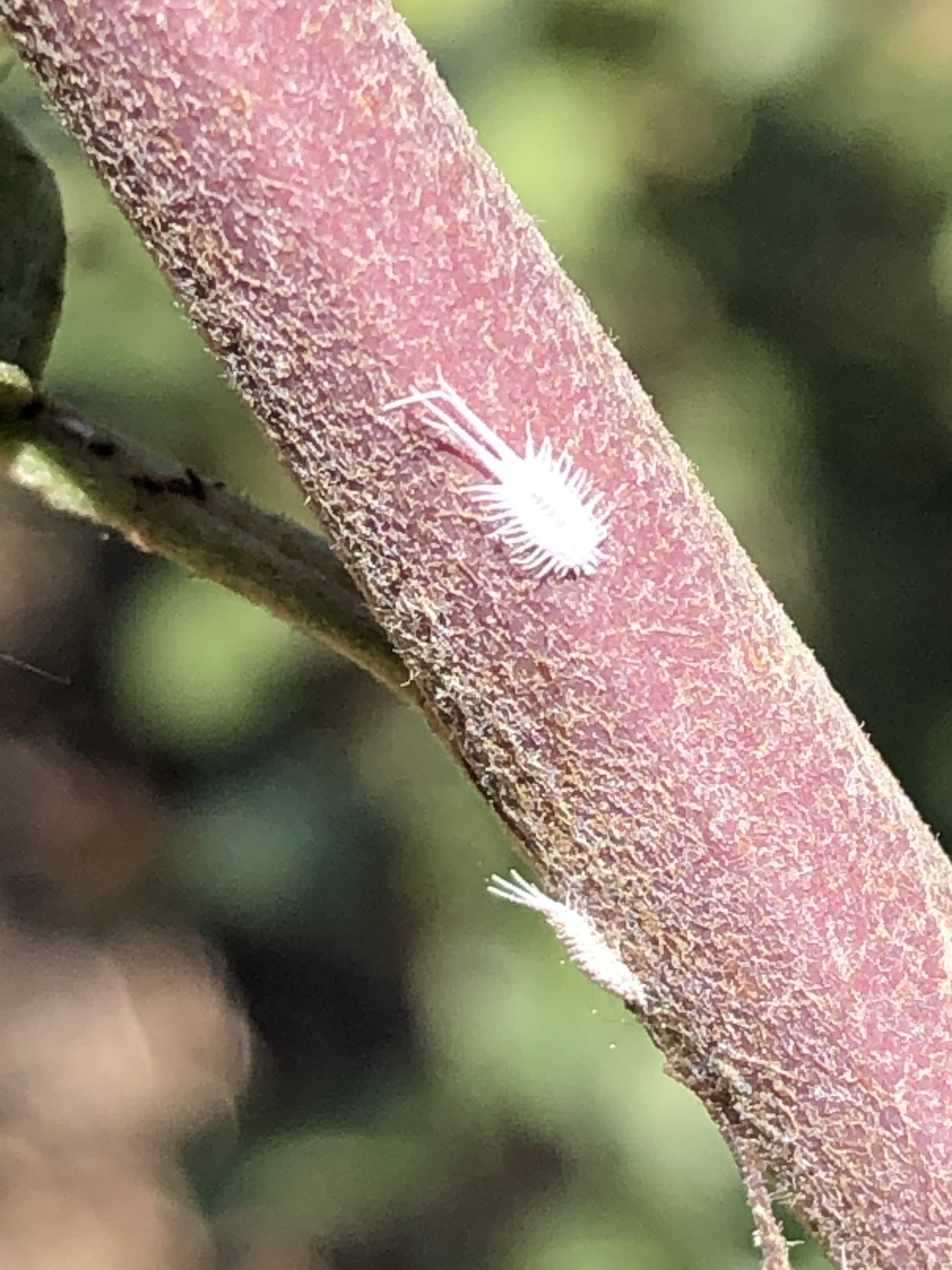
The narrow window in which mealybugs are in exposed conditions makes timing of sprays critical. Photo: Rae Kwong, Agriculture Victoria Research
Management of mealybugs
Pruning to allow more open canopies that provide better air movement and improve spray penetration may help with control. The narrow window in which mealybugs are in exposed conditions makes timing of sprays critical. Good timing relies on good monitoring.
Choice of pesticide is also critical because of potential interaction with control of other pests, resistance management considerations and off-target impacts on beneficial species. Chapter 6 of the IPDM Manual provides more detail.
Effective monitoring
The use of corrugated cardboard bands, wrapped around branches at about head height, will provide sheltered sites in which females will produce eggs and crawlers. Regular inspection of these bands to detect changes in crawler populations, in combination with leaf inspections to detect movement of third instar nymphs off the leaves, will assist timing of sprays. Maintaining the bands throughout the season will allow detection of each generation and help with detection of parasitoid activity. Mummified mealybugs will be present under the bands if parasitoids are active. Fruit damage inspections during the season should be used to examine fruit for mealybugs in the calyx and stem ends.
Further information on how to set up bands, additional mite sampling and fruit damage inspection guidelines are described in Chapters 3 and 6 of the IPDM Manual.
Biological control
The mealybug destroyer
The predatory ladybird beetle Cryptolaemus montrouzieri is known as the mealybug destroyer. Both the adult and larval stages feed on mealybugs. The larvae of C. montrouzieri look superficially like large mealybugs, a disguise that may confuse ants that often protect colonies of honeydew-producing mealybugs. The larvae are voracious predators of mealybug crawlers and second and third instar nymphs, including those of the longtailed species. The mealybug destroyer is available from biocontrol agent suppliers in Australia and results in successful control in greenhouses and should be effective under netting in orchards.
Increased effectiveness is more likely to be achieved when introduced as both larvae and adults. Larvae do not fly and therefore continue to search for prey on the release trees after they clean up each colony. Adults are likely to fly off looking for new colonies once they have cleaned up localised colonies.
Some pesticides that are relatively harmless to other beneficials appear to be detrimental to C. montrouzieri and have long residual effects. It is important to refer to Chapter 6 of the IPDM Manual for known effects of pesticides and to discuss susceptibility of the strain of beetles you are purchasing with the supplier before ordering them.
Parasitoid wasps
Several parasitoid wasps prey on mealybugs and can provide good control. It is therefore important the spray program does not damage populations. Lacewing larvae, particularly those of the green lacewing (Mallada signata) are voracious predators of mealybugs, aphids and mites. Likewise, syrphid fly larvae prey on mealybugs and woolly apple aphids. The wasps, lacewings and syrphids are naturally occurring in orchards but some are also available commercially to supplement wild populations if required.
It is important to note that if you wish to purchase biocontrol agents, they should be purchased from Australian suppliers. This ensures compliance with strict quarantine laws and regulations governing importation of live organisms from overseas.

Predatory lacewing larva (pictured to right of mealybug) covered in the remains of its prey. Photo: Rae Kwong, Agriculture Victoria Research
Resources
The Integrated Pest and Disease (IPDM) manual 2nd edition was prepared by David Williams and Oscar Villalta (Agriculture Victoria) with contributions by Stephen Quarrell (University of Tasmania), Kevin Dodds (NSW DPI), Paul James (Lenswood Co-op), and Alison Mathews and Stewart Learmonth (WA DPIRD). The IPDM Manual is available online, free of charge at: extensionaus.com.au/ozapplepearipdm/ipdm-manual-for-apples-and-pears
The IPDM Monitoring Calendar has been designed to help you monitor your orchards more effectively: extensionaus.com.au/ozapplepearipdm/wp-content/uploads/sites/15/2018/10/IPDM-Monitoring-Calendar_28112018_DW-FINAL.pdf
The IPDM Monitoring Sheet is designed for recording pests and diseases in regular sampling of your orchard, using the protocols described in monitoring methods. Timing of sampling can be guided by the monitoring calendar: extensionaus.com.au/ozapplepearipdm/wp-content/uploads/sites/15/2018/10/IPDM-monitoring-sheet-FINAL-1.pdf
Acknowledgement
 The PIPS 4 Profit program’s Pest and disease management (AP22001) project has been funded by Hort Innovation, using the apple and pear research and development levy, contributions from the Australian Government and co-investment from Agriculture Victoria. It is supported regionally by the Tasmanian Institute of Agriculture, Pomewest and NSW Department of Primary Industries. Hort Innovation is the grower-owned, not-for-profit research and development corporation for Australian Horticulture.
This article was first published in the Spring 2024 edition of AFG.