
IPDM in focus: apple leafhopper (or canary fly)
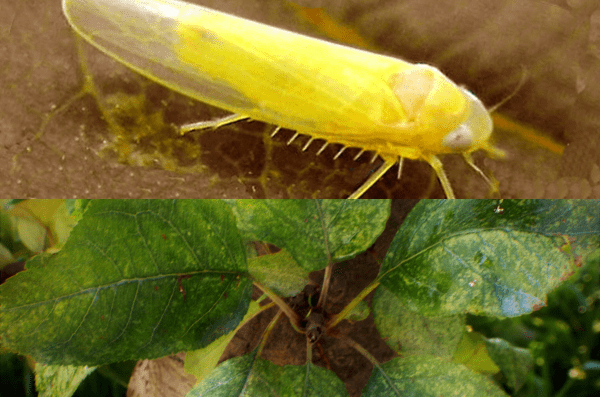
Apple leafhoppers are sap-feeding insects that cause mottles to occur on leaves, impacting photosynthesis.
Depending on the climate and the region, apple leafhoppers – known as canary flies in Tasmania because of their yellow colour – can have between one and three generations per year. They overwinter as eggs that are laid in autumn beneath the bark of twigs and smaller branches on host plants such as apple, hawthorn and blackberry. The first generation of adults occur in early December and the second generation emerge during harvest around March.
As similarly observed with mites, high numbers of apple leafhopper can cause irritation both to orchard workers’ eyes and through the inhalation of their cast skins.
Yellow sticky traps placed high in a tree can indicate trends in populations and generations. A one-minute assessment of five randomly selected trees or blocks in your orchard could provide useful data for developing thresholds if leaf damage is linked to yield and fruit size distribution data from harvest assessments. See the pest and disease monitoring section in chapter 3 of the Integrated Pest, Disease and Weed Management manual for Australian Apple and Pears for details about how to conduct a one-minute assessment.
A natural enemy for the apple leafhopper in Australia is a tiny parasitic wasp called Anagrus armatus. The parasitoid attacks apple leafhopper eggs and can provide good control in many situations. However, it is likely that insecticides applied to control other pests also impact A. armatus, reducing its numbers and effectiveness in the orchard.
For more information on apple leafhoppers, see page 150 of the IPDM manual for Australian Apples and Pears: https://extensionaus.com.au/ozapplepearipdm/ipdm-manual-for-apples-and-pears/.
Acknowledgement
 The PIPS 4 Profit program’s Pest and disease management (AP22001) project has been funded by Hort Innovation, using the apple and pear research and development levy, contributions from the Australian Government and co-investment from Agriculture Victoria. It is supported regionally by the Tasmanian Institute of Agriculture, Pomewest and NSW Department of Primary Industries. Hort Innovation is the grower-owned, not-for-profit research and development corporation for Australian Horticulture.
This article was first published in the Winter 2024 edition of AFG.



