
Improvement in apple tree performance with fulvic acid
Gordon Brown reviews two research papers concerning the benefits of applying fulvic acid to apple crops.
Fulvic acid is one of the breakdown products of organic matter in the soil. It is the water soluble component of the humic substances and is a mixture of small molecules that are yellow to light brown in colour. Humic substances make up about half of the dissolved organic matter in our rivers and oceans, of which fulvic acid is the dominant component. Australian soils are notoriously low in organic matter and, due to their soluble nature, extremely low in fulvic acid which has been leached out over time.
Fulvic acid can be applied to crops through their foliage or roots. Many claims are made about the benefits of applying fulvic acid to crops; these claims tend to be related to:
- healthier soils
- robust root development
- improved nutrient uptake
- increased plant disease resistance
- improved plant drought tolerance
- binding of soil and plant toxins
- improved crop yield and quality.
Fulvic acid is available in Australia in products ranging from 4 per cent to 95 per cent fulvic acid and most are allowable inputs for organic producers. In Australia the typical label use rate is 100g to 500g per 100 litres for foliar application, 300g to 1kg per hectare through fertigation or as a 1% mix with fertiliser. Fulvic acid is not a registered pesticide and no product containing fulvic acid is registered with the APVMA.
For the two research papers being reviewed this quarter, one looked at ground application while the other studied foliar-applied fulvic acid to apple trees.
The first paper studied the impact of 150kg/ha fulvic acid on a range of physiological and genetic responses including tree photosynthesis, sugar translocation, and anthocyanin content of the fruit peel.
The second paper used a pot hydroponics trial to study the application of 20g/100L foliar fulvic acid every three days for 15 days and its impact on trees growing in soil contaminated with cadmium. Cadmium is a heavy metal found as a contaminant in older or poorly manufactured fertiliser blends and is commonly present in agricultural soils that have been fertilised for an extended period of time. Cadmium in the soil can lead to reduced tree growth and productivity. This trial looked at the impact on tree physiology and genetics of short-term exposure of roots to cadmium, including the impact on apple roots and tree performance.
It is interesting to note that the rate of soil application in the first trial is far greater than that stated on the Australian fulvic acid labels; 150kg/ha versus 1kg/ha/fertigation. In communications with the author of the research it was identified that in China growers commonly apply an annual dressing of 150kg/ha fulvic acid after harvest which is why this rate was chosen. It is not clear why the label rates in Australia are so different to the practice in China.
It is more difficult to relate the foliar-applied trial to commercial practice. In the trial, the treatment was applied every three days as a fulvic acid spray to small, young trees growing in liquid media. Whereas in Australia we apply it to mature trees growing in soil on a less frequent basis, making a direct comparison difficult.
Soil-applied fulvic acid
While the trial studied the rates of fulvic acid from 50kg to 200kg/ha, there was a clear optimum of 150kg/ha for each of the two years of this study. This rate will be the focus in this review. In addition to the fulvic acid which was applied 40 days after full bloom, all trees received 543kg/ha of urea split between flowering, 40 days after flowering and 100 days after flowering. A variety of tree responses were measured, including gene expression and enzyme activities, but are not reported in this review. The responses of commercial value are summarised in Figure 1. They are the average response across two seasons and it is worth noting that the responses were identical in the individual seasons.
Annual application of 150kg/ha of fulvic acid resulted in a 62 per cent increase in the rate of photosynthesis as well as a 25 per cent increase in the percentage of photosynthate sent to the fruit. It is unfortunate that fruit yield was not reported; however, the 62 per cent increase in the rate of photosynthesis indicates that there was a potential yield improvement from say 50 tonnes/ha to 80 tonnes/ha and, as the percentage of photosynthate sent to the fruit increased by 25 per cent, there was a further potential yield improvement. This suggests that final yield could potentially reach 100 tonnes/ha with this rate of fulvic acid application to the soil.
By the use of radioactive nitrogen, it was found that the loss of nitrogen from the soil and plant system was dramatically reduced from 60 per cent down to 38 per cent, with both the soil and the tree retaining more nitrogen. This resulted in a dramatic improvement in the utilisation of applied nitrogen by the tree and indicates that the level of nitrogen fertilisation may be reduced with the use of fulvic acid. Importantly it was found that this improvement in nitrogen uptake resulted in higher nitrogen content of the leaves but not of the fruit, thus avoiding the detrimental over-accumulation of nitrogen in the fruit and associated issues such as bitter pit.
Fruit colour is an important character of fruit which impacts the commercial value of the crop. The red colour of apples is due to the content of anthocyanin in the peel. In this research the anthocyanin content of the peel was found to be 56 per cent greater for the fulvic acid treatment. While the nature of the fruit colour was not reported, it can be assumed that this increase in peel anthocyanin would have led to more extensive and/or deeper red colouration, increasing the financial value of the fruit.
While 150kg of fulvic acid is relatively expensive, at around $2,000, the potential improvement in yield and fruit colour indicates it is a viable option. Research needs to be conducted in Australia to confirm if this is the case and to develop new application guidelines for soil-applied fulvic acid.
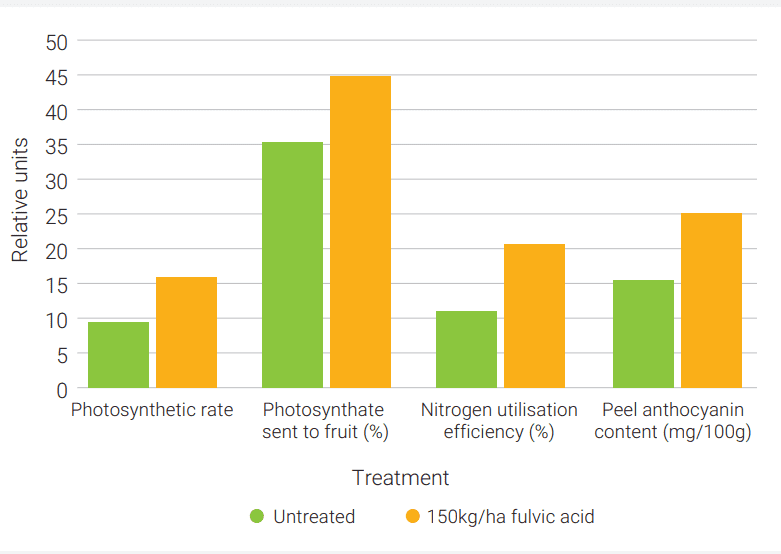
Figure 1: The impact of annual application of 150kg/ha fulvic acid on the rate of photosynthesis, the percentage of photosynthate sent to the fruit, nitrogen utilisation efficiency and the quantity of anthocyanin in the peel of apples averaged across two seasons.
Foliar-applied fulvic acid
This trial was conducted at the same institute as the soil-applied experiment and involved some of the same authors. Figure 2 summarises the measured characters of commercial interest, root surface area, above ground dry weight, photosynthetic rate and nitrogen utilisation efficiency. As for the soil experiment, all of the characters of interest displayed the same response. Compared to the untreated control, the foliar-applied fulvic acid improved all characters, while growing the trees in containers with toxic levels of cadmium dramatically reduced each of the characters, often halving the performance of the trees. By applying foliar fulvic acid to the trees growing in soil contaminated with cadmium, all the symptoms of cadmium toxicity were dramatically reduced.
The authors identified that fulvic acid improved root growth and tree performance through regulating antioxidant capacities, optimised photosynthesis, increased root carbon and nitrogen metabolism as well as improved the distribution of photosynthates. The increased root photosynthates in fulvic acid treated trees allowed for enhanced root activity and performance for absorbing water and nutrients.
In this trial only one low rate of foliar fulvic acid was used. There is a chance that a higher rate may have totally eliminated cadmium toxicity symptoms. Research is required to determine if this would be the case.
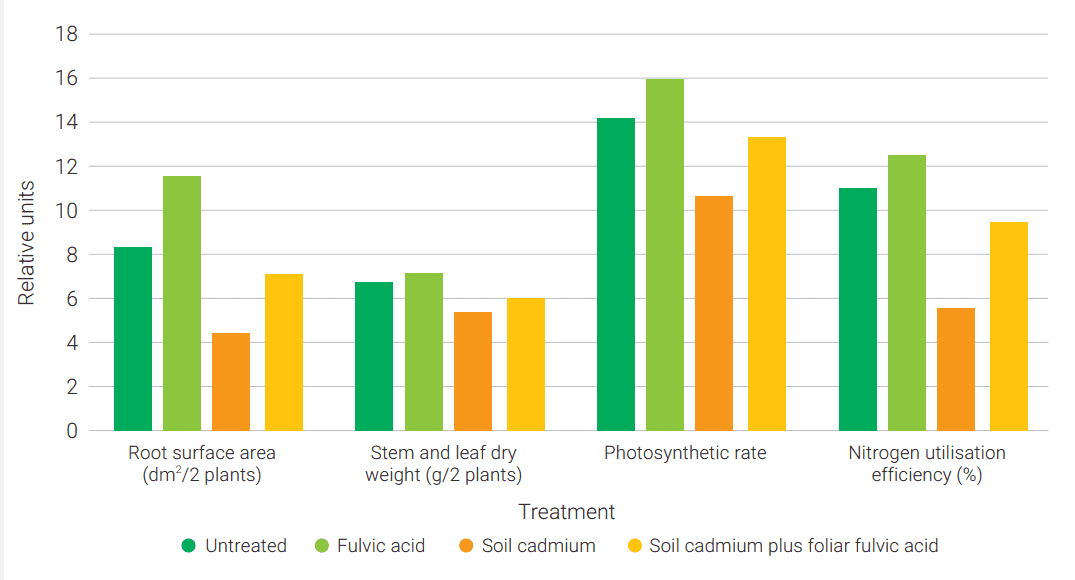
Figure 2: The impact of foliar application of 20g/100L fulvic acid to apple trees growing in toxic levels of cadmium on root surface area, stem and leaf dry weight, rate of photosynthesis and nitrogen utilisation efficiency.
Take home messages
Fulvic acid application to apple trees:
- increases the rate of photosynthesis and quantity of sugars sent to the fruit, with potential to dramatically increase yield of fruit
- increases the quantity of anthocyanin in the apple peel, potentially leading to ‘redder’ fruit with a higher market value
- improves the efficiency of nitrogen utilisation, potentially allowing for decreased nitrogen fertiliser rates
- decreases the impact of cadmium and possibly other toxins in the soil.
Further reading
- “The combined application of urea and fulvic acid regulates apple tree carbon and nitrogen metabolism and improves anthocyanin biosynthesis”, https://doi.org/10.3390/agronomy14092062
- “Fulvic acid alleviates cadmium-induced root growth inhibition by regulating antioxidant enzyme activity and carbon-nitrogen metabolism in apple seedlings”, https://doi.org/10.3389/fpls.2024.1370637
This article was first published in the Autumn 2025 edition of AFG.



