
Importance of carbohydrate manipulation in managing tree stress
What do we already understand about the role of carbohydrates in flower formation and development, and how might this be used to better manage the impact of physical stress on crop load? The NSW DPIRD team working on the PIPS 4 Profit Optimising apple production systems (AP22004) project reviews the research.
Variations in environmental conditions are significant obstacles to maximising pome fruit yield. Stress events such as frost, heat, hail, drought and wind all contribute to yield reduction in orchards. During flowering and fruit set they can cause flower injury, flower abortion (deformed pollen tubes, pollen sterility and ovule abortion) and premature fruit drop (Sinha et al 2021). Low temperatures in spring, freezing and drought are the most common stressors during flowering and fruit set in pomes.
Flower injury is a growing concern affecting fruit production and quality. Spring frost events present a significant physical stress limitation on apple production globally, causing substantial economic losses (Chen et al 2024; Parker et al 2021). Ice crystals destroy cell structures, causing biophysical damage to the flower (Rodrigo 2000), while, at the other extreme, drought stress reduces flower fertility, impacting subsequent fruit set (Sinha et al 2021).
In addition to applying various external protective strategies to reduce risks, it is important to focus on improving the tree’s physiological response to such events. Carbohydrates are crucial for flower metabolism, determining flower quality, initial ovary growth and retention; hence, they play an essential role in flower fate during physical stress. Although stress tolerance is influenced by the cultivar, dormancy status and phenological stages, research has shown it can be significantly enhanced by nutrient and carbohydrate levels (Palonen and Buszard 1997). An example being reduced freezing injury of pear flowers that have high levels of flower and shoot carbohydrate.
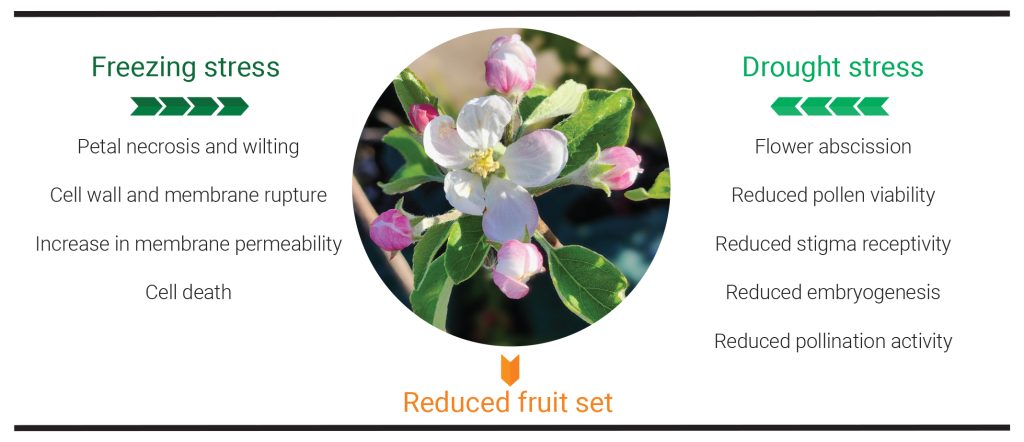
Figure 1: Overview of freezing and drought stress effects on apple flowers. Photo: Reema Prakash
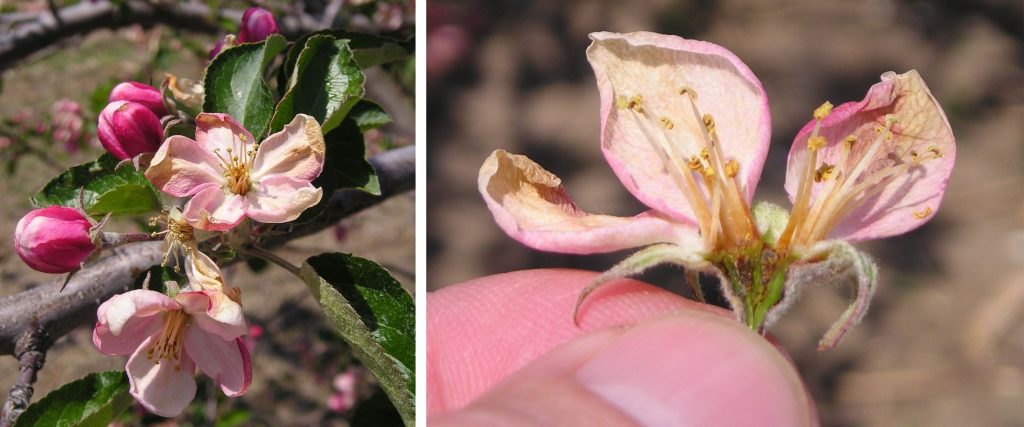
Figure 2: Apple blossoms with symptoms of frost damage. Photos: Mark Longstroth, MSU Extension
Role of carbohydrates in stress tolerance
Soluble carbohydrates – sugars and starches that provide the plant with its immediate energy needs – have numerous and multipurpose roles in plant metabolism, including growth, reproduction and response to stresses. Therefore, variations in sugar content can influence the plant’s tolerance to physical stress. Starch is a long-term energy reserve, while several soluble sugars (called osmoprotectants) serve to protect plant cells from sudden swelling or shrinkage by signalling certain molecules, antioxidant defence systems and hormone regulators during physical stress (Li and Sheen 2016). Table 1 summarises the important roles of soluble carbohydrates in stress tolerance during flowering, fruit set and development.

Table 1: Roles of key soluble carbohydrates in plant reproduction and physical stress. Source: Dempsey and Thavarajah 2024; Gangola and Ramadoss 2018; Han et al 2024; Rossouw et al 2024. *Cryoprotectants are substances used to protect biological tissues from damage during freezing and thawing.
Importance of maximising carbohydrate availability for growing fruit
Sugar metabolism plays a crucial role in flower induction and flowering. Sucrose, glucose and fructose concentration in trees influences hormone signalling, and high sugar levels before bud burst are associated with enhanced yields.
Crop load management practices are used to achieve a balance between the number of fruits on a tree and the available tree resources. This balance mainly depends on the altered sink–source relationship, which enhances carbohydrate availability and allocation among the fruits, increasing their size and quality and reducing biennial bearing. Efficient crop load management earlier in the season maximises carbohydrate availability for growing fruits (Bound 2019). While crop load management and related fruit quality have been widely studied, less has been researched on flower quality improvements of pome fruit trees, although crucial for producing high-quality fruit (Francescatto et al 2016).
Apple and pear flowering is a complex physiological process and, for both fruits, the yield depends on the quality and quantity of flowers (Hanke et al 2007; Kumar et al 2024). For both trees, the floral development involves the induction (a signal to become floral), initiation (transition of vegetative buds to floral buds) and differentiation (development of floral organs) in the first season, while the actual bloom occurs in the second season, after winter dormancy (Foster et al 2003; Marafon et al 2010). Inadequate carbohydrate management during flower initiation in the first season results in biennial bearing, disrupting regular production in the next season (Campbell and Kalcsits 2024). In addition, climatic extremities during the delicate periods of floral development may interfere with fruit production. Enhanced carbohydrate management early in the reproductive phase might be useful in mitigating any adverse physical impact to fruit production.
Can artificial spur extinction improve early carbohydrate management and stress tolerance?
Crop load management through ASE involves bud thinning before flowering to precisely determine the number of fruits and their location on each tree limb (Tustin et al 2014b). ASE eliminates a large proportion of buds before bud break; the remaining buds develop into flowers and fruits with reduced competition for reserve carbohydrates and other resources (Tustin et al 2014a). This method, therefore, allows for improved carbohydrate management at the earliest possible stage during reproduction, that is, before flowering.
Unlike other thinning methods, ASE-treated trees might not express physiological drops (Tustin et al 2014a), implying optimal allocation of carbohydrates and other resources to the growing fruits. This directs more efficient usage of reserve carbohydrates for bud break and reproductive development, minimising resource wastage and enhancing flower and fruit quality. At the same time, more reserves may be retained in the tree to provide for sugar movement and use during physical stress.
ASE could be useful in the mitigation of physical stress. To fully understand the benefits of ASE on physical stress mitigation, PhD research at Charles Sturt University seeks to build on the current NSW DPIRD-led PIPS 4 Profit crop load management trials at Batlow by investigating the role of ASE and carbohydrate manipulation in the mitigation of spring frost and drought stress in apple trees. The study’s findings will significantly contribute to assessing the effectiveness of ASE techniques in sustainable crop load management.
Research underway in Batlow
The Spring 2024 edition of AFG outlined the research underway at Jeremy Smart’s Tingira Orchard in Batlow as part of the PIPS 4 Profit Optimising apple production systems (AP22004) project. Researchers are investigating carbohydrate supply and demand through early autumn leaf removal in Alvina Gala, and artificial spur extinction (ASE) and mechanical bloom thinning in Rosy Glow.
The Wagga Wagga-based research team of the NSW Department of Primary Industries and Regional Development (NSW DPIRD) is investigating the effectiveness of these management strategies along with the economic and sustainability implications. The key questions are:
- Can we improve the efficiency of chemical thinning by manipulating early spring carbohydrate supply for the early variety, Alvina Gala?
- How effective are the non-chemical methods of thinning, including ASE and mechanical blossom thinning, for Rosy Glow?
- What are the economic feasibility and sustainability benefits of non-chemical crop load management methods in Rosy Glow?
Acknowledgement
 The PIPS 4 Profit Optimising apple production systems (AP22004) project is funded by Hort Innovation, using the Hort Innovation apple and pear research and development levy, contributions from the Australian Government and co-investment from the Tasmanian Institute of Agriculture, Agriculture Victoria, Department of Primary Industries and Regional Development WA, NSW Department of Primary Industries and Regional Development, Fruit Producers SA and APAL. Hort Innovation is the grower-owned, not-for-profit research and development corporation for Australian horticulture.
This article was first published in the Winter 2025 edition of AFG.
References
Bound SA (2019) “Precision crop load management of apple (Malus x domestica Borkh.) without chemicals”, Horticulturae, 5(1):3.
Campbell T and Kalcsits L (2024) “Strategies to overcome biennial bearing in apple – a review”, European Journal of Agronomy, 158:127213.
Chen R, Wang J, Li Y, Bai R, Huang M, Zhang Z, Zhao L, Qu Z and Liu L (2024) “Higher risk of spring frost under future climate change across China’s apple planting regions”, European Journal of Agronomy, 159:127288.
Dempsey M and Thavarajah D (2024) “Low molecular weight carbohydrates and abiotic stress tolerance in lentil (Lens culinaris Medikus): a review”, Frontiers in Plant Science, 15:1408252.
Foster T, Johnston R and Seleznyova A (2003) “A morphological and quantitative characterization of early floral development in apple (Malus × domestica Borkh.)”, Annals of Botany, 92:199–206.
Francescatto P, da Silva AL, Petri JL, Couto M, Leite GB and Racsko J (2016) “Quality of apple flowers grown in different latitudes”, Acta Horticulturae, 1130:95–102.
Gangola MP and Ramadoss BR (2018) “Sugars play a critical role in abiotic stress tolerance in plants”. In: Wani SH (ed), Biochemical, Physiological and Molecular Avenues for Combating Abiotic Stress Tolerance in Plants, Academic Press, 17–38.
Han Y, Liang A, Xu D, Zhang Y, Shi J, Li M, Liu T and Qi H (2024) “Versatile roles of trehalose in plant growth and development and responses to abiotic stress”, Vegetable Research, 4:e007.
Hanke MV, Flachowsky H, Peil A and Hättasch C (2007) “No flower no fruit – genetic potentials to trigger flowering in fruit trees”, Genes Genomes Genomics, 1:1–20.
Kumar A., Mushtaq M, Kumar P, Sharma DP and Gahlaut V (2024) “Insights into flowering mechanisms in apple (Malus × domestica Borkh.) amidst climate change: an exploration of genetic and epigenetic factors”, Biochimica et Biophysica Acta, 1868:130593.
Lee KS, Ryu S, Jeong JH, Cho JG, Lee SK and Han JH (2023) “Effect of carbohydrate levels under autumn defoliation on cold tolerance during the subsequent flowering season in pear” Scientia Horticulturae, 307:111530.
Li L and Sheen J (2016) “Dynamic and diverse sugar signaling” Current Opinion in Plant Biology, 33:116–125.
Longstroth M (2021) Assessing frost and freeze damage to flowers and buds of fruit trees, MSU Extension, Michigan State Univeristy. Available from: www.canr.msu.edu/news/assessing_frost_and_freeze_damage_to_flowers_and_buds_of_fruit_trees.
Marafon AC, Herter FG, Hawerroth FJ and Silva AS (2010) “Floral bud initiation and development of three pear tree (Pyrus sp.) cultivars in two subtropical regions during the summer period”, Acta Horticulturae, 872:121–126.
Palonen P and Buszard D (1997) “Current state of cold hardiness research on fruit crops”, Canadian Journal of Plant Science, 77:399–420.
Parker L, Pathak T and Ostoja S (2021) “Climate change reduces frost exposure for high-value California orchard crops”, Science of the Total Environment, 762:143971.
Rodrigo J (2000) “Spring frosts in deciduous fruit trees – morphological damage and flower hardiness”, Scientia Horticulturae, 85:155–173.
Rossouw GC, Orr R, Bennett D and Bally ISE (2024) “The roles of non-structural carbohydrates in fruiting: a review focusing on mango (Mangifera indica)”, Functional Plant Biology, 51:FP23195.
Sinha R, Fritschi FB, Zandalinas SI and Mittler R (2021) “The impact of stress combination on reproductive processes in crops”, Plant Science, 311:111007.
Tustin S, Breen K, van Hooijdonk B, Bound S, Parkes H, Tabing O, Middleton S, Wilkie J and Close D (2014a) “Fewer spurs lead to a better and more reliable fruit set”, Australian Fruitgrower, 8(9):25–27.
Tustin S, van Hooijdonk B, Breen K, Middleton S, Wilkie J, Parkes H, Tabing O, Close D and Bound S (2014b). “Spur extinction – a natural process leading to a new crop management technology”, Australian Fruitgrower, 8(5):26–29.



