
Helping growers make smarter choices
By tapping into AI and machine learning, Jane’s Weather is working to close some of the big gaps in current weather prediction so growers can make more informed, timely decisions.
Every grower knows how crucial an accurate weather forecast can be. Many of us spend hours poring over the predictions of our local meteorological forecast – and often find ourselves frustrated or bemused by their inaccuracy. The thousands of microclimates across Australia are unique in ways that the blunt instruments of weather bureaus can’t quite capture. And even if you’ve got a weather station on your orchard, it’s only good at telling you what weather events have already happened – not what’s on the horizon.
Jane’s Weather – a weather monitoring and forecasting project spearheaded by 7NEWS Melbourne meteorologist Jane Bunn in collaboration with industry research and development corporation Hort Innovation – is trying to change that.
Using artificial intelligence (AI) and machine learning, this weather app promises weather that’s ‘more accurate, more often’. It integrates forecasting data from meteorological bureaus all around the world, pairs this data with information from users’ own weather stations, and combines the data to build a site-specific forecasting engine.
Josh Cross, who works in client support at Jane’s Weather, explained that the frequent distance and difference in elevation between farms and their nearest Bureau of Meteorology (BoM) station can make official weather forecasts completely inaccurate.
“We have a weather station on Jane’s own farm which is optimising the forecast with AI machine learning for her unique plot, which is a maritime environment 300m above sea level. The closest BoM station to that particular farm is a good 25 to 30 kilometres away, so obviously very different conditions. We’ve closed that gap for people who are too far away from official stations, who are not getting an accurate reliable forecast at their plot.”
When logging in to Jane’s Weather, users see a ‘weather worm’ or graph (Figure 1) that shows the progression of temperature and other metrics over the last week or so and into the next 10 days. They also have access to a toolbox that shows metrics like frost risk, fog risk, storms, high winds, cloud cover, dew point, Delta-T (indicator of evaporation rate), humidity, UV index and, of course, wind.
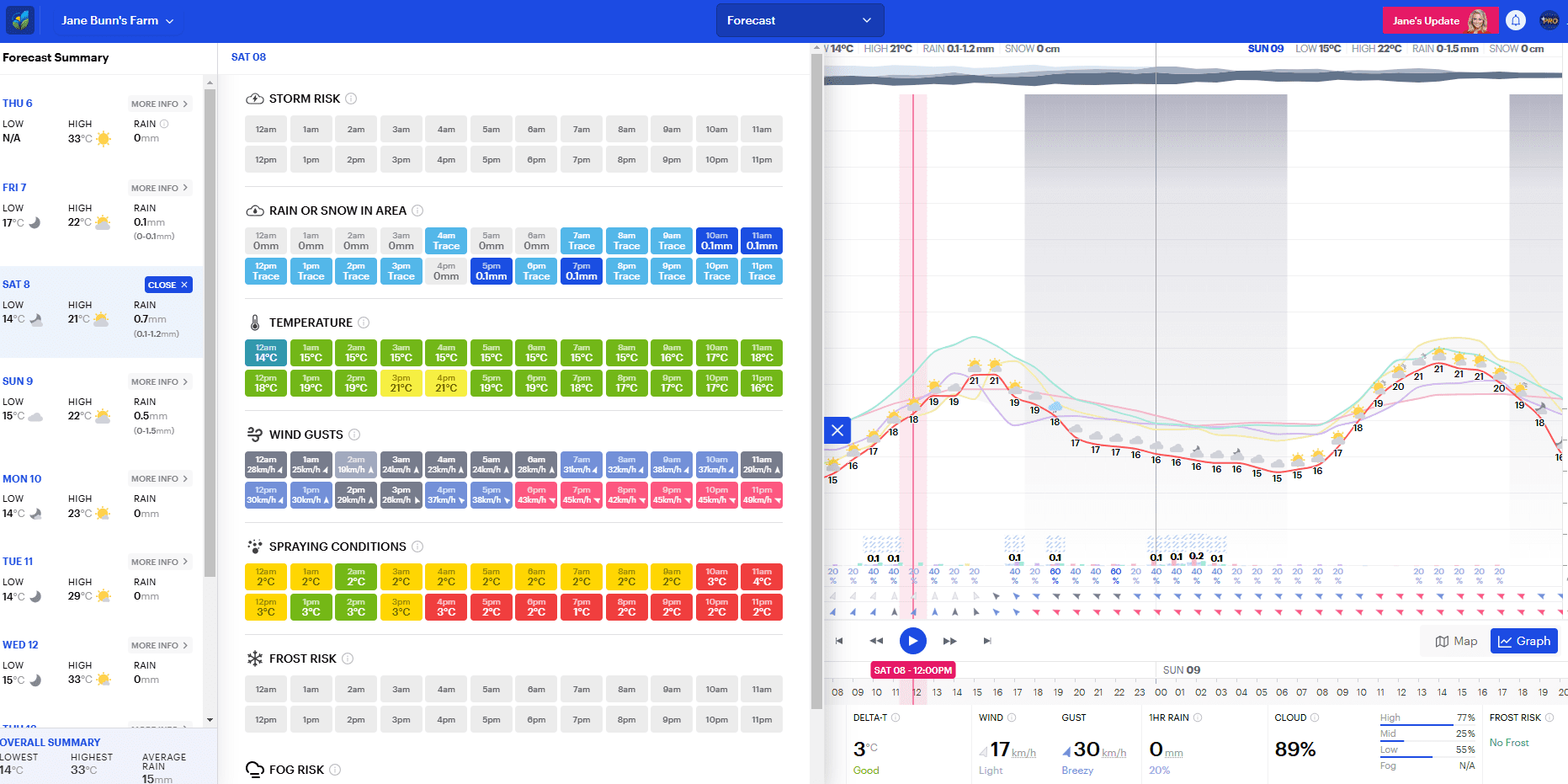
Figure 1: An example of the ‘weather worm’ and hyper-localised weather details that users see when they log in to the app.
“Having accurate wind is optimal for precision farming, because it can mean the difference of planning for twice as much irrigation or spraying,” Josh said. “Accuracy is key here.”
He gave the example of a NSW farmer who needs to order in water for irrigation. The accuracy of the Jane’s Weather wind and temperature prediction can mean the difference between ordering one load of water or four.
Fortunately, says Josh, wind is one thing Jane’s Weather does particularly well.
“The AI model, when you integrate your weather station, it nails wind,” he said. “For some reason the AI just loves getting wind the most accurate out of all the variables.”
To get the best accuracy out of the app, you’ll need at least one weather station. You’ll also need to wait several weeks for the machine learning to take in enough detail about your conditions to do the job.
The Jane’s Weather app integrates with all major weather station brands. Along with data from major weather forecasters like the United States’s Global Forecast System, Canada’s Global Environmental Multiscale model, the European Centre for Medium-Range Weather Forecasts and the BoM, it also uses data from other publicly available weather stations near you, such as the Department of Agriculture, Forestry and Fisheries’ networks.
After about 80 days of ingesting data from your weather station, the system will come up with its own weather model for your site. And if you happen to use multiple weather stations, you can get granular forecasts down to the orchard block if you so choose.
But even without bringing in site-specific AI data, Jane’s Weather does effortlessly what many growers laboriously do themselves: aggregate, compare and average out weather forecasts.
“What we do is we bring all of those models into this algorithm under the one umbrella,” Josh said. “Then, using machine learning and AI, that’s adapted further and optimised. The machine learning goes, okay, when all of the models are forecasting high winds in a particular location, there are actually low winds here, so I’m going to adjust that for your site and you’re going to get a lower wind forecast compared to what the others are telling you, because that just doesn’t happen here. So, it has tailored that forecast for your very special, unique, 9km by 9km area wherever you are.”
It’s easy to see the applications of a forecast as detailed as this. Sophisticated Delta-T prediction can help adjust spray schedules for best efficacy (Figure 2). You can also set up personalised alerts for temperature, frost, wind and more. In the desktop version of the app, colour-coded boxes illustrate the severity of upcoming weather events hour by hour, making it easy to see at a glance what you’re in for over the next 24 hours.
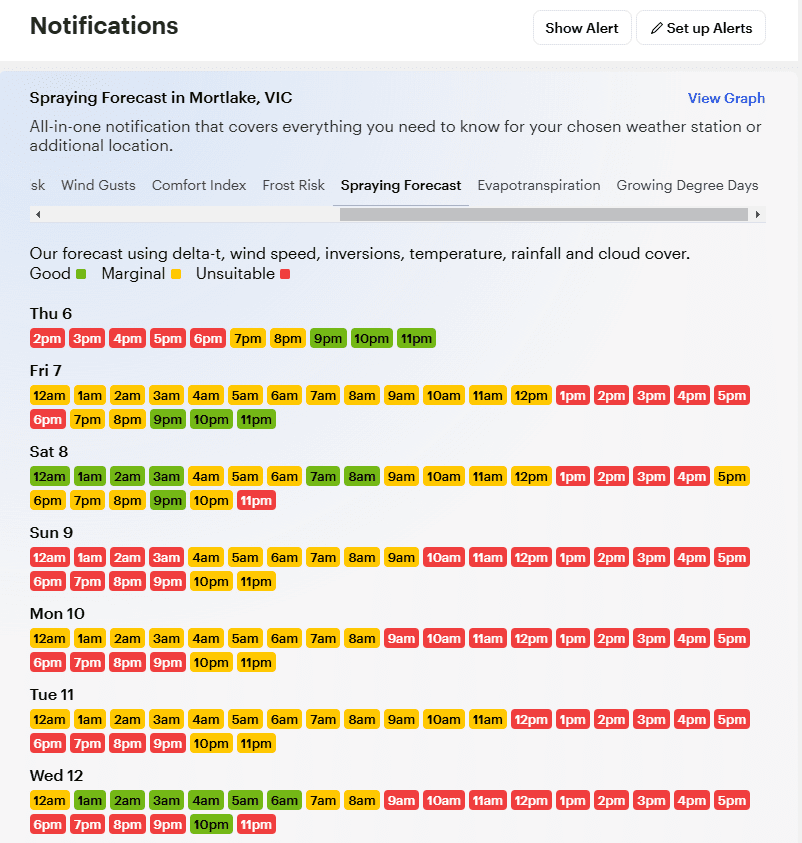
Figure 2: The app takes the uncertainty and guesswork out of knowing when to carry out certain tasks on the orchard, such as spraying.
And along with the standard 10-day forecast, there are also long-term forecasts in the form of seasonal outlooks. This includes data on surface temperatures, the Indian Ocean Dipole, the Pacific Decadal Oscillation index and other long-range meteorological trends.
What’s next for the initiative?
For the past year or so, Jane’s Weather has been researching disease forecasting with support from Hort Innovation. This data remains in the app’s back end, but there are plans to bring it to the client-facing side soon. In addition, more advanced weather metrics and more detailed ag- and grower-specific data will be added to Jane’s Weather PRO this year, including:
- solar radiation
- heat stress
- soil temperature and moisture content for top 1cm, top 10cm, 10–28cm (mid-soil layer), 28–100cm (lower soil layer) and 100–289cm (deep soil layer)
- chill hours and portions
- dew risk
- downy mildew
- vapour pressure deficit
- advanced spraying calculator
- further pests and diseases.
Get involved
As this current project wraps up, the Jane’s Weather platform will become more widely available, with a pricing structure that makes sense for growers’ budgets. For those who join before 30 April 2025, there’s a unique opportunity to get involved with 6 months free or at half the price of a normal Jane’s Weather PRO subscription. Early participants will also have a direct role in shaping the platform, providing feedback and helping Jane’s Weather to co-design advanced features – such as forecasted weather conducive to diseases like black spot and powdery mildew. Contact Jane’s Weather for further information: [email protected]
After 30 April 2025, new customers can try the app for free for 30 days before taking up an annual subscription for $990. Visit www.janesweather.com for more information.
Acknowledgment
The Using AI and machine learning to improve weather forecasting (AS23005) project is funded through Hort Innovation Frontiers with co-investment from Jane’s Weather and contributions from the Australian Government.
Jane’s Weather – the basics
Weather station integration: Jane’s Weather integrates with all major weather station brands. Once connected, the data is fed into the AI model to provide highly accurate, farm-specific forecasts.
AI-optimised forecasts: The system uses a combination of global weather models, fine-tuned with machine learning and real-time station data, to deliver tailored forecasts for each user’s specific microclimate.
Customisable alerts and thresholds: Users can set custom thresholds for key weather variables (for example, wind speed, temperature, spraying conditions) and receive notifications/alerts based on their personalised settings, helping them plan for critical weather events such as frost, high winds or heat stress.
Advanced weather variables: In addition to basic weather data, Jane’s Weather offers advanced weather forecasts such as growing degree days (GDD), evapotranspiration, frost risk, spraying conditions, chill hours and more to better help farmers make confident decisions for irrigation, disease management, spraying and more.
AI-powered learning: After 80 days of observing conditions, the system develops a personalised weather model, continually improving the accuracy of the forecasts on your orchard.
User feedback: Farmers have reported significant improvements in accuracy, particularly for wind and temperature forecasts, helping them optimise irrigation and spraying and confidently stay ahead.
Sally Baldwin, Picnic Point Farm, East Gippsland, Victoria
“We signed up [for the Jane’s Weather PRO trial] because we were hoping to get a more localised, accurate forecast. Our nearest weather station is 28km away and the topography over there is quite different. It’s a lot closer to the coast and we’re in a little river valley, so the wind, temperature and rainfall can all be quite different.
What we were ultimately hoping to get out of Jane’s Weather is a more accurate day-to-day forecast, but that part of it does rely on having a weather station. We’re keen to get that set up.
We’re looking forward to seeing how it goes. The better the weather forecast, the better decisions we can make, even if they’re only small discrepancies from what the actual forecast is. It’s always handy to be as accurate as possible.
I don’t know if it’ll change anything in a big way – more just a lot of things in a little way. Things like spraying and overhead irrigation – it does a really good Delta-T reading and historic graphs. We enjoy looking at the weather and seeing what’s happening because it plays a big role in any agriculture business, so the more accurate the better.
You kind of get rough ideas of how the weather’s slightly different from here to the local station, but it’s nice to know for sure. If the easterlies are always a little bit weaker or the westerlies stronger, if the temperature’s a bit higher on hot days, or a bit colder on cold days – you get better frost warnings and heat warnings ahead of time.
It’s really good just to have that record of historic information too. Having the here-and-now accurate to the location is really good.”
This article was first published in the Autumn 2025 edition of AFG.



