
Full transparency as Quality Project aims for consistent high-quality eating experience
No passes or fails in 2025, as Quality Project broadens access to results and moves to full identification.
New season fruit quality data trends and individual packhouse performance will be shared openly with eligible grower members from April, as the APAL Quality Project ramps up efforts to ensure consumers get the best possible eating experience – and get it consistently.
In response to grower feedback, test results will not be marked as pass or fail, and the data reported will be expanded from the top 20 packhouses by volume to all packhouses for which a sufficient sample has been tested.
In addition, packhouses will be identified by name alongside their results, and results shared more broadly with all APAL members who have been approved for access to the login-secured APAL Member Hub.
APAL Head of Industry, Government Relations and Advocacy Jeremy Griffith said growers had raised ‘quite reasonable’ concerns about the way data was reported previously and APAL had adjusted the process as a result.
“The suggestion that we went with was that we will not be telling people they have a ‘pass’ or a ‘fail’; we’re not making a judgement,” Jeremy said. “Nor are we making a judgement about the point in the supply chain at which the fruit is tested.
“What we are doing is testing in supermarkets and publishing that number. Pressure might be 5.9 kilogram force per square centimetre (kgf/cm2) or it might be 6.7kgf/cm2. Everyone will know that if somebody has a 2.8 and every other result is a 6, then that fruit should not be reaching the consumer.”
Providing data insights that inform decisions that drive profit and market growth is central to APAL’s focus on supporting industry to build a stronger, more sustainable and profitable future.
Consumer research1 commissioned by both APAL and Hort Innovation has found unreliable quality to be one of the biggest barriers to repurchase.
“Why is quality important?” Jeremy asked. “We know from the research that if quality is poor, people don’t come back. That was backed up very bluntly by Brad Banducci [former Woolworths CEO] at the ACCC Supermarkets Inquiry when he said price alone was not enough to win; in fruit and veg, ‘how long the product lasts at home becomes unbelievably important’.
“We know growers want to send the best fruit possible and they understand they have to make sure it can last the journey. This project is about providing information to assist with decision-making at harvest to get a better result, a better experience for the consumer and a better outcome for industry.”

Maturity testing is a vital tool to ensure fruit is picked at its optimum maturity for the intended purpose: long-, medium- or short-term storage or immediate consumption. Photo: Victoria Baker Photography
Now in its second year, the Quality Project aims to provide a better understanding of the fruit quality reaching supermarket shelves and drive improvements to ensure consumers get a consistently high-quality eating experience.
Growers seeking support for practice change to improve quality results this harvest are encouraged to either contact APAL’s Industry Services or their local agronomist.
Over the past 18 months, APAL has been testing samples of Royal Gala and Pink Lady apples and Williams and Packham pears collected from high-volume stores across three major retailers in Sydney, Melbourne and Brisbane.
Since the commencement of project, over 50,000 pieces of fruit have been tested for Brix (sugars), pressure, bruising and blemishes and, where a minimum 10 pieces of fruit have been sampled, the average score for Brix and pressure has been reported.
Results are reported in the APAL Quality Hub and users agree not to share the confidential information as a condition of access.
For further information about the APAL Quality Project, contact [email protected].
To register for access to the APAL Member Hub, visit https://apal.org.au/member-hub/.
Further reading
1Consumer trends at growers’ fingertips (AFG Spring 2024)
What consumers want from apples and pears (The Source, 2018)
Acknowledgement
The Quality Project is delivered by APAL as part of the Developing orchardists of the future (LP23001) project. It is funded through Hort Innovation Frontiers with co-investment from APAL and contributions from the Australian Government.
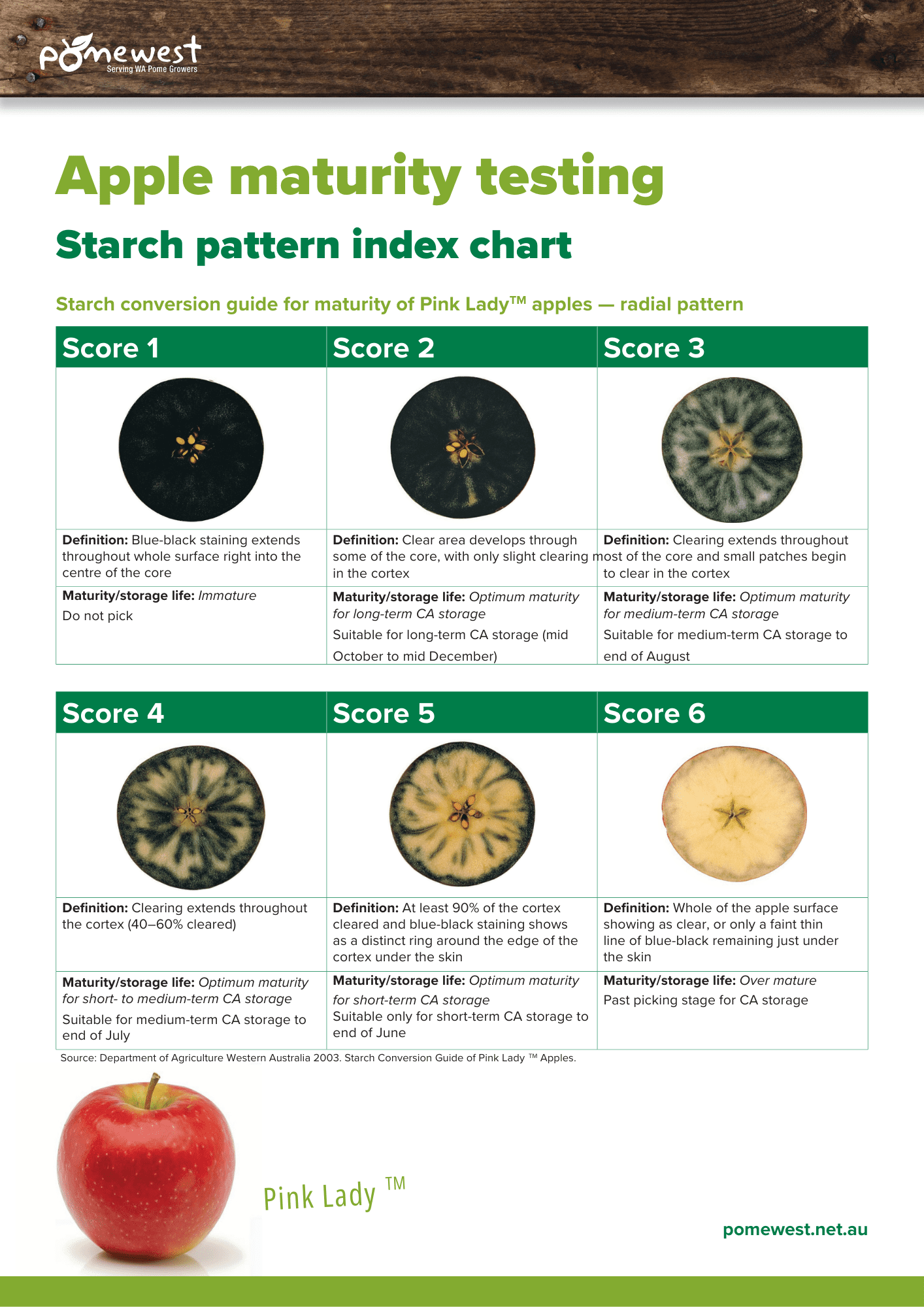
This chart is taken from Apple maturity testing, a step-by-step guide, produced by Pomewest. For charts for Gala and Granny Smith, visit www.pomewest.net.au/pome-projects/qualitytestingproject.
This article was first published in the Autumn 2025 edition of AFG.



