
Electrolysed water for post-harvest apple treatment
Electrolysed water is a new technology currently used in dip and dump tanks. Dr Gordon Brown reviews recent research in this article from the Summer 2021 edition of AFG.
Take home messages
- Electrolysed water is a new technology with potential to replace sanitising systems currently used in dip and dump tanks.
- Electrolysed water is environmentally friendly and does not need a store of concentrate sanitiser.
- Commercial equipment currently available appears to focus on the production of acidic or neutral pH electrolysed water.
- There is not much research on alkaline electrolysed water for ‘curative’ post-harvest disease control although this paper indicates there is potential for this technology to control post-harvest diseases after infection.
I first came across electrolysed water at a scientific conference in the early 1990s. At the time this technology was a bit of a mystery and getting to the fine details about its operation was difficult. Since then there have been 360 scientific papers looking at electrolysed water for disease control when sprayed onto crops or as a post-harvest treatment. One of the earliest scientific reports on this technology, in 1998, studied the impact of electrolysed water sprayed onto ‘Golden Delicious’ and ‘Fuji’ apple trees. This found that while anode water induced russeting the cathode water reduced it and improved fruit firmness at harvest. This paper was soon followed, in 2001, by one studying the impact of post-harvest dipping peaches in anode water for the control of brown rot and it was found that electrolysed water is a very effective surface sanitiser.
Since this time most research in horticulture has focussed on the use of acidic (anode water) or neutral electrolysed water. In Australia the use of electrolysed water in citrus packhouses was studied last year and it was found that a commercial system effectively killed Penicillium in the washwater, but it acted as a sanitiser and had little impact on the appearance of the disease in stored fruit.
Commercially electrolysed water is becoming popular in the restaurant trade where it is used as a sanitiser and is replacing chlorine-based sanitisers. Some of the advantages of electrolysed water over chemical sanitisers is that it can be manufactured as required on site, it is environmentally friendly, and it has approval for use in the organic industry. Here we will review South African research on the post-harvest use of alkaline electrolysed water on Botrytis development in stored ‘Granny Smith’ apples.
What is electrolysed water?
Take some water, add some table salt, put two electrical plates in the solution and apply a DC voltage. This causes Hypochlorous acid (HOCl) and chlorine gas to form in the solution at the anode electrode and sodium hydroxide (NaOH) and hydrogen gas at the cathode electrode. Both Hypochlorous acid and sodium hydroxide are effective sanitising agents. A very common use of this process is in saltwater swimming pools. Some systems allow for water removal from one side of the cell. If water is removed from near the anode, then acid electrolysed water is obtained and if it is removed from near the cathode then alkaline electrolysed water is obtained (not as stable as the acid form).
The system used in these trials was built for the purpose and the electrolysed water generated had a free available chlorine concentration of 500ppm, an oxidation potential of greater than – 800mV (a reducing agent) and a pH of 11 (alkaline). Electrolysed water applications at this pH are not common. Normally alkaline electrolysed water does not contain any chlorine although it does contain sodium hydroxide (caustic soda) as a sanitising agent.
What they did
It is well known that neutral and acidic electrolysed water is an effective fruit surface and dump tankwater sanitiser, however its ability to control post-harvest rots after infection is poor. The authors of this research report used alkaline electrolysed water and studied the impact on the control of a newly established postharvest disease in ‘Granny Smith’ apples.
To obtain the newly infected fruit a cork borer was used to injure the fruit prior to infecting with Botrytis cinerea, a common post-harvest pathogen of apples. The fruit were then placed in a humid environment at 20°C for 20 hours to allow for the infection process to take place and this was followed by six hours in dry air to dry the fruit. They were then dipped in different electrolysed water solutions (50, 100, 200, 300, 400 or 500ppm chlorine) for 5, 10 or 15 minutes prior to placement in a 5°C coolroom. A sample of fruit was not dipped in electrolysed water to act as an untreated control. The report does not state if this untreated sample was dipped in clean tap water or left undipped.
Fruit was removed from cold storage at 0, 1, 2 or 3 weeks and placed in a 24°C room for two days before damage assessment.
Fruit appearance
The authors report that there was no impact of dipping time on disease control indicating that this method of disease control is not highly sensitive to duration of treatment. A comment is made that at the highest rates of electrolysed water application (400 and 500 ppm) the lenticels took on a bright colour and appearance change although it cannot be determined if this was sufficient to downgrade the fruit. At concentrations below 200ppm the lenticels were damaged by Botrytis growth. Lenticels on fruit subjected to 300ppm electrolysed water had lenticels similar in appearance to the control fruit.
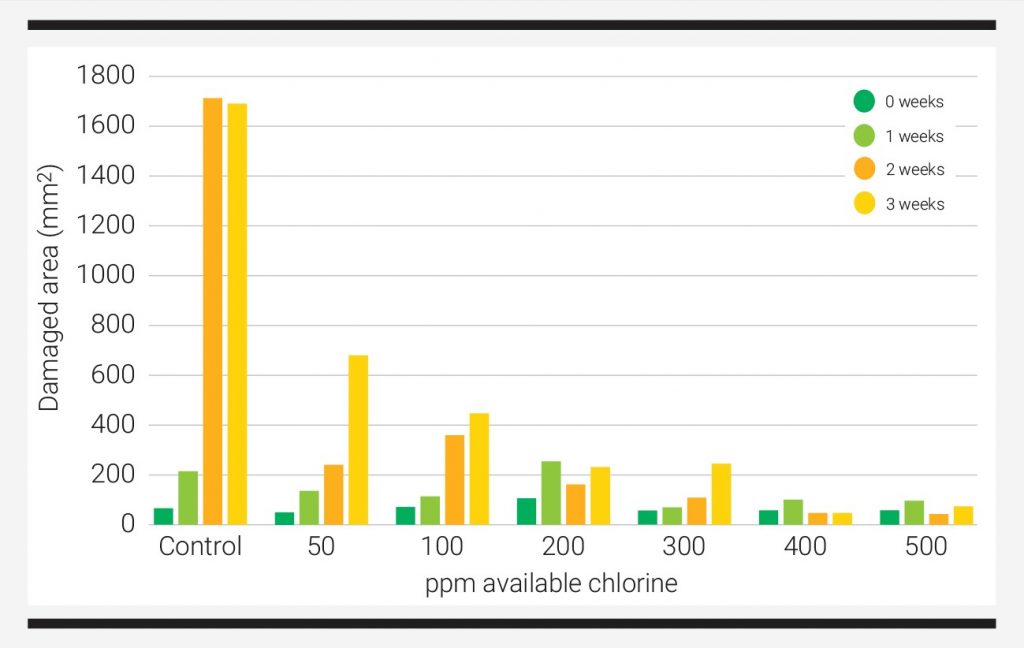
Figure 1. The area of damaged Granny Smith apple skin due to Botrytis cinerea following fruit dipping with alkaline electrolysed water prior to storage at 5°C for 0, 1, 2 or 3 weeks and two days at 24°C. Data averaged across dipping times.
Botrytis cinerea control
Data presented by the report has been simplified and summarised into Figure 1. This shows that after two weeks of storage the untreated fruit were severely damaged by Botrytis and that damage was dramatically reduced with all alkaline electrolysed water treatments. At three weeks of storage the level of damage in the 400 and 500ppm available chlorine treatment was no different to when the fruit were placed into storage indicating curative action against Botrytis in freshly infected fruit. For the 50,100, 200 and 300ppm available chlorine treatments the level of damage was seen to increase with every week. As the electrolysed water treatment has no residual activity it would be expected that the level of damage observed with these treatments will continue to increase.

Figure 2. Apple images of Botrytis cinerea damage area on Granny Smith apples with alkaline electrolysed water concentration dipping after four weeks of storage at 5°Cand two days at 24°C. Row B dipped for 5 minutes, C dipped for 10 minutes, and D dipped for 15 minutes.
Visually the degree of disease control by alkaline electrolysed water can be seen in Figure 2. This set of photos was reported to have been taken from fruit stored for four weeks, one week longer than the data provided. Even so, if these are representative photos of fruit from the treatments, it can be seen that the level of control achieved by concentrations at or greater than 200ppm is excellent. The lenticel damage reported for the 400 and 500ppm treatment is not apparent in these images.
Conclusions
This research has shown that alkaline electrolysed water is an extremely effective surface sanitiser and has curative action against Botrytis that has freshly infected apples. Dipping time is not as important as chlorine concentration and the fruit appear to tolerate this treatment.
Further Reading
Post-harvest evaluation of a new electrolysed water sanitiser system



